Seeing a Doctor in Japan: Why the Visit Is 3 Minutes — and How to Actually Be Heard
You waited 30 minutes in a packed waiting room. The doctor looked at you for two minutes, said something vague, and prescribed medicine that felt weaker than what you can buy at home without a prescription. If you're a foreigner in Japan, this is probably not your imagination — and you're far from alone.
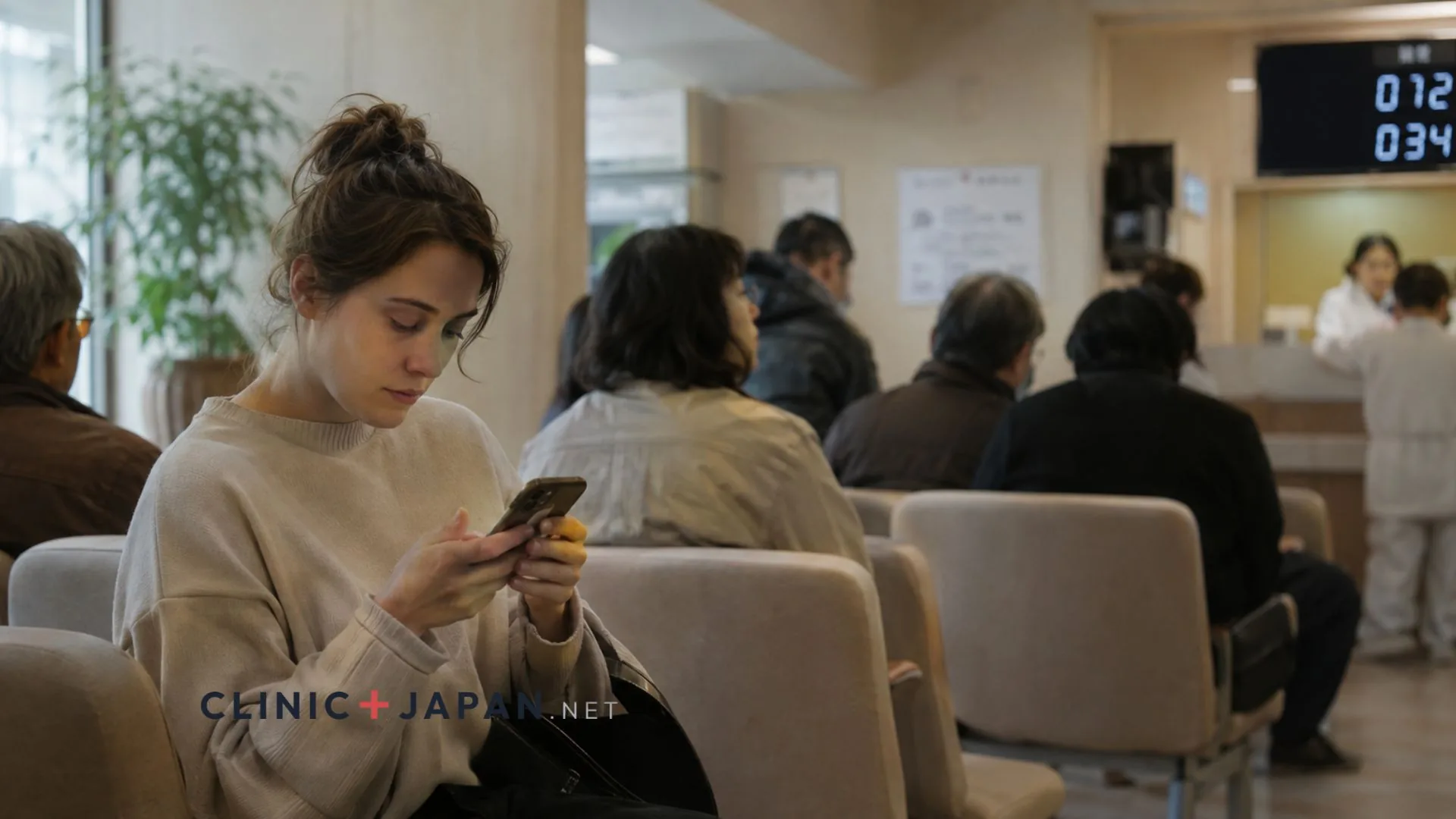
Japanese outpatient visits really are short — often 3–10 minutes — because the system is built for volume and iteration, not single deep consultations: Japan runs one of the highest doctor-visit rates in the OECD on fewer doctors per capita than average. The system assumes you'll come back if symptoms persist, that an annual health screening already covers the deep check, and that patients state their symptoms — and often their expectations — clearly and quickly. Foreigners who learn to work with these unwritten rules (prepared symptom notes, explicit test requests, strategic use of referral letters) report dramatically better experiences.
The complaint every foreigner recognizes
A recent thread on Reddit's r/japanlife — "I am very dissatisfied with Japanese clinics" — put it bluntly: a resident of three years described waiting half an hour to be seen for two minutes, receiving an unclear diagnosis and medication that didn't work. The thread drew over 160 comments, and the top reply — upvoted by hundreds — captured what long-term residents have quietly learned:
- You are expected to arrive with a hypothesis. Many residents report the consult goes better when you name the condition you suspect and even the medication you want. Several commenters described doctors literally asking what medicine they'd like.
- First-line prescriptions are deliberately mild. Stronger treatment usually comes on the second or third visit, not the first.
- Finding a good clinic runs on word of mouth. There is no widely-trusted public review layer, so quality information travels through colleagues and friends.
None of this is written on any clinic's website. It's the gap between how the system actually works and what a foreign patient expects walking in — and that gap, not the doctors themselves, produces most of the frustration.
The numbers behind the 3-minute visit
Japan even has a name for it: 三分診療 (sanpun shinryō, "three-minute medicine") — a term Japanese patients themselves use, sometimes with resignation. The arithmetic explains it:
| Indicator | Japan | OECD average |
|---|---|---|
| Practising doctors per 1,000 people | 2.6 | 3.9 |
| Doctor consultations per person per year | among the highest in the OECD (historically ~12/year) | roughly half that |
| Hospital beds per 1,000 | 12.5 | 4.2 |
Fewer doctors serving one of the world's highest visit volumes means the math only closes one way: short consultations. A systematic review of consultation lengths across 67 countries found primary-care visits range from under a minute to 22.5 minutes (Sweden), and that 18 countries — covering about half the world's population — average five minutes or less. Japan's typical 3–10 minute outpatient visit sits firmly in the world's short-consultation group, alongside a level of access most countries can't match: same-day dermatology, no gatekeeper, a few thousand yen per visit.
The dissatisfaction is measurable, too. A 2022 study of highly skilled foreign professionals living in Japan (BioMed, DOI: 10.3390/biomed2040034) found 23.4% were dissatisfied with Japanese medical care — and the factor most strongly correlated with dissatisfaction was not clinical quality but communication problems with medical personnel.
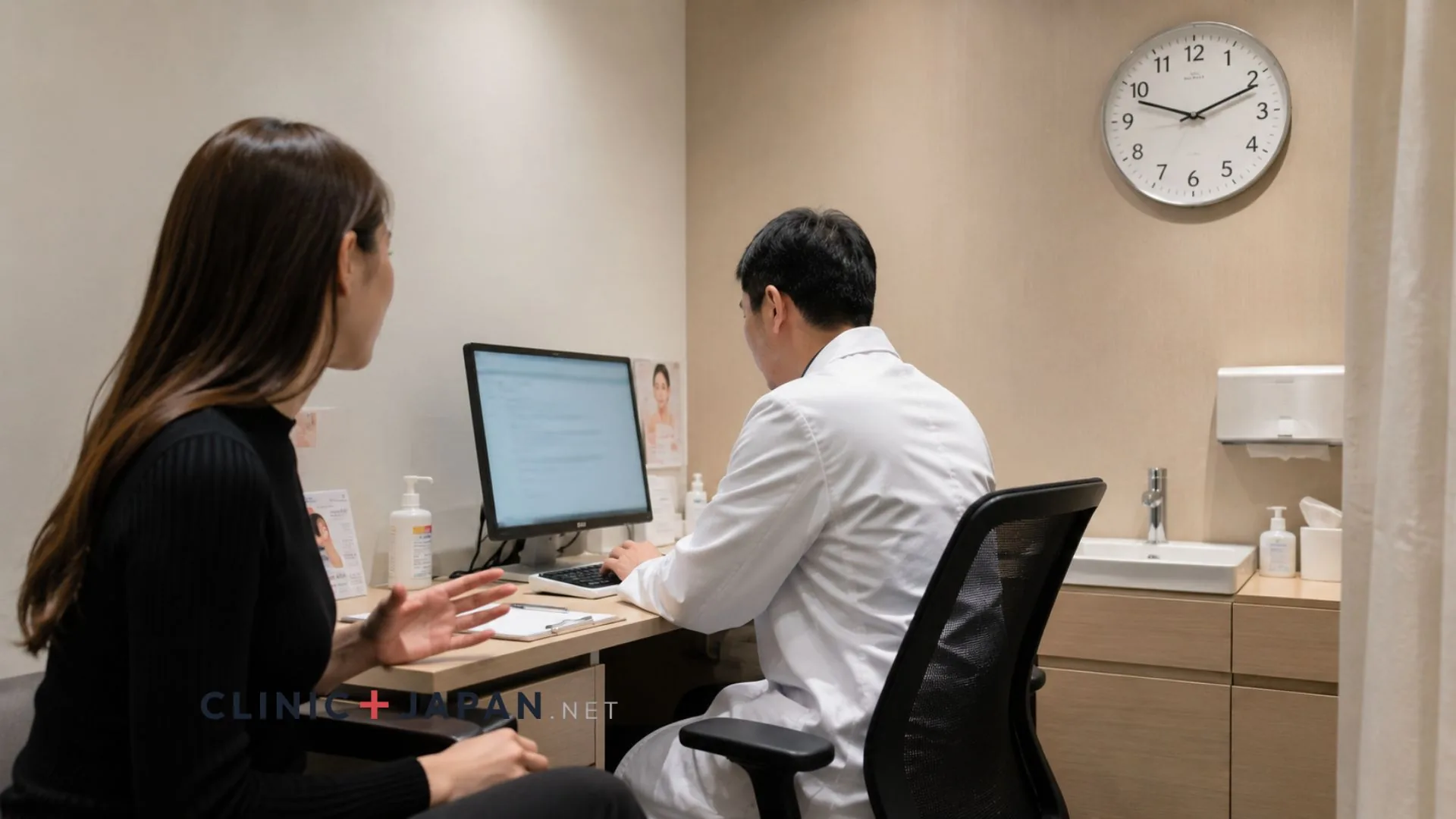
Why the system is built this way (it's not laziness)
Understanding the design makes the experience less maddening — and easier to use well:
- Iteration instead of one deep visit. Visits are cheap (typically ¥1,000–3,000 with insurance) and access is unlimited, so the system treats diagnosis as a process: start with the mild, cheap, low-risk option; escalate on the next visit if symptoms persist. A Western patient expects resolution in one visit; the Japanese system expects a feedback loop.
- The annual screening carries the deep check. Nearly everyone in Japan gets a subsidized annual health check (健康診断, kenshin) through work or their municipality — blood work, ECG, chest imaging. Doctors implicitly assume this baseline exists, which is why a walk-in visit rarely re-runs broad diagnostics.
- Mild first, strong later — by design. Conservative first prescriptions reduce side-effect risk across a system that processes enormous patient volume. It feels dismissive; it's actually a triage protocol.
- Communication hierarchy. Japanese medical culture historically expects patients to listen rather than negotiate. Doctors provide minimal unsolicited explanation — not because they can't explain, but because the norm assumes you'll ask if you want more.
The playbook: how to actually be heard
Long-term residents converge on the same tactics. They work because they fit the system instead of fighting it:
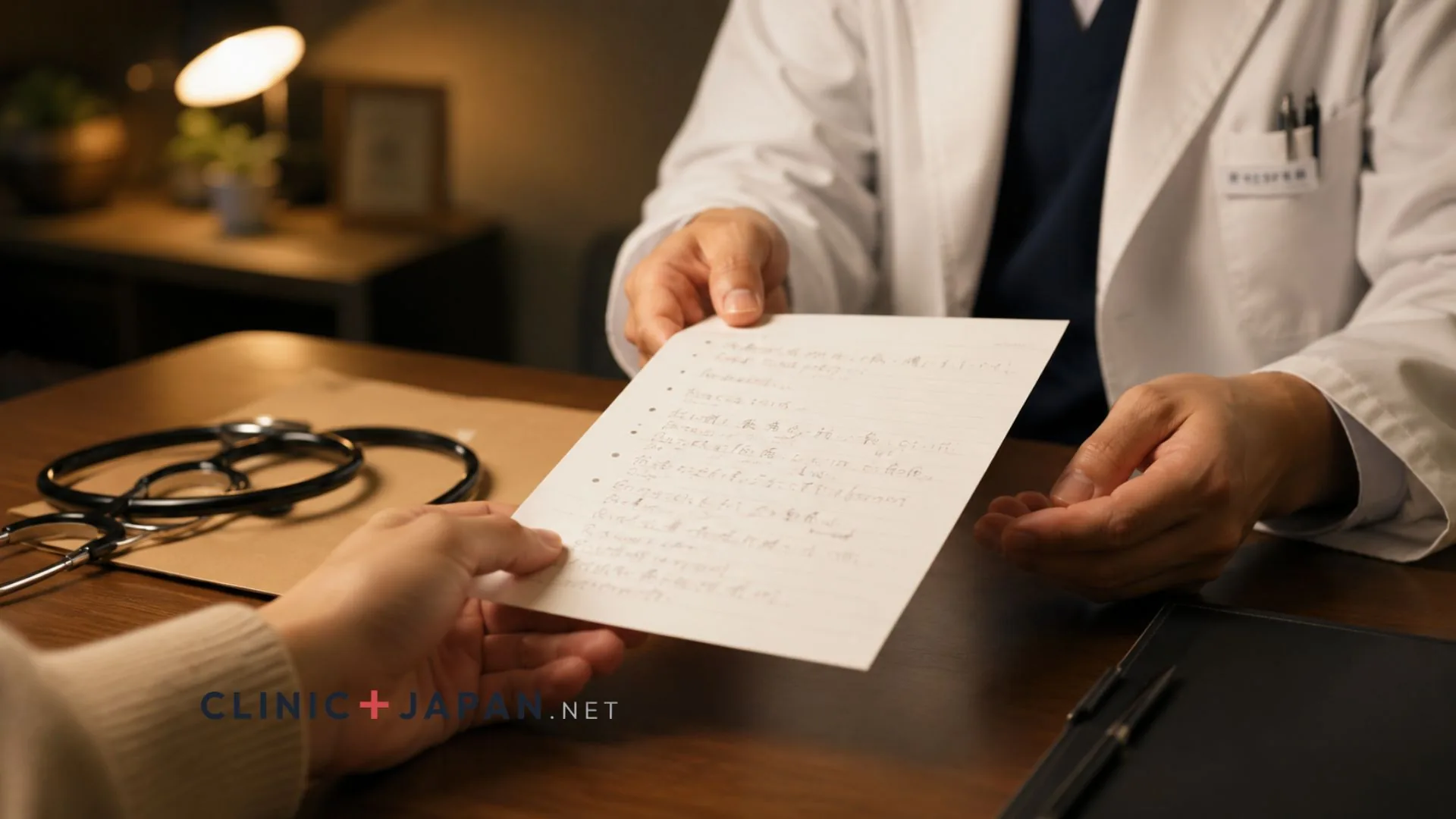
- Bring a written symptom note — ideally in Japanese, even machine-translated. One line each: what, since when, how often, what you've tried. This single habit converts a 3-minute consult from guesswork into targeted medicine. Doctors respond visibly better to a paper they can scan in five seconds.
- State your hypothesis and your ask. "I think this may be ○○. Could I have a test for it?" (検査をお願いできますか, kensa o onegai dekimasu ka). In Japan this is not rude — it's efficient, and many doctors expect it.
- Ask for specific strength if a mild drug already failed: say exactly what you took and that it didn't work. That sentence is what unlocks the second-line prescription on the first visit.
- Use the return visit strategically. Persisting symptoms + a documented first visit = escalation. If you're still unwell, going back is not failure; it's how the system routes you to tests and referrals.
- Request a referral letter (紹介状, shōkaijō) to a university or general hospital if a clinic can't resolve your issue. It costs a few thousand yen and changes how seriously the next doctor treats your case.
- Choose the venue by the job. Minor and fast → any local clinic. Complex, chronic, or "I need to be listened to" → international clinics with longer appointment slots, or hospitals via referral. Our list of English-speaking clinics in Japan covers which ones offer real English consultation rather than reception-only English.
- Prepare the language you'll need. Our clinic Japanese phrase guide and communication guide were written for cosmetic visits, but the consultation phrases transfer directly to any clinic.
Where Japan flips: paid consultations are the opposite
Here's the part that surprises people who only know insurance-covered care: Japan's private-pay (自由診療, jiyū shinryō) consultations — dermatology, aesthetics, private screening — run on the opposite model. Because the clinic isn't bound by the national fee schedule, consultations commonly run 20–60 minutes, with detailed explanations, imaging, and written quotes. The "3-minute doctor" and the "45-minute consult" are the same country, different payment rails.
If your frustration is specifically about skin — the most common trigger in expat threads — an insurance dermatologist will give you 3 minutes and a mild steroid, while a private dermatology consult will give you a long assessment at a higher price. Both are rational; they're just different products. Our guides to English-speaking skin clinics in Tokyo and what to expect in a Japanese private consultation cover that side of the system.
FAQ
Is the 3-minute consultation a sign of bad medicine?
Not by outcome measures — Japan performs above the OECD average on most access and quality indicators. It's a volume-optimized design: short visits, unlimited access, iterative escalation. It fails foreigners mainly at the communication layer.
Why did the doctor ask me what medicine I want?
Japanese outpatient culture assumes an informed, repeat-visiting patient. Stating your suspected condition and preferred treatment is normal and speeds up care. It feels backwards to Westerners; locally it's just efficient.
How do Japanese people find good clinics?
Largely word of mouth — coworkers, family, neighborhood reputation. There's no dominant trusted review platform, which is exactly why foreigners without local networks struggle more than locals do.
Can I just ask for tests directly?
Yes. "検査をお願いできますか" (Could I get a test?) is a normal request. Doctors may explain why one isn't needed, but asking is expected, not rude.
When should I go to a hospital instead of a clinic?
For anything complex, persistent, or multi-system — via a referral letter (紹介状) from a clinic. Walking into a large hospital without one adds a surcharge and often a long wait.
Sources & method
- r/japanlife thread (Nov 2026) — community sentiment; specific comment claims are paraphrased, not verified individually. Used to define the pain points, not as clinical evidence.
- Mori et al., BioMed 2022 — dissatisfaction rate (23.4%) among skilled foreign professionals; correlation of communication problems with dissatisfaction. Small sample (n=90, 20.7% response rate) — treat as directional, not definitive.
- Irving et al., BMJ Open 2017 systematic review — international consultation lengths (67 countries; 48 seconds to 22.5 minutes; 18 countries ≤5 min).
- OECD Health at a Glance 2025 — Japan — doctors per 1,000 (2.6 vs 3.9), hospital beds, quality indicators.
- Consultation-frequency comparison uses OECD doctors' consultations data; Japan has ranked at or near the top of the OECD for decades. We say "among the highest" rather than a single number because the latest year varies by country.
- What we didn't include: we found no reliable source for an exact average consultation length in Japan (figures from 3 to 10 minutes circulate without primary data), so we report the range and label 三分診療 as the cultural term it is, not a measured statistic.