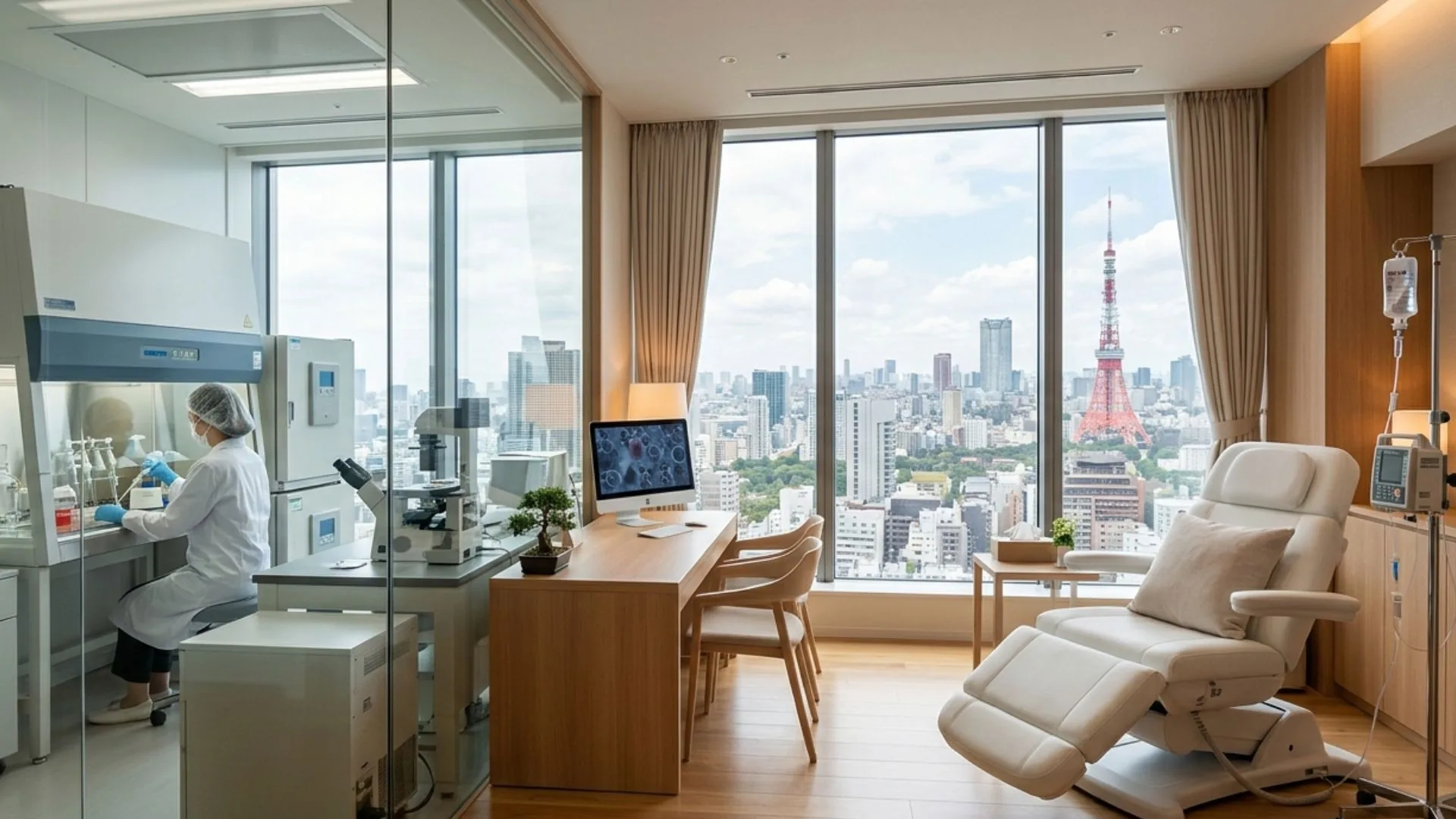
The global stem cell therapy market is booming, but it's also rife with unregulated clinics making extraordinary claims. Japan stands apart from this chaos. The Japanese government took a proactive approach: rather than banning or ignoring stem cell treatments, they created a legal framework that allows innovation while protecting patients. The result is a system where clinics can offer advanced treatments (including culture-expanded cells with 100-300 million cell counts) that would be illegal in the US or EU — but every single treatment plan must pass government review first. For context on how Japan's medical system works for foreigners generally, see our medical tourism Japan guide.
For foreign patients, this means Japan offers a unique combination: access to cutting-edge therapies that aren't available in most Western countries, delivered under the world's strictest safety oversight, by physicians with rigorous training and licensing requirements. The trade-off is cost — Japan is more expensive than Mexico, Turkey, or Southeast Asia. But for patients who prioritize safety and legitimacy, the premium is justified. If you're comparing destinations, our Japan vs Korea vs Thailand comparison covers the broader medical tourism landscape.
1. Why Japan for Stem Cell Therapy
| Factor | Japan | Most Other Countries |
|---|---|---|
| Legal status | Fully regulated under ASRM (2014) | Gray area or outright banned |
| Government oversight | MHLW reviews every treatment plan | Self-regulated or minimal |
| Cell processing | Certified Cell Processing Centers (CPCs) | Variable lab standards |
| Cell counts | 100–300 million (culture-expanded) | Often lower / non-expanded |
| iPSC research | Global leader (Nobel Prize origin) | Limited access |
| Adverse event tracking | Mandatory government reporting | Voluntary or none |
| Foreign patient access | Full access, same legal protections | Variable |
Japan's position as the world leader in regenerative medicine isn't marketing — it's structural. The 2014 ASRM was the first comprehensive national law specifically governing stem cell therapy anywhere in the world. It was passed partly because of Dr. Yamanaka's iPSC breakthrough, which created both enormous potential and the need for a regulatory framework to manage it responsibly. Since then, Japan has built the infrastructure — certified labs, trained physicians, reporting systems — that makes safe stem cell therapy possible at scale.
From 2025, the MHLW also implemented expanded on-site inspection powers, allowing officials to conduct random or targeted inspections of clinics offering regenerative medicine. This is a significant enhancement to patient safety — clinics that cut corners face heavy fines and immediate closure. For foreign patients, this means the risk of encountering an outright fraudulent clinic in Japan is extremely low compared to other destinations.
2. The Legal Framework (ASRM Explained)
Understanding the legal structure is essential for any patient considering stem cell therapy in Japan. The Act on the Safety of Regenerative Medicine (再生医療等の安全性の確保等に関する法律) classifies all regenerative treatments into three risk tiers:
| Class | Risk Level | Examples | Approval Process |
|---|---|---|---|
| Class I | High | iPSC therapy, gene-modified cells, ESC | Strictest review by specialized MHLW committee |
| Class II | Medium | Culture-expanded MSCs (most commercial treatments) | Review by certified regenerative medicine committee |
| Class III | Low | PRP (platelet-rich plasma), non-cultured cells | Standard review process |
Most commercial stem cell treatments available to foreign patients in Japan fall under Class II — medium risk, culture-expanded mesenchymal stem cells (MSCs). This means the clinic has submitted a complete treatment plan to a government-accredited review committee and received approval. The plan details the cell source, harvesting procedure, lab processing protocol, administration method, follow-up care, and adverse event reporting process.
There is a second law — the Pharmaceuticals and Medical Devices (PMD) Act — which governs commercially marketed regenerative products. Only a few stem cell products have received full PMDA marketing approval (such as Temcell for graft-versus-host disease). The vast majority of clinic-based treatments operate under ASRM, not PMDA approval. This means they are legal and regulated but not "proven" in the pharmaceutical sense. For more on how Japan's medical system differs from other countries, see our guide to medical pricing in Japan.
3. Treatment Types & What They Treat
Mesenchymal Stem Cells (MSCs) — The Standard
The overwhelming majority of commercial stem cell treatments in Japan use mesenchymal stem cells harvested from the patient's own adipose (fat) tissue or bone marrow. These autologous cells are processed and culture-expanded in certified labs over 4-6 weeks, multiplying from a small sample into 100-300 million cells. The expanded cells are then re-administered via IV infusion or targeted injection depending on the condition being treated. Some clinics also offer stem cell-based skin rejuvenation treatments that combine MSC therapy with laser or light-based procedures for enhanced results.
Conditions Commonly Treated
| Condition | Evidence Level | Method | Typical Cost |
|---|---|---|---|
| Knee osteoarthritis | Strong (RCT meta-analysis 2025) | Intra-articular injection | ¥1.5M–3M |
| Anti-aging / longevity | Very limited (small observational studies) | IV infusion | ¥1.5M–5M |
| Diabetes (Type 2) | Emerging (not yet established treatment) | IV infusion | ¥2M–4M |
| Stroke recovery | Emerging (Phase II trials) | IV infusion | ¥3M–7M |
| Erectile dysfunction | Early (preclinical + case studies) | Local injection | ¥1M–3M |
| Chronic pain / joints | Moderate (clinical studies) | Injection to affected area | ¥1M–3M |
| Cosmetic / skin | Moderate (clinical experience) | Local injection + IV | ¥1M–3M |
| Hair restoration | Early (clinical studies) | Scalp injection | ¥500K–2M |
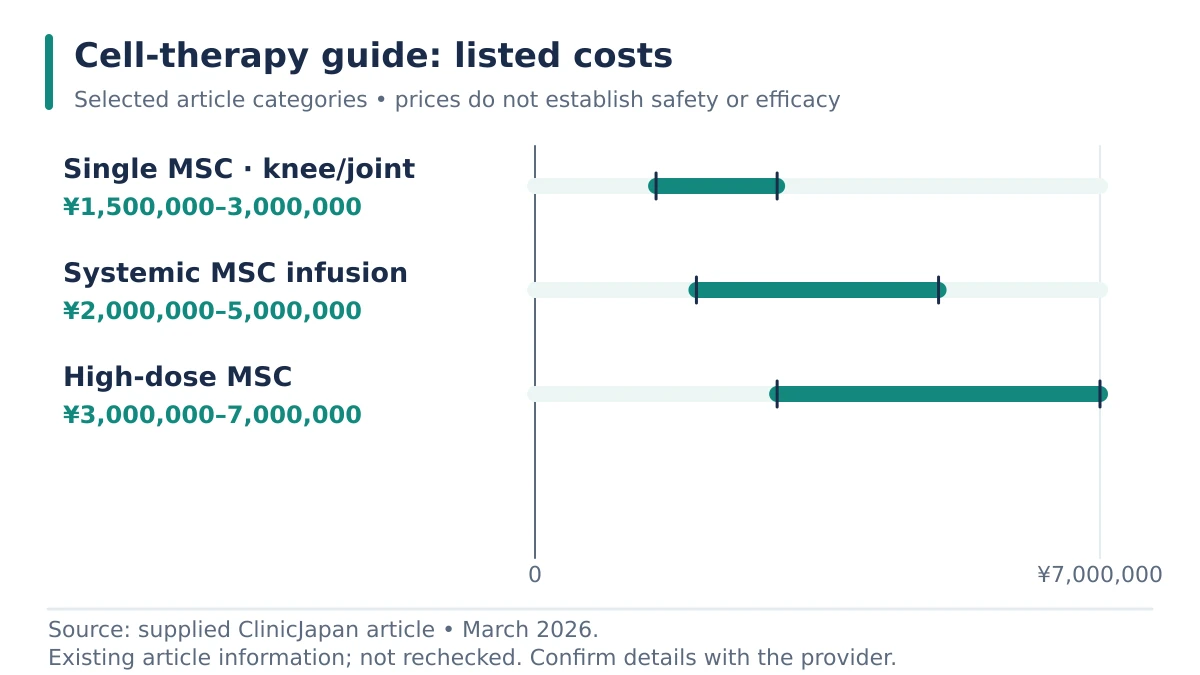
4. Complete Cost Breakdown
| Treatment | Japan Price (¥) | USD Equivalent | Notes |
|---|---|---|---|
| PRP therapy (Class III) | ¥50,000–200,000 | $350–1,400 | Same-day, no culture needed |
| Single MSC injection (knee/joint) | ¥1,500,000–3,000,000 | $10,000–20,000 | Culture-expanded, targeted |
| Systemic MSC IV infusion | ¥2,000,000–5,000,000 | $14,000–35,000 | Anti-aging, systemic conditions |
| High-dose MSC (200M+ cells) | ¥3,000,000–7,000,000 | $20,000–50,000 | Neurological, complex conditions |
| Exosome therapy | ¥300,000–1,000,000 | $2,000–7,000 | Cell-free alternative, growing popularity |
| NMN IV drip (longevity) | ¥50,000–150,000 | $350–1,000 | Per session, not stem cells per se |
These prices are treatment-only. Factor in additional costs for foreign patients: round-trip flights ($800–2,000 depending on origin), accommodation in Tokyo (¥10,000–30,000/night — see our recovery hotels guide for recommended stays), medical interpreter if needed (¥20,000–50,000/session — see how to communicate at Japanese clinics), and a possible second trip if using culture-expanded cells. Total all-in cost for a standard MSC treatment: approximately $15,000–40,000 including travel.
Japanese health insurance does not cover elective stem cell therapy. All treatments are self-pay (自費診療). A few specific stem cell products that have received full PMDA marketing approval (like Temcell for GVHD) may be covered, but these are hospital-based treatments for serious medical conditions, not the elective therapies discussed in this guide. For payment methods accepted at Japanese clinics, see our payment guide.
5. The Foreigner's Step-by-Step Process
Step 1 — Remote Consultation (2-4 weeks before travel): Contact a clinic or medical facilitator. Most English-speaking clinics offer video consultations. You'll submit medical records, discuss your condition and goals, and receive a treatment plan with a cost estimate. This step costs nothing at most clinics.
Step 2 — Approval & Planning: The clinic confirms you're a candidate. You receive a detailed plan, sign consent forms, and arrange payment (most clinics require partial or full advance payment). If you need a Medical Stay Visa (stays over 90 days or multiple entries), the clinic provides supporting documentation. For more on the booking process, see how to book a clinic in Japan.
Step 3 — First Trip to Japan (1-2 days): Cell harvesting. A physician collects a small sample of adipose tissue (fat) from your abdomen or thigh under local anesthesia. The procedure takes about 30 minutes. Recovery is minimal — you can walk out the same day. The sample goes to a certified Cell Processing Center (CPC) for culture expansion.
Step 4 — Culture Period (4-6 weeks): You return home. The lab cultures your cells from a few million to 100-300 million. You'll receive updates on the progress. This waiting period is what makes Japanese therapy distinctive — the high cell count from culture expansion is a key factor in treatment efficacy.
Step 5 — Second Trip to Japan (2-3 days): Cell administration. Depending on your treatment, cells are delivered via IV infusion (systemic), intra-articular injection (joints), or targeted injection. The infusion itself takes 30-60 minutes. You'll stay for observation and a follow-up appointment the next day. If combining your trip with other treatments, many patients also schedule Botox, filler treatments, or professional skin treatments during the same visit.
Step 6 — Follow-Up (ongoing): Most clinics offer remote follow-up at 1, 3, 6, and 12 months. Some coordinate with your local physician for continued monitoring.
6. How to Verify a Clinic Is Legitimate
✓ MHLW Registration Number (再生医療等提供計画番号) — Every legitimate clinic has one for each treatment they offer. Ask for it. Verify it on the MHLW database.
✓ Cell Processing Center (CPC) — Ask whether they use an in-house or outsourced CPC, and whether it's government-certified.
✓ Physician Credentials — Look for board certification in regenerative medicine or a relevant specialty (orthopedics, internal medicine, etc.).
✓ Transparent Pricing — Legitimate clinics provide detailed cost breakdowns upfront with no hidden fees.
✓ Realistic Outcomes — If a clinic promises "100% cure" for any condition, walk away. Honest clinics discuss probabilities and realistic expectations.
7. Japan vs Other Countries
| Country | Cost Range | Regulation | Cell Quality | Best For |
|---|---|---|---|---|
| Japan | $10K–50K | Strictest (MHLW/ASRM) | Highest (culture-expanded, certified CPCs) | Safety-first patients |
| South Korea | $7K–20K | Strong (MFDS) | High | Cost-quality balance |
| Mexico | $3.5K–15K | Limited (COFEPRIS) | Variable | Budget-conscious |
| Turkey | $3K–10K | Moderate (JCI varies) | Variable | All-inclusive packages |
| USA | $25K–50K+ | Restrictive (FDA limits expansion) | Limited (no culture-expansion) | Local convenience |
| Thailand | $5K–15K | Moderate | Moderate to high | Medical tourism + recovery |
Japan's key differentiator isn't just regulation — it's the ability to culture-expand cells to very high counts (100-300 million) in certified labs. In the US, the FDA generally prohibits culture-expansion of cells for clinical use outside of approved clinical trials. This means US stem cell clinics typically use same-day processing with much lower cell counts. Japan's ASRM framework permits culture-expansion under government oversight, giving patients access to higher-potency treatments that are simply not available domestically in most Western countries. If you're weighing Japan against Korea specifically, our Korea vs Japan cosmetic comparison covers both aesthetic and medical tourism factors. For English-speaking clinic options in Tokyo, see our English-speaking clinic directory.
8. Risks & What to Watch Out For
A 2021 meta-analysis in Stem Cell Research & Therapy analyzing 15 years of MSC therapy safety data found that MSC treatment is generally safe, with the most common adverse events being mild and temporary: low-grade fever (immune response to cell infusion), headache, nausea, and minor pain at the harvest or injection site. Serious adverse events are rare in properly regulated settings.
That said, stem cell therapy is not risk-free. Potential risks include infection (extremely low in Japanese certified labs), allergic reaction (rare with autologous cells), tumor formation (theoretical concern, no confirmed cases in properly regulated MSC therapy), and treatment failure (the cells simply don't produce the desired effect). The most common "risk" is disappointment — treatments don't work for everyone, and outcomes vary significantly between patients.
The biggest risk for foreign patients is not medical but informational: choosing an unregulated clinic, overpaying for treatments with minimal evidence, or being misled by exaggerated marketing claims. This is why the verification checklist in Section 6 is essential. Japan's regulatory framework dramatically reduces but does not eliminate these risks.
9. Essential Japanese Phrases
| English | Japanese | Reading |
|---|---|---|
| Stem cell therapy | 幹細胞治療 | kansaibou chiryou |
| Regenerative medicine | 再生医療 | saisei iryou |
| Treatment plan number | 提供計画番号 | teikyou keikaku bangou |
| Cell Processing Center | 細胞加工施設 | saibou kakou shisetsu |
| Adipose-derived (from fat) | 脂肪由来 | shibou yurai |
| Culture-expanded | 培養 | baiyou |
| How many cells? | 細胞数はいくつですか? | saibousuu wa ikutsu desu ka? |
| What are the risks? | リスクは何ですか? | risuku wa nan desu ka? |
| Total cost | 合計金額 | goukei kingaku |
| Self-pay treatment | 自費診療 | jihi shinryou |
| Medical visa | 医療滞在ビザ | iryou taizai biza |
| Do you have English support? | 英語対応はありますか? | eigo taiou wa arimasu ka? |
For more medical Japanese phrases, see our complete Japanese phrases guide for cosmetic clinics. Most English-speaking stem cell clinics have medical coordinators who handle all communication, but knowing the key terminology helps you evaluate what you're being offered.
10. FAQ
Considering Stem Cell Therapy in Japan?
Tell us your treatment and dates. Within 24 hours we’ll send 2–3 English-friendly clinics that fit, with prices, add-on fees and English support checked.
Get 2–3 clinic options →Free · reply within 24 hours · or ask our AI advisor
Related Guides
About this guide: Cost data compiled from published pricing of Tokyo-based stem cell clinics (Cell Grand Clinic, Star Clinic Omotesando, Helene Clinic) as of March 2026. Legal framework information from official MHLW/ASRM documentation. Clinical evidence references from published peer-reviewed meta-analyses cited in text. This is an editorially independent guide — we are not affiliated with any medical facilitator, and some clinics mentioned may be advertising partners; any partnership is disclosed on the page and never affects prices, rankings or recommendations. This content is for informational purposes only and does not constitute medical advice. Stem cell therapy carries risks; consult a qualified physician before making treatment decisions.