1. Tatcha is an American brand, and that is the key fact
Nearly every English page about this product implies you are buying Japanese skincare. The reality is more specific, and it changes how you should think about the price.
Tatcha was founded in 2009 by Victoria Tsai in San Francisco, after a trip to Kyoto, with an innovation centre in Japan known as the Tatcha Institute. Unilever announced an agreement to acquire the brand in 2019. It is a US company drawing on Japanese ingredients and rituals, manufacturing in Japan, and selling to a Western prestige market.
2. What it costs
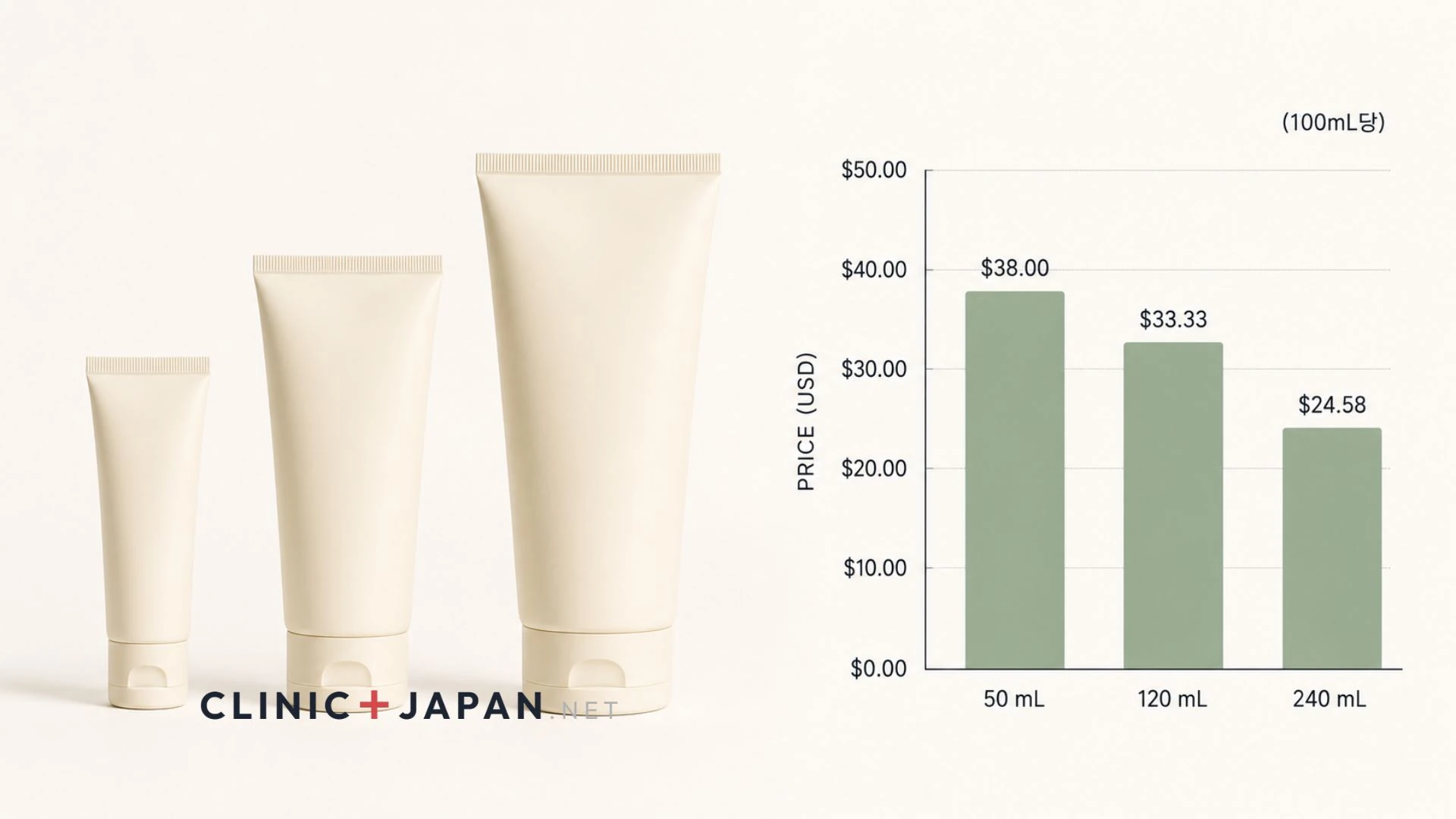
| Size | Price | Per 100 mL |
|---|---|---|
| 50 mL (mini) | $19.00 | $38.00 |
| 120 mL (full) | $40.00 | $33.33 |
| 240 mL (largest) | $59.00 | $24.58 |
The largest size is 26% cheaper per millilitre than the standard one, which is the only meaningful value decision on this page. The mini is a trial size and priced like one.
For scale: $40 buys a 120 mL cream cleanser here. In a Japanese drugstore, roughly the same money buys DHC's 200 mL cleansing oil at ¥2,725 andSenka Perfect Whip at around ¥500, with change. That is not an argument that Tatcha is bad — it is the context most reviews leave out.
3. What it actually is
A pH-neutral, amino-acid-based cream cleanser containing Japanese rice powder, hyaluronic acid and an algae blend, which foams when you add water. The formula includes fragrance. Tatcha positions it for normal to dry skin.
| Component | What it is doing |
|---|---|
| Amino acid surfactant base | The actual cleansing system. Milder than sulfate-based cleansers and the reason it does not strip |
| Japanese rice powder | The brand story ingredient. Provides very mild physical softening |
| Hyaluronic acid and algae blend | Humectants in a rinse-off product — limited contact time by design |
| pH-neutral formulation | The genuinely good part. Respects the skin's acid mantle better than high-pH foaming cleansers |
4. Is it worth $40?
Two things are true at once and most reviews only tell you one of them.
| Fair to say | Also fair to say |
|---|---|
| The pH-neutral amino-acid base is a genuinely good cleansing system for dry skin | Amino-acid cleansers are the Japanese drugstore default, at a fifth of the price |
| Texture, scent and packaging are unusually pleasant | Those are the things you are actually paying the premium for |
| It is widely available in the West with real customer support | Availability is the service, not a property of the formula |
| Rice-based cleansing has genuine roots in Japanese practice | Rice powder is a minor player in this formula; the surfactants do the work |
5. What Japan sells instead
If the appeal is the amino-acid cleansing category rather than the brand, Japan's domestic shelf is where that category lives.
| If you want | Look at |
|---|---|
| A gentle daily foaming cleanser | Senka Perfect Whip, around ¥500 — the Japanese default |
| Oil cleansing for makeup and sunscreen | DHC Deep Cleansing Oil, ¥1,100–2,725 |
| Hydration-focused basics | Hada Labo |
| The whole category with prices | Our Japanese skincare guide |
Two honest caveats on that swap. Japanese domestic packaging is Japanese-only, so ingredient lists and instructions take effort. And the drugstore alternatives are formulated for a domestic market — fragrance levels and textures differ, and cheaper does not mean it will suit you. Buy the small size first, whichever direction you go.
6. The verdict
The Rice Wash is a well-made, pH-neutral amino-acid cream cleanser that is pleasant to use and will not strip dry skin. If you enjoy it, buy the 240 mL and pay 26% less per millilitre than you would for the standard tube.
Buy it because you like it, not because you think you are buying Japan. What you are buying is a Japanese-inspired American brand, manufactured in Japan, priced for the Western prestige market. The cleansing philosophy behind it is genuinely Japanese — and in Japan, that philosophy costs about ¥500.
7. The rice powder question, and who should avoid it
The rice powder is the brand story, and it is also the one part of this formula with a practical downside that the marketing does not mention. It is a physical exfoliant — very finely milled, but present, and reviewers consistently report feeling it.
For most people on most days, that is a pleasant quality. It is also why this cleanser gets described as leaving skin unusually soft. But a physical exfoliant in a product marketed for twice-daily use creates a specific problem for two groups.
| Situation | Why it matters |
|---|---|
| Active acne or breakouts | Rubbing physical particles over inflamed lesions is a reliable way to make them worse. A plain non-abrasive cleanser is the better call while skin is active |
| Around the eyes | The skin there is thinner than anywhere else on the face and does not need mechanical exfoliation twice a day. Keep the product away from the orbital area |
The fragrance, separately
The formula contains fragrance, and this cuts both ways more sharply than with most products. The scent is one of the things reviewers praise most consistently — it is a substantial part of what the premium buys. It is also the single most common reason for a bad reaction to an otherwise gentle cleanser, and fragrance sensitivity does not correlate with how mild the surfactant base is.
If you have reacted to fragranced skincare before, the gentleness of the amino-acid base will not protect you. That is a formulation fact rather than a criticism — but it means "it is very gentle" and "it contains fragrance" are both true, and only the first one appears in the marketing.
| You | Verdict |
|---|---|
| Dry or normal skin, no fragrance issues, enjoy the ritual | Buy the 240 mL and save 26% per millilitre |
| Curious but unsure | The 50 mL at $19 is a fair test, if poor value per millilitre |
| Oily skin | Wrong product in the range. Tatcha's own oil-control cleanser exists for this |
| Active acne, or fragrance-sensitive | Skip it. Neither problem is solved by paying more |
| Chasing Japanese skincare specifically | Skip it — this is an American brand. See Japanese skincare |
8. FAQ
Sources & Method
Prices are Tatcha's own listed prices for the three sizes on its official store, checked on 8 August 2026; per-100 mL figures are our own arithmetic on them. Formulation description, the pH-neutral amino-acid base and the presence of fragrance are the brand's own statements. Founding, location and the Unilever acquisition are from Unilever's own announcement and contemporaneous trade reporting. Japanese comparison prices are carried over from our DHC and Senka guides and were not re-surveyed here. The value assessment and the drugstore alternatives are our own editorial position.
| Source | Used for |
|---|---|
| The Rice Wash product page Tatcha · primary · accessed 8 Aug 2026 | The $19 / $40 / $59 prices by size in section 2, the pH-neutral amino-acid base, the rice powder, hyaluronic acid and algae blend, and the confirmation that the formula contains fragrance |
| Unilever to acquire Tatcha Unilever · corporate announcement, 2019 · bot-protected, verified via search index | The 2009 founding by Victoria Tsai in San Francisco, the Tatcha Institute innovation centre in Japan, and the acquisition agreement — all in section 1 |
| Unilever Acquires Tatcha in Deal Said Approaching $500M WWD · trade press, June 2019 · accessed 8 Aug 2026 | Corroboration of the founding story and acquisition context in section 1 |
| Source | Used for |
|---|---|
| Per-100 mL figures Editorial calculation · Our arithmetic on listed prices | Section 2 and the FAQ. Rounded to the nearest cent |
| The value assessment ClinicJapan Research Team · Editorial opinion | Sections 4 and 6. Our position that a rinse-off cleanser is the lowest-leverage step in a routine, and that the premium buys texture, scent, packaging and availability rather than formula performance, is judgement rather than a measured comparison — we have not run a head-to-head test |
| The physical-exfoliant assessment ClinicJapan Research Team · Reflects widely reported user experience, not a measured test | Section 7. Tatcha describes the rice powder as softening; the characterisation of it as a mild physical exfoliant, and the resulting cautions around active acne and the eye area, are our editorial reading of consistent user reports. Anyone with active acne should follow a dermatologist rather than a product page |
| Japanese comparison prices ClinicJapan Research Team · Carried over from our other guides, not re-surveyed | Sections 2 and 5. Sourcing for the DHC and Senka figures is on their respective pages |
| Bot-protected source Editorial note · Transparency item | The Unilever press release blocks automated requests, so we could not fetch it directly at time of writing and verified its existence and content through the search index. The link is live for human readers |
Related Guides
About this guide: This is an independent guide. We receive no commission from Tatcha, Unilever, Sephora, any retailer, or any brand named or linked above, and nobody paid to be included. Prices, sizes and formulations change — confirm before buying. Cleanser choice for a diagnosed skin condition is a question for a dermatologist. Informational only; not medical advice.