1. What changes on November 1
Until now, Japan's tax-free shopping worked at the counter. You showed your passport, the shop took the consumption tax off (10% on most goods, 8% on food and drink), and consumables such as cosmetics and food had to be sealed in special tax-free packaging. From November 1, 2026 the system becomes what Japan calls the refund method: you pay the normal tax-inclusive price, and the shop (or a company working for it) pays the tax back once customs has confirmed you took the goods out of the country.
The new rules apply by purchase date, not by departure date, and there is no transition period. Anything bought from midnight on November 1 follows the new system, and anything bought up to October 31 follows the old one. (A few late-night shops that close their business day after midnight may process the first hour of November 1 under the old rules.)
| Until October 31, 2026 | From November 1, 2026 | |
|---|---|---|
| Price at the till | Tax taken off on the spot | Full price including tax |
| When you get the tax | Immediately | After customs confirms at departure |
| Minimum spend | ¥5,000 (general goods and consumables counted separately) | ¥5,000 before tax, per shop per day, all goods counted together |
| Cap on consumables | ¥500,000 | No cap |
| Sealed bag for cosmetics, food | Required | Abolished |
| “Personal use” requirement | Yes | Abolished |
| Customs confirmation window | — | 90 days, counted from the day after purchase |
| Items of ¥1,000,000 or more (before tax) | Standard record | Detailed product information recorded, such as brand, model and serial number where one exists |
For most visitors the practical change is cash flow. You now pay the tax at the till, about 10% more on most goods, and wait to get it back, and you have one more job to do at the airport.
2. Who can still shop tax-free
Eligibility has not changed. The people who can buy tax-free are:
- foreign nationals in Japan on Temporary Visitor status (the normal tourist entry), and diplomatic or official status;
- members of the US forces in Japan and others covered by the US–Japan Status of Forces Agreement;
- cruise passengers and others on short landing permits, such as transit or port-of-call permits;
- Japanese nationals who have lived outside Japan continuously for two years or more (they show proof of that, which from November can include a My Number card showing they moved abroad).
Apart from diplomatic, official and SOFA status, the shop must also be able to confirm that you entered Japan less than six months ago (for Japanese nationals living abroad, that your temporary return began less than six months ago).
Foreigners who live in Japan on a work, study or other residence status are not eligible, and that has not changed either. If you are an expat in Tokyo, the new system does not apply to you; if a friend is visiting, it applies to them.
3. From the shop to the refund
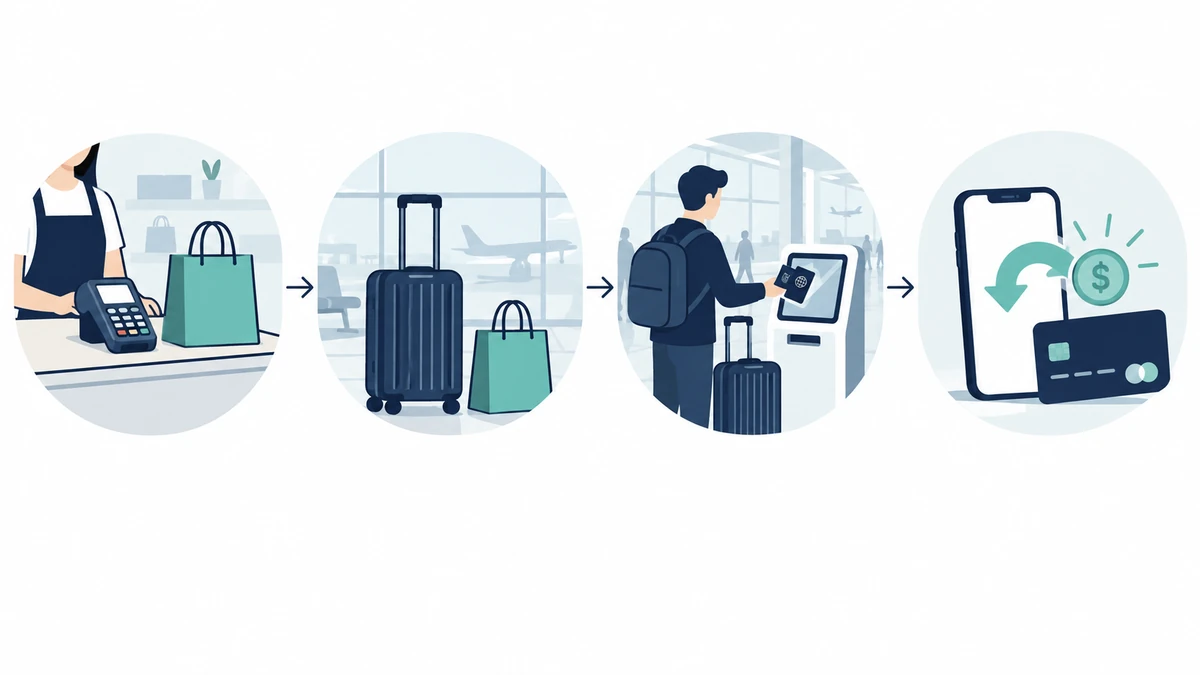
- At the shop. Look for the tax-free sign, show your passport (or the passport QR code in Visit Japan Web where the shop accepts it) and buy at least ¥5,000 before tax in one shop on one day. You pay the full tax-inclusive price. The shop sends a purchase record linked to your passport to Japan's National Tax Agency system.
- Register how you want to be refunded. The shop, or its refund company, tells you which method it offers, for example a bank transfer, a credit card refund, an app, or cash at the departure airport or port. Do this before you leave the shop if you can, while staff can help.
- Keep everything with you. Every item on that tax-free receipt has to be in your possession when customs checks at departure.
- Customs confirmation at departure. At the airport or port, before you check in your bags, you scan your passport at a tax-free kiosk. Green means done. Red means an officer checks the goods.
- The refund. Customs sends the confirmation to the tax system, the shop or its refund company receives it, and the tax is paid back by the method you chose.
4. At the airport
This is the step that did not exist before, and the order matters.
Do it before you check in your suitcase. Customs has to be able to see the goods if the kiosk asks for an inspection, so the procedure cannot be done after your bags have been checked. The official guidance is that customs confirmation, including any inspection, has to be finished before check-in, so allow extra time, especially on busy days.
Green or red. When you scan your passport, the screen shows whether an inspection is needed. A green result means the confirmation is complete. A red result sends you to a customs inspection point with the goods.
Smartphone option. At Narita, Haneda, Kansai, Chubu, Fukuoka, New Chitose and Naha, the procedure can also be done online through Visit Japan Web inside a designated airport Wi-Fi area, without queuing at a kiosk. Set up Visit Japan Web with your passport before the trip if you plan to use it.
Liquids. Sunscreen, toners and lotions in large bottles cannot go in hand luggage through security. That is not a problem under the new system as long as you do the customs step first: scan at the kiosk with the suitcase still with you, then check the suitcase in as normal.
If you used or ate something. If anything you bought tax-free is no longer with you, do not use the kiosk: go to the customs counter and tell the officer. See section 6 for what that means for the refund.
5. How and when you get the money
The law does not set how refunds are paid. Each tax-free shop decides, either doing it itself or using a refund company, which means the refund may come from a company other than the shop where you bought the goods. The National Tax Agency gives bank transfer, credit card refund, app payment and cash at the departure port as examples.
Because each shop or refund company sets its own process, three things are worth asking at the till:
- How will I be refunded, and do I need to register anything now?
- When will the money arrive after I leave?
- Is any fee deducted from the refund? The official guidance does not cover fees, so this is up to the shop or refund company.
If you register a wrong card or bank detail, the refund can fail, and if the mistake is on your side the money may simply not be paid. Check the details before you leave the counter. Some shops may choose to refund you before departure at their own risk, but you cannot count on that.
6. The one-receipt rule
This is the rule most likely to cost shoppers money. Japan's National Tax Agency is explicit: if, at customs, you do not have even one of the items on a single purchase record, customs cannot confirm any of the items on that record. One purchase record is usually one tax-free receipt.
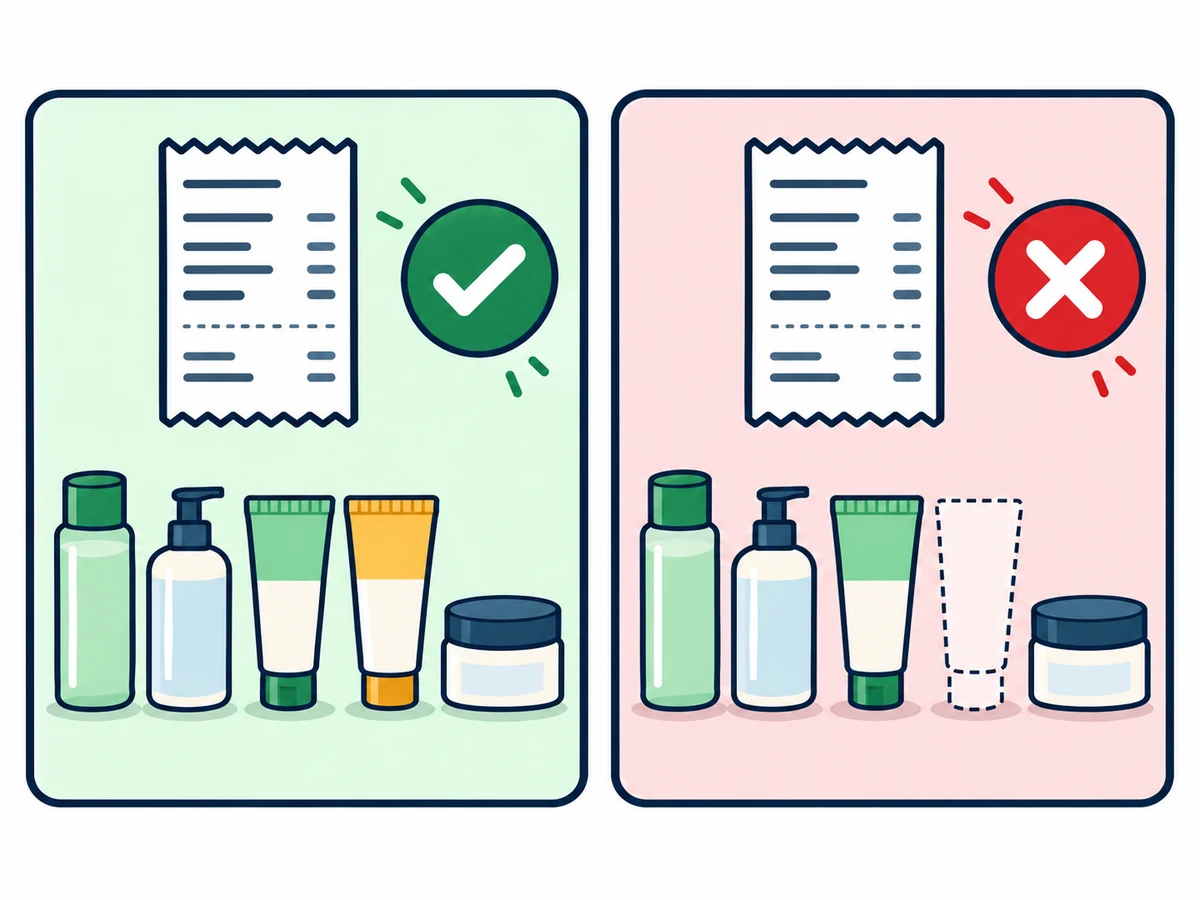
The sealed bag has gone, so nothing physically stops you opening a product. But if you buy eight items on one receipt, open one sunscreen and use it up, the other seven lose their refund too. In practice:
- Anything you want to use during the trip, buy separately, either on its own receipt or as a normal purchase without tax-free.
- Keep each tax-free receipt's items together in your luggage.
- Do not give tax-free items away as gifts in Japan, or post them home, before you leave.
7. Buying skincare and cosmetics under the new system
Japanese drugstore skincare is one of the main reasons visitors shop tax-free, and the changes cut both ways for it.
Better: cosmetics are no longer a special category. There is no consumables cap and no sealed bag, and a shop can combine your skincare and your electronics towards the same ¥5,000 minimum. The ¥500,000 consumables cap is gone, but you can only buy tax-free what you can carry out of Japan yourself.
Worse: you pay the full price first, and everything on the receipt has to leave Japan with you, unused, because of the one-receipt rule.
| Amount | |
|---|---|
| Goods before tax | ¥20,000 |
| Consumption tax at 10% | ¥2,000 |
| You pay at the till | ¥22,000 |
| Refund after customs confirms | Up to ¥2,000, minus any fee if the shop or refund company charges one |
A simple way to shop: buy one small set to use during the trip at full price, and buy the stock you are taking home on one tax-free receipt per shop, late in the trip. If you are deciding what to buy, our guides to the best Japanese skincare, Japanese beauty products, Anessa and Biore sunscreen prices, Hada Labo and drugstore makeup list current prices.
Shipping from the shop. If a shop arranges shipping overseas at the time of purchase and hands the goods straight to the carrier, that is treated as an export in its own right, so the shop can sell without tax and you do not need the airport step for those goods. Posting things home yourself before you fly is different: goods bought tax-free and sent separately do not qualify for the refund.
Clinic treatments are not covered. Tax-free shopping covers goods only, not services such as treatments at a cosmetic clinic. Products a clinic sells could qualify only if the clinic is itself a registered tax-free shop. See our Japan trip cost guide for how to budget treatments separately.
8. If your trip straddles November 1
- Bought up to October 31: old rules. Tax comes off at the till, consumables go into special tax-free packaging, the old limits apply, and you still carry the goods out and show your passport to customs when you leave, as before.
- Bought from November 1: new rules. Full price, customs confirmation at departure, refund afterwards.
- One trip can produce receipts under both systems. Keep them apart. New-system purchases also need the kiosk step before check-in.
9. Mistakes that cost the refund
| Mistake | What happens |
|---|---|
| Checking your suitcase before the customs kiosk | You can no longer do the customs procedure at all, and a checked bag will not be brought back for it |
| Using or eating one item from a tax-free receipt | The whole receipt cannot be confirmed |
| Posting purchases home yourself before departure | No refund for those goods |
| Leaving Japan more than 90 days after purchase | Outside the window; the deadline counts from the day after purchase |
| Wrong card or bank details at registration | The refund can fail |
| Arriving at the airport with no time to spare | Confirmation, including any inspection, has to be finished before check-in |
10. FAQ
11. Sources & Method
Every rule in this guide comes from Japanese government material: the Japan Tourism Agency's page, FAQ and eligibility list for travellers, and the National Tax Agency's overview and Q&A on the refund method, all read on 6 October 2026. The airline liquids rule in section 4 is general aviation security practice, not part of the tax-free guidance. The worked example in section 7 is our own arithmetic at the standard 10% rate. Where the official material leaves a decision to individual shops, such as refund method, timing and fees, we say so rather than guessing. The rules are new, and airport procedures in particular may be refined after launch, so check the official page before you travel.
| Source | Used for |
|---|---|
| 消費税免税店サイト: 旅行者向け特設ページ Japan Tourism Agency · primary · accessed 6 Oct 2026 | The traveller steps, the kiosk and green/red procedure, the Visit Japan Web airports, and the requirement to finish before check-in |
| Japan. Tax-free Shop: FAQ for travellers Japan Tourism Agency · primary · accessed 6 Oct 2026 | Completing customs before checking baggage, what to do if consumables were used, the carry-out quantity limit |
| 免税購入対象者の範囲 Japan Tourism Agency · primary · accessed 6 Oct 2026 | The eligibility list, including SOFA status and the six-month condition |
| 現行制度とリファンド方式の比較 Japan Tourism Agency · primary · accessed 6 Oct 2026 | The departure requirements under the old system for purchases up to October 31 |
| 輸出物品販売場制度はリファンド方式に移行します National Tax Agency · primary · April 2025 · accessed 6 Oct 2026 | The old vs new table, the 90-day window and its counting, the one-receipt rule, the ¥1,000,000 item rule, Japanese nationals abroad |
| Q&A(リファンド方式・概要編) National Tax Agency · primary · accessed 6 Oct 2026 | Start by purchase date and no transition period, eligibility list, airport procedure, separately posted goods, refund methods and failed refunds |
| Source | Used for |
|---|---|
| インバウンド免税「リファンド方式」開始まで約3ヶ月 Travel Voice · trade press · 15 Aug 2026 · accessed 6 Oct 2026 | Cross-check of the traveller steps and the point that refunds may come from a company other than the shop |
Related Guides
About this guide: This is an independent guide. We receive no commission from any shop, refund company or brand named or linked above. The refund method is new, and shops and airports may refine their procedures after November 1, 2026; check the Japan Tourism Agency's page before you travel. Informational only; not tax or legal advice.