1. What a trip actually costs
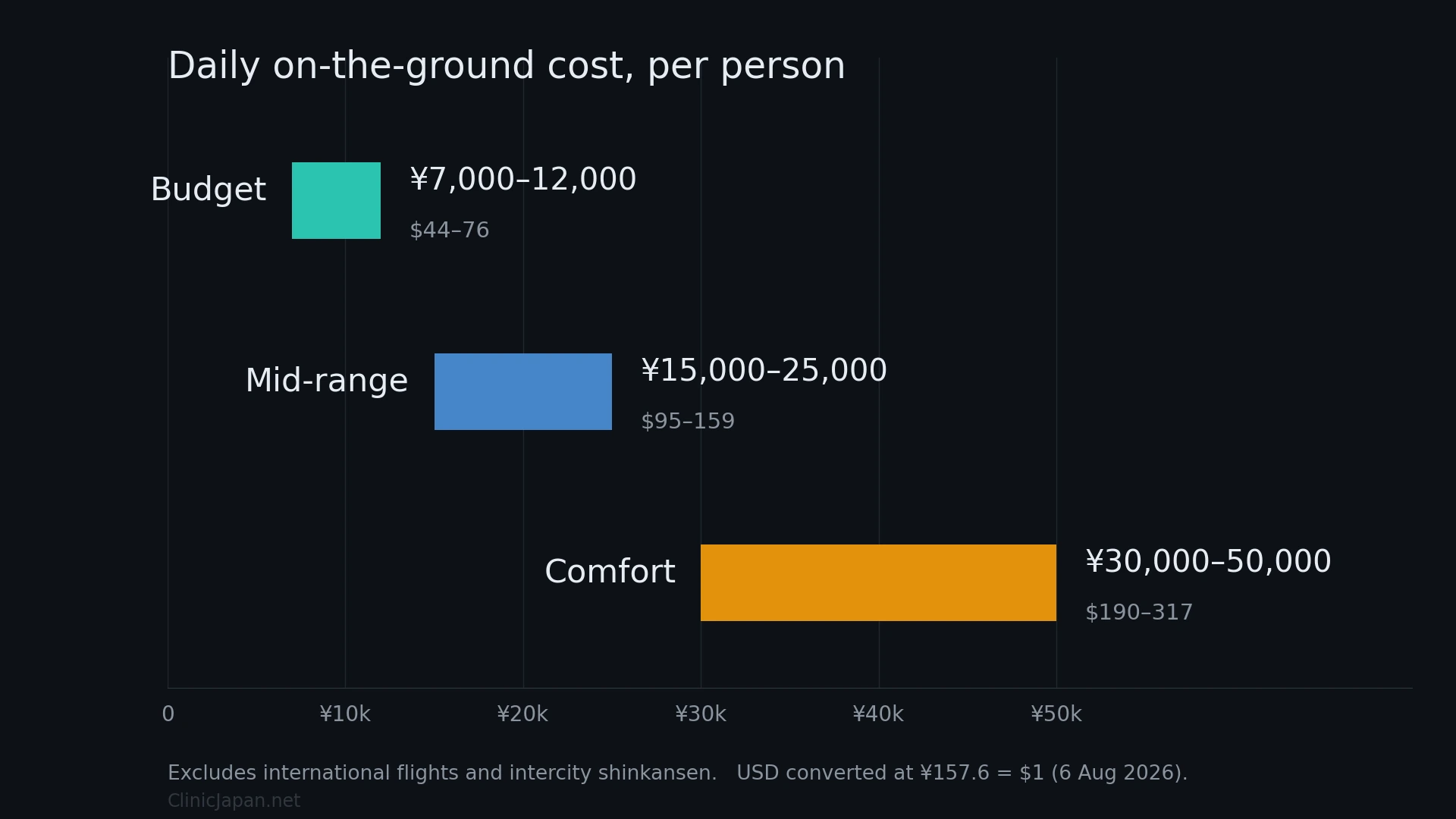
Most budget guides give you one number, which is useless because the number is almost entirely a function of how you travel rather than where you go. Japan is not expensive or cheap; it is unusually elastic. The gap between a comfortable budget trip and a comfortable mid-range trip is wider here than in most destinations, and both are genuinely pleasant.
| Style | Per day | In USD | What that looks like |
|---|---|---|---|
| Budget | ¥7,000–12,000 | $44–76 | Hostel or capsule, convenience-store and standing-shop meals, IC card only |
| Mid-range | ¥15,000–25,000 | $95–159 | Business hotel, restaurant meals, one or two paid sights a day |
| Comfort | ¥30,000–50,000 | $190–317 | Four-star hotel, several sit-down meals, taxis when convenient |
These figures exclude international flights and intercity shinkansen, which are lumpy costs better handled separately — sections 4 and 5. Tokyo and Kyoto sit at the upper end of each band; Osaka, Fukuoka, Hiroshima and Sapporo are noticeably cheaper for the same standard.
2. Accommodation
| Type | Per night | Notes |
|---|---|---|
| Hostel / capsule | ¥2,500–4,000 | Per bed. Japanese capsule hotels are clean and genuinely usable, not a compromise |
| Business hotel | ¥8,000–14,000 | Per room. Toyoko Inn, APA, Dormy Inn. Small, well located, often with breakfast |
| Mid-range hotel | ¥15,000–30,000 | Per room. Larger rooms, better locations |
| Ryokan | ¥20,000–60,000+ | Per person, usually including dinner and breakfast. A one-night experience, not a base |
Business hotels are the single best value in Japanese travel and the reason a mid-range trip is affordable. Rooms are small by Western standards — genuinely small — but spotless, quiet, walkable to a station, and priced per room rather than per person, which halves the cost for couples.
3. Food, which is cheaper than you expect
This is where Japan defies its reputation. Eating well is inexpensive; eating badly is what costs money, because the expensive tourist-facing restaurants near major stations are the worst value in the country.
| Meal | Price | In USD |
|---|---|---|
| Convenience store breakfast or lunch | ¥500–900 | $3–6 |
| Ramen or gyudon at a standing shop | ¥800–1,300 | $5–8 |
| Teishoku set lunch at a restaurant | ¥1,000–1,500 | $6–10 |
| Izakaya dinner with drinks | ¥2,500–4,500 | $16–29 |
| Depachika prepared food, after 7pm | ¥500–1,200 | $3–8 |
Two habits cut the food line substantially without cutting quality. Take lunch at restaurants that are expensive at dinner — the lunch set at a good place is often a third of the evening price for the same kitchen. And use department-store food basements in the last hour before closing, when prepared food is discounted; it is better than most restaurant food at a convenience-store price.
4. Transport, and the JR Pass question
Local transport is cheap and predictable: a prepaid IC card covers subways and buses nationwide, and ¥1,000–1,500 a day covers normal city movement. Intercity travel is where the decision sits.
| Price | Verdict | |
|---|---|---|
| JR Pass 7 days | ¥50,000 | Needs a route beyond the standard triangle to break even |
| JR Pass 14 days | ¥80,000 | Worth it only with heavy long-distance movement |
| JR Pass 21 days | ¥100,000 | For genuinely wide itineraries |
| Tokyo–Kyoto one way | ~¥14,000 | The single most common intercity leg |
| Tokyo–Kyoto–Hiroshima–Tokyo | ~¥55,000 | Roughly break-even against the 7-day pass |
Basing yourself in fewer cities is the largest single lever on total cost. Osaka in particular works as a Kansai base with Kyoto 30 minutes away, Nara 45 and Kobe 30 — see things to do in Osaka. Two bases across two weeks beats six hotels.
5. Flights and the fixed costs
International airfare from the US typically runs $800–1,500 return depending on origin, season and how far ahead you book, and it is the least controllable line in the budget. It also swamps everything else on a short trip, which is the argument for going longer rather than more often: the daily cost of a Japan trip falls sharply after the first week.
| Item | Cost |
|---|---|
| International flight (from US) | $800–1,500 return |
| Airport transfer, each way | ¥1,000–3,200 |
| eSIM or pocket wifi, per week | ¥1,500–4,000 |
| Travel insurance | Varies — do not skip it |
| Attractions, per paid sight | ¥1,200–3,200 |
6. Realistic totals
| Style | Ground cost | + Flight | Total |
|---|---|---|---|
| Budget | ¥70,000–120,000 | $800–1,100 | ~$1,250–1,860 |
| Mid-range | ¥150,000–250,000 | $900–1,300 | ~$1,850–2,890 |
| Comfort | ¥300,000–500,000 | $1,100–1,500 | ~$3,000–4,670 |
Add intercity rail on top: roughly ¥30,000–55,000 for a Tokyo–Kansai itinerary, more if you go further. Couples save meaningfully at the mid-range and comfort tiers because hotel rooms are priced per room, not per person; the ground cost for two is typically 1.5× rather than 2× a solo trip.
7. If the trip includes treatments
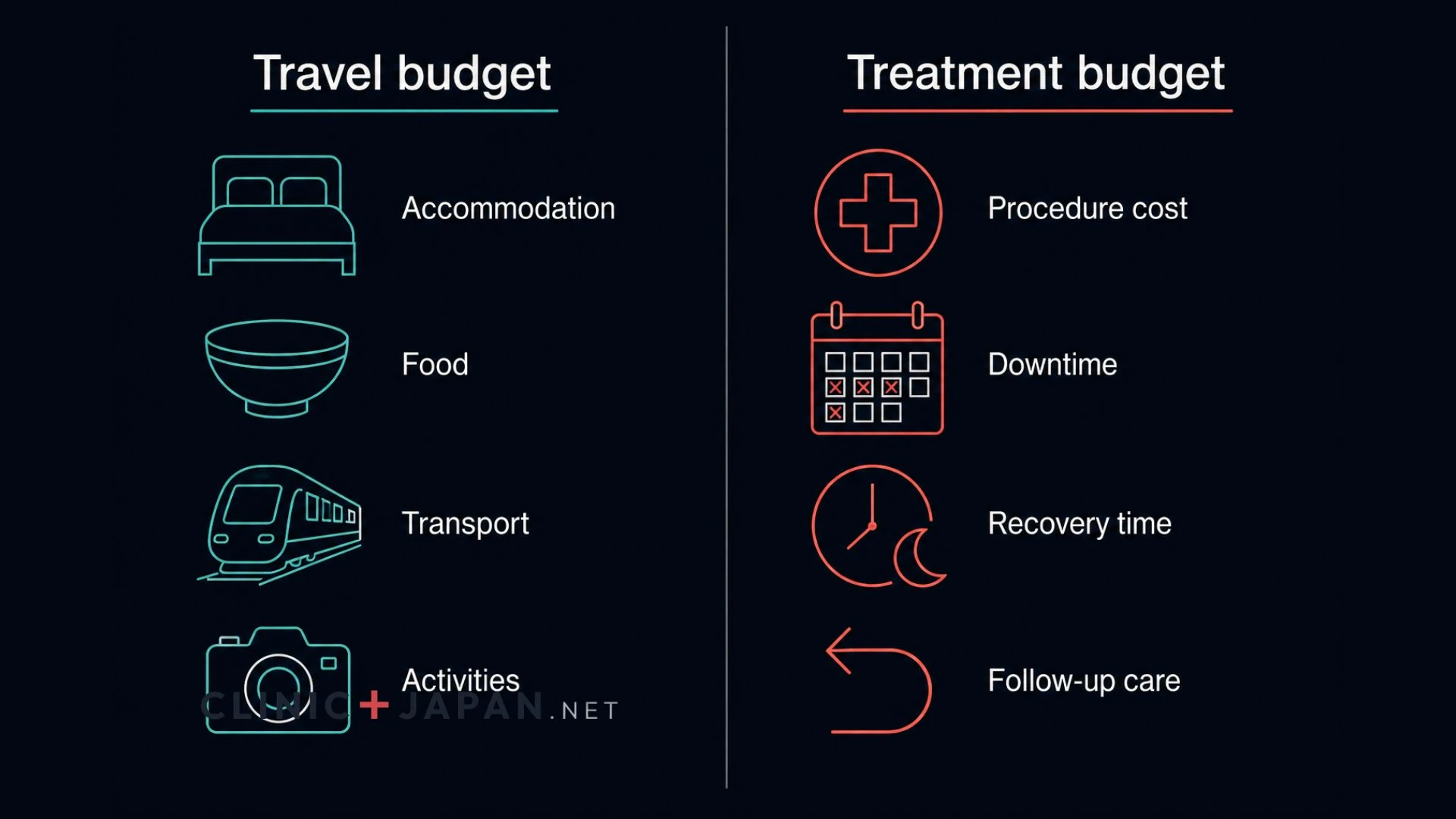
This is a different budget, and mixing the two is the most common planning error we see. A cosmetic or dental treatment trip has its own cost structure — procedure fees, consultation fees, recovery accommodation, buffer days, and sometimes a follow-up visit — and it does not scale with your travel style at all. A budget traveller and a comfort traveller pay the same for the same procedure.
| Travel budget | Treatment budget | |
|---|---|---|
| Scales with | Hotel tier, meals, pace | Procedure only |
| Controllable? | Highly | Barely — clinic tier is the only lever |
| Timing effect | Peak season raises it 30–40% | None, but holiday closures block dates |
| Buffer needed | None | Downtime and follow-up days at the end |
Budget them as two separate lines and the trip prices correctly. Our medical tourism planning guide covers the treatment side end to end, the 2026 price list covers procedure costs, and how to book a clinic covers the reservation process. One scheduling point that catches people: clinics and specialist salons close entirely during Golden Week, Obon and the New Year period.
8. What actually moves the number
Ranked by effect, largest first.
| Lever | Effect |
|---|---|
| Travel in May, June or October | 30–40% off accommodation vs sakura season |
| Fewer bases, longer stays | Cuts rail spend and dead time |
| Business hotels over international chains | Halves the accommodation line at the same convenience |
| Lunch sets instead of dinner | Same kitchens at a third of the price |
| Skip the JR Pass unless the route earns it | Up to ¥20,000 on a two-city itinerary |
| Tax-free shopping with your passport | 10% off qualifying purchases over the threshold |
| Osaka or Fukuoka instead of Tokyo as a base | Noticeably lower nightly rates for the same standard |
What does not work: skipping meals, avoiding transport, or staying far from a station to save on the room. Japan punishes the last one particularly — the time and fares you lose commuting exceed the saving.
9. FAQ
Sources & Method
Daily spend bands, accommodation and meal prices are the consensus of several independent 2026 budget analyses read in August 2026, cross-checked against each other rather than taken from one source; where they disagreed we took the wider range. Rail pass and point-to-point fares are as published for 2026. Every USD figure converts at ¥157.6 = $1, the rate on 6 Aug 2026 — the yen figures are the real ones and the dollar column moves with the exchange rate. Flight costs are indicative for US origins and vary more than any other line.
| Source | Used for |
|---|---|
| Japan Rail Pass — official site JR Group · primary · accessed 7 Aug 2026 | Current 7 / 14 / 21-day pass pricing and eligibility |
| JR West rail passes West Japan Railway Company · primary · accessed 7 Aug 2026 | Regional pass alternatives referenced in the break-even discussion |
| Source | Used for |
|---|---|
| Daily Budget for Japan 2026 — food, hotels and transport by city BluePlanet / SelfGuideJapan · secondary · accessed 7 Aug 2026 | Daily bands by travel tier; the JR Pass break-even worked example (Tokyo–Kyoto–Hiroshima–Tokyo ≈ ¥55,000) |
| Japan Travel Budget Guide 2026 Japan Trip Navi · secondary · accessed 7 Aug 2026 | Business hotel and hostel nightly rates, meal prices, attraction admission range |
| Japan Travel Budget Guide JapanNook · secondary · accessed 7 Aug 2026 | Cross-check on the budget and mid-range daily bands |
| How Much Does a Trip to Japan Cost in 2026? AirHub · secondary · accessed 7 Aug 2026 | All-in ten-day totals from US origins and the flight cost range |
| Source | Used for |
|---|---|
| Japan Tourism Statistics Japan National Tourism Organization (JNTO) · primary · accessed 7 Aug 2026 | Where readers can check current inbound volume and seasonality themselves |
| Japan Tourism Agency Ministry of Land, Infrastructure, Transport and Tourism · primary · accessed 7 Aug 2026 | Official visitor consumption survey series, for readers who want the underlying spend data |
| Source | Used for |
|---|---|
| Travel budget vs treatment budget separation ClinicJapan Research Team · Our own synthesis, not a cited source | Section 7 in full. The point that treatment costs do not scale with travel style, and the buffer-day requirement, are our editorial position based on how treatment trips actually sequence |
| Levers ranking in section 8 ClinicJapan Research Team · Directional, not a measured result | The ordering of cost levers is our judgement. The 30–40% seasonal accommodation swing is drawn from the cost sources above; the ranking itself is not |
| Exchange-rate dependency Editorial note · Transparency item | Every USD figure is a conversion at one day's rate. Yen figures are the primary numbers throughout |
Related Guides
About this guide: This is an independent guide. We receive no commission from any airline, hotel, rail operator, booking platform or clinic named or linked above, and nobody paid to be included. Prices move — accommodation seasonally, rail fares by revision, and every dollar figure with the exchange rate. Treat these as planning ranges and confirm current prices before booking. Informational only; not medical advice.