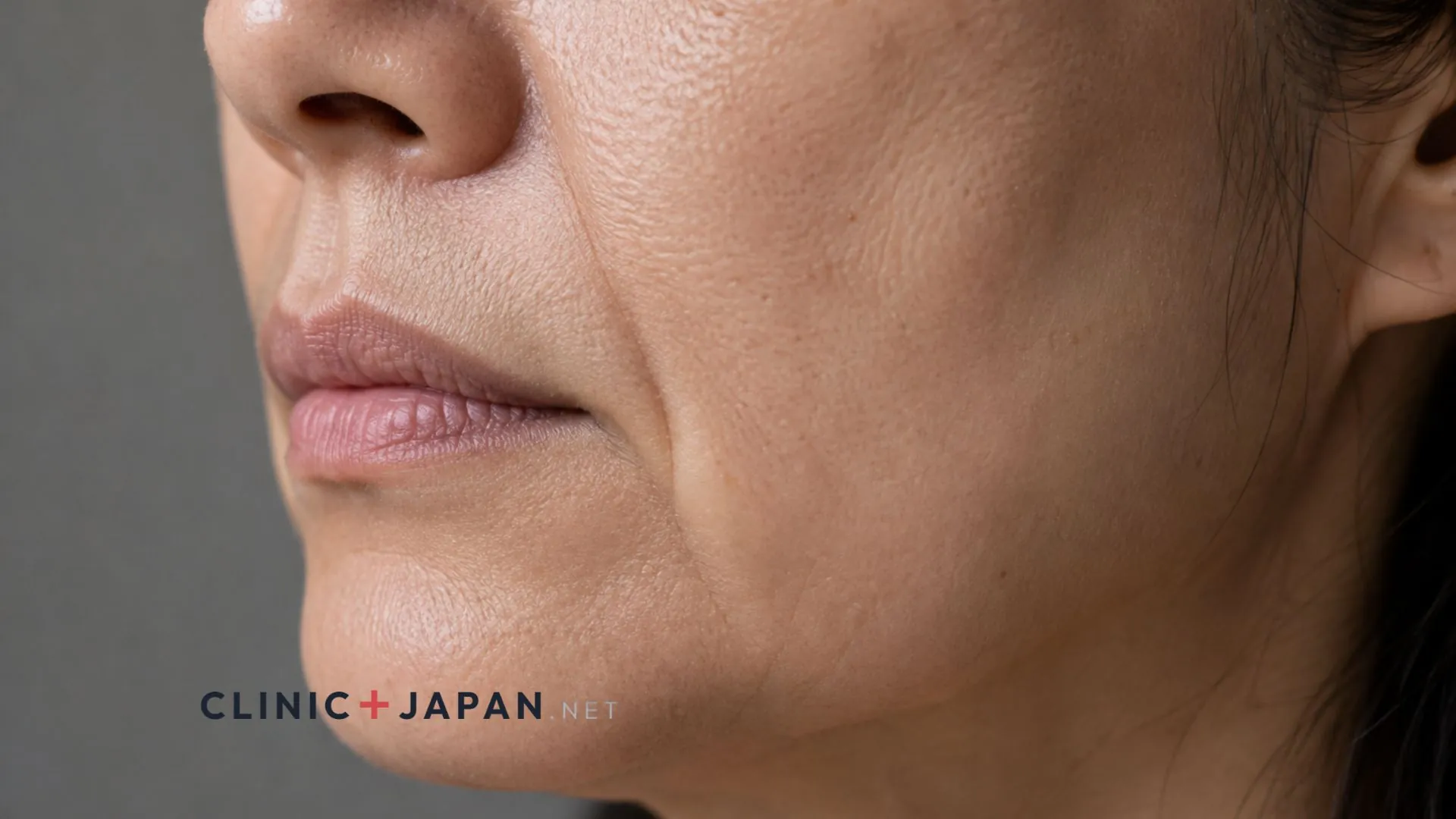
1. It is a corner problem, not a line problem
The groove running from the outer corner of the mouth down towards the jaw has a clinical name that describes it better than the puppet metaphor does: the static labiomandibular fold. And the word doing the work in that name is static — unlike a smile line, this one is present at rest.
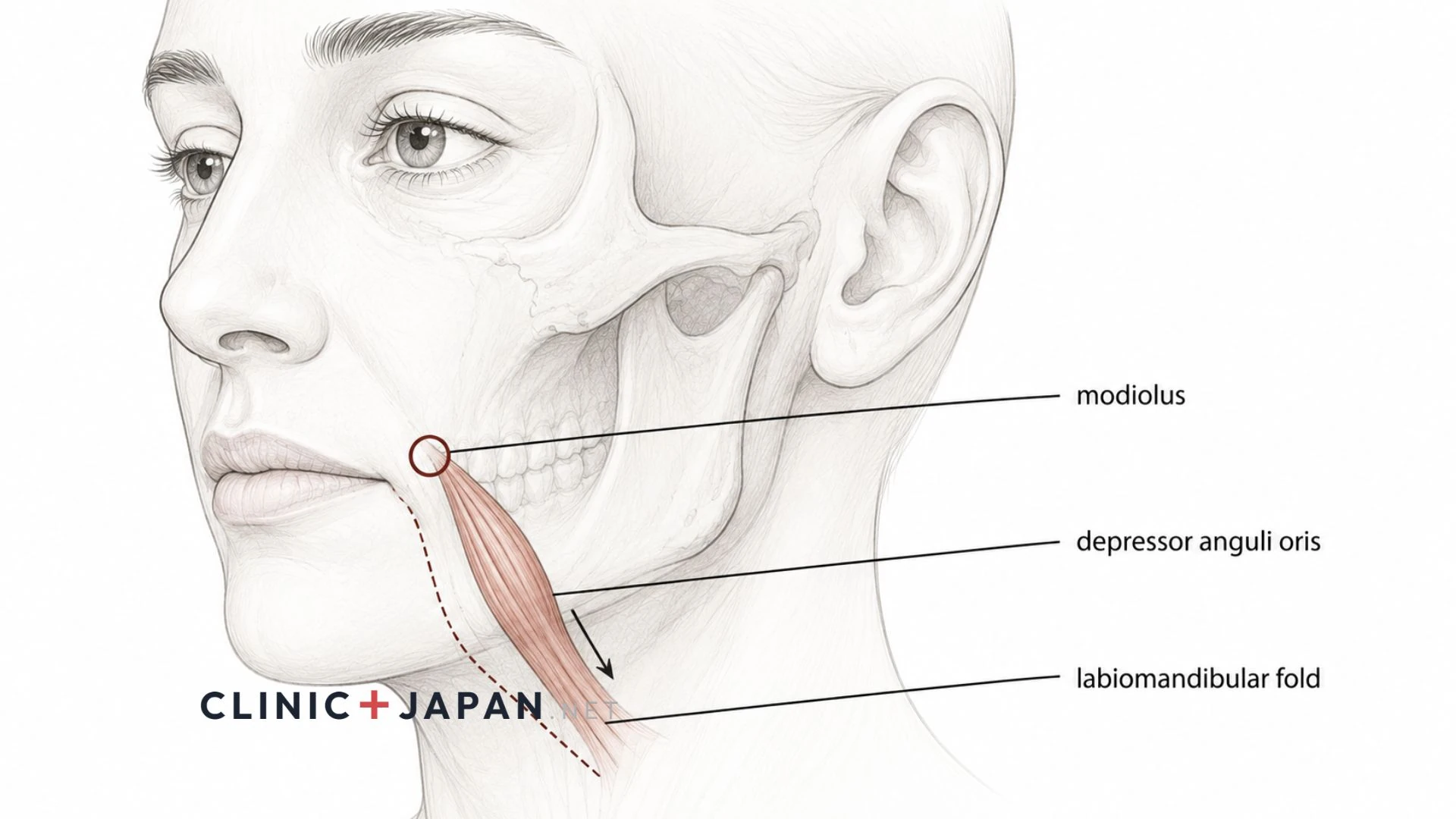
Underneath it sits a structure most people have never heard of and every injector thinks about constantly. The modiolus is the dense fibromuscular knot just lateral to the corner of the mouth where several facial muscles converge and anchor. It is the hinge the mouth corner swings on. When the tissue around it descends and the muscles that pull downward keep pulling, the corner drops — and the fold below it deepens as a consequence of the drop.
2. Why it happens — three layers, not one
Three things change simultaneously, on different timescales, and a treatment plan that addresses only one of them is the usual reason results underwhelm.
| Layer | What changes | What it does to the mouth corner |
|---|---|---|
| Bone | A 2026 review of facial bone ageing reports maxillary height falling by roughly 8–15% and the mandibular angle opening by 3–7° with age, with distinct resorption patterns around the pyriform aperture and the alveolar processes | The scaffold the lower face hangs on retreats and rotates. Everything soft sitting on it moves down and forward |
| Fat and soft tissue | Volume in the supramuscular and submuscular fat layers around the corner is lost and redistributed | The corner loses its support and the fold above the jowl deepens |
| Muscle | The depressor anguli oris — the muscle whose only job is to pull the mouth corner down — keeps working against a corner with less support | A persistent downward vector, which is why some faces look displeased at rest |
That same 2026 bone review notes a sex difference worth knowing: women showed greater orbital change with age, while men showed more pronounced mandibular remodelling. Which is a useful reminder that "the standard approach for marionette lines" is a marketing phrase rather than an anatomical one.
3. What the treatment literature actually supports
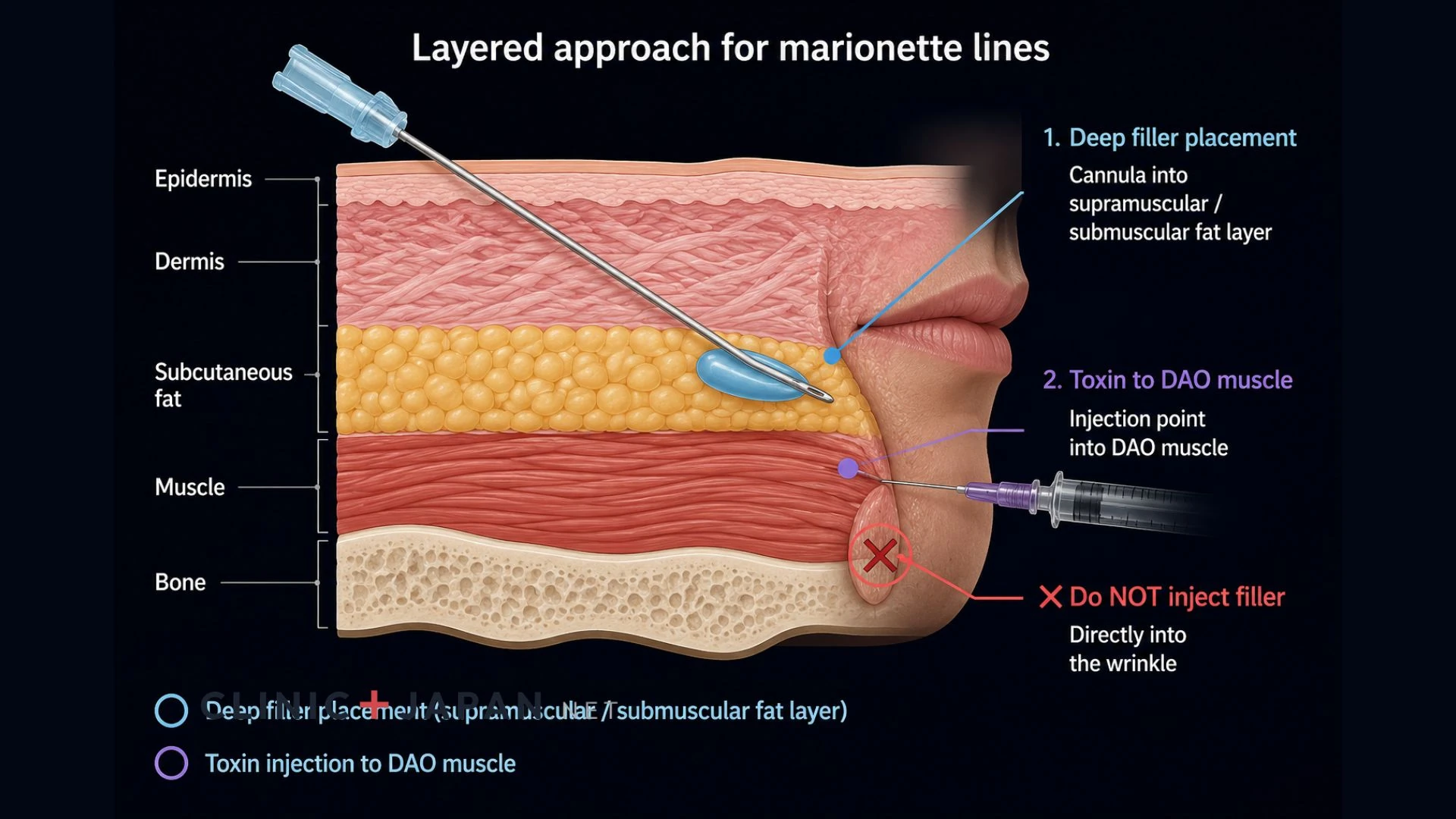
The clinical anatomy review for this area sets out the technique consensus plainly: filler placed with a cannula into the deeper supramuscular and submuscular fat layers addresses the volumetric loss, and neurotoxin into the depressor anguli oris improves the result by reducing the downward force on the mouth corner. Combined, not either alone.
The most useful outcome data comes from a prospective, evaluator-blinded study that treated drooping mouth corners in a defined sequence — monophasic hyaluronic acid to correct the corner first, then the commissure, then the deep marionette fold, followed by incobotulinumtoxinA along the depressor anguli oris and mentalis.
| Measure | Result | What it tells you |
|---|---|---|
| Filler volume, corner correction | Median 0.2 mL right side, 0.25 mL left | Small. Far less than the "one syringe per side" many people expect |
| Filler volume, commissure and fold | Median 0.18 mL and 0.15 mL respectively | Also small, and some patients received none at these steps |
| Toxin dose | Mean 26.5 units total, across depressor anguli oris and mentalis | The muscle component is a real part of the treatment, not a garnish |
| Mouth corner angle | Median −4° at baseline, −1° at two weeks, −1° at three months | An objective measurement, and it held over the follow-up period |
| Global aesthetic improvement | Median score of 3 at both two weeks and three months | Consistent, moderate improvement rather than transformation |
4. The risk that belongs to this region
The lower face is not the highest-risk filler territory — that is the nose and glabella — but it is not benign either. The facial artery and its branches run through this area, and vascular occlusion is the complication that matters.
A meta-analysis of published vascular complications after facial filler injection collected 93 cases from 30 articles. Blindness was the main consequence, accounting for 61% of them; partial or total recovery occurred in 28% of cases and there was no improvement in the majority. The authors' conclusion is the one to carry into a consultation: injury to the ophthalmic and retinal arteries during filler injection can cause irreversible harm, and physicians injecting fillers need proficient anatomical knowledge.
| Ask | Why it matters |
|---|---|
| Cannula or needle? | The technique literature for this area favours a cannula for the deeper layers. A clinic with a considered answer either way is a better sign than one that has not thought about it |
| Is hyaluronidase on site? | It is the reversal agent for hyaluronic acid, and it needs to be in the building, not ordered in |
| Are you also treating the depressor anguli oris? | If the answer is "we just fill the line", you are getting half the approach the anatomy literature describes |
| How much are you planning to use? | The prospective data used tenths of a millilitre per step. A plan built around emptying syringes is a different plan |
| What is the correction path? | Overfilled lower faces are the most common regret in this category, and dissolving is a separate appointment and a separate fee |
5. Doing this in Japan
Marionette line correction in Japan is private-pay, priced per syringe, and the price spread is driven almost entirely by which filler brand is used. Our verified range for this area is ¥50,000–140,000 using one to two syringes, which is the same range as nasolabial folds.
| Item | Cost | Notes |
|---|---|---|
| Marionette lines (マリオネットライン) | ¥50,000–140,000 | 1–2 syringes. Note that the prospective study above used a fraction of a syringe per side |
| Filler per syringe, US brands | ¥50,000–80,000 | Juvederm and Restylane lines |
| Filler per syringe, Korean brands | ¥25,000–45,000 | CHAEUM, Elravie and similar. Widely used in Japanese clinics |
| Botulinum toxin, per area | ¥4,000–35,000 | Depends on product tier. Only Allergan's Botox Vista holds MHLW cosmetic approval in Japan |
| Cannula fee | ¥3,000–5,000 | Often itemised separately. Worth paying here |
| Hyaluronidase | ¥10,000–30,000 | The correction path. Budget for the possibility before you inject, not after |
The full breakdowns are on filler cost by area in Japan, dermal filler in Japan and Botox in Japan. If the assessment points towards laxity rather than volume, thread lift and HIFU in Tokyo are the adjacent options, and face lifting in Japan is the overview.
6. When filler is the wrong answer
Not every deepening fold at the mouth corner is a volume problem, and the honest version of this article says so.
| What is actually going on | Reasonable approach | Why not filler alone |
|---|---|---|
| Corner drops, fold moderate, skin reasonably firm | Small-volume deep filler plus depressor anguli oris toxin — the combined approach | This is the indication the evidence describes |
| Jowling with clear skin laxity | Lifting procedures — threads, energy devices, or a surgical opinion | Filling under a jowl adds weight to the thing that is descending |
| Fine perioral lines with sun damage | Resurfacing and topical retinoids | Filler does not change skin quality, and this area shows texture unforgivingly |
| Significant lower-face volume loss overall | A structural plan starting higher on the face, not at the fold | Treating the endpoint of a descent in isolation is the classic overfilling route |
| Strong downward pull, minimal volume loss — a resting face that looks stern | Toxin alone may be enough | Some people are buying filler for a muscle problem |
7. Our position
Marionette lines are the area where we would most strongly advise choosing the injector over the price. The reasoning is in the evidence itself: the technique consensus is layered and combined, the objective outcome data uses small volumes placed in specific planes, and the failure mode — an overfilled lower face — is expensive to reverse and obvious to everyone but the person who bought it.
What is reasonable to expect is what the prospective study measured: a mouth corner that sits closer to neutral, a moderate global improvement, and objective change holding at three months. What is not established is how long this specific correction lasts beyond that window, because nobody has published it.
And there is a limit to what any of this addresses. The bone underneath is remodelling — the maxilla losing height, the mandibular angle opening — and injectables sit on top of that process rather than reversing it. Treating well means treating the corner, the muscle and the volume together, expecting a good year rather than a permanent fix, and being honest with yourself about whether what you are looking at is a fold or a face that has changed shape.
8. FAQ
Sources & Method
Every clinical claim here is sourced to a named, PubMed-indexed paper, and each PMID below was confirmed against the PubMed record rather than taken from a secondary summary. Volumes, unit doses and angle measurements are reported exactly as the source study reports them, including the medians and interquartile framing. Japanese prices are the ranges verified for our own Japan filler pricing guides in March 2026 and cross-checked against published clinic price lists — treat them as ranges rather than quotes and confirm with the clinic. The consultation questions in section 4 and the finding-to-intervention table in section 6 are our own editorial framework, not the recommendation of any cited paper.
| Source | Used for |
|---|---|
| Anatomical-based diagnosis and filler injection techniques: marionette line (PMID 39894451) Hong et al., Journal of Dermatological Treatment, 2025 · clinical anatomy and technique review · accessed 14 Aug 2026 | The 'static labiomandibular fold' terminology and the modiolus explanation in section 1; the finding that modiolus position in Asian populations predisposes to commissural ptosis and wrinkle formation, in section 2; and the technique consensus in section 3 — cannula-delivered filler into the supramuscular and submuscular fat layers plus neurotoxin into the depressor anguli oris, described as a multimodal approach to a multifactorial wrinkle |
| Nonsurgical correction of drooping mouth corners using monophasic hyaluronic acid and incobotulinumtoxinA (PMID 31125173) Bae et al., Journal of Cosmetic Dermatology, 2020 · prospective, evaluator-blinded study · accessed 14 Aug 2026 | The entire outcomes table in section 3 — median filler volumes of 0.2 mL and 0.25 mL for the corner correction steps and 0.18 mL and 0.15 mL for the commissure and fold steps, a mean total of 26.5 units of incobotulinumtoxinA across depressor anguli oris and mentalis, mouth corner droop moving from a median −4° to −1° at two weeks and three months, and a median Global Aesthetic Improvement Scale score of 3. Also the three-month follow-up limit flagged in the warning box and section 7 |
| Facial bone aging: an update and literature review (PMID 41716329) Lee et al., JPRAS Open, 2026 · systematic literature review · accessed 14 Aug 2026 | The skeletal figures in section 2 and section 7 — maxillary height decreasing 8–15%, mandibular angle increasing 3–7°, region-specific resorption around the pyriform aperture and alveolar processes, and the sex difference showing greater orbital change in women and more pronounced mandibular remodelling in men |
| Vascular Complications after Facial Filler Injection: A Literature Review and Meta-analysis (PMID 31360292) Sito et al., Journal of Clinical and Aesthetic Dermatology, 2019 · meta-analysis of 93 cases from 30 articles · accessed 14 Aug 2026 | Section 4's risk figures — 93 cases across 30 articles, blindness as the main consequence at 61%, partial or total recovery in 28% of cases, and the authors' conclusion that ophthalmic and retinal artery injury can be irreversible and that injectors need proficient anatomical knowledge |
| Source | Used for |
|---|---|
| Filler Japan Cost by Area ClinicJapan · our own price research, verified March 2026 | The ¥50,000–140,000 marionette line range for one to two syringes, the per-syringe brand pricing (¥50,000–80,000 US brands, ¥25,000–45,000 Korean brands), the ¥3,000–5,000 cannula fee and the ¥10,000–30,000 hyaluronidase figure in section 5 |
| Botox Japan ClinicJapan · our own price research, verified March 2026 | The ¥4,000–35,000 per-area botulinum toxin range in section 5 and the note that only Botox Vista carries MHLW cosmetic approval in Japan |
| Source | Used for |
|---|---|
| 'Filling the line alone fails' ClinicJapan Research Team · Our framing of the cited anatomy, not a claim any paper makes in these words | Section 1 and the title. The cited review describes marionette lines as multifactorial and recommends a multimodal approach; the sharper claim that filling the crease in isolation disappoints is our editorial reading of that, and individual results vary |
| Consultation questions ClinicJapan Research Team · Editorial checklist | Section 4. The five questions are ours, built from the technique and complication literature cited above. No paper proposes this list |
| Finding-to-intervention table ClinicJapan Research Team · Editorial judgement, not a validated algorithm | Section 6. Matching jowling to lifting procedures and perioral texture to resurfacing reflects standard practice as we understand it, but it is our synthesis and cannot substitute for an in-person assessment |
| Duration extrapolation caveat ClinicJapan Research Team · Transparency item | The warning box in section 3. The three-month follow-up is the cited study's; the observation that longer duration claims for this fold are extrapolated from other facial areas is our own, and it is not a claim that those durations are wrong |
Related Guides
About this guide: This is an independent guide. We receive no commission from any filler or toxin manufacturer, clinic, or brand named or linked above, and nobody paid to be included. Dermal filler and botulinum toxin are medical procedures requiring a qualified physician; volumes and unit doses cited here are what specific published studies used and are not recommendations for your face. Prices change and vary by clinic, and product approval status differs by country. Sudden pain, blanching or vision change after any injectable is a medical emergency. Informational only; not medical advice, and not a substitute for consultation with a doctor.