1. What a jowl is — and why it is not a wrinkle
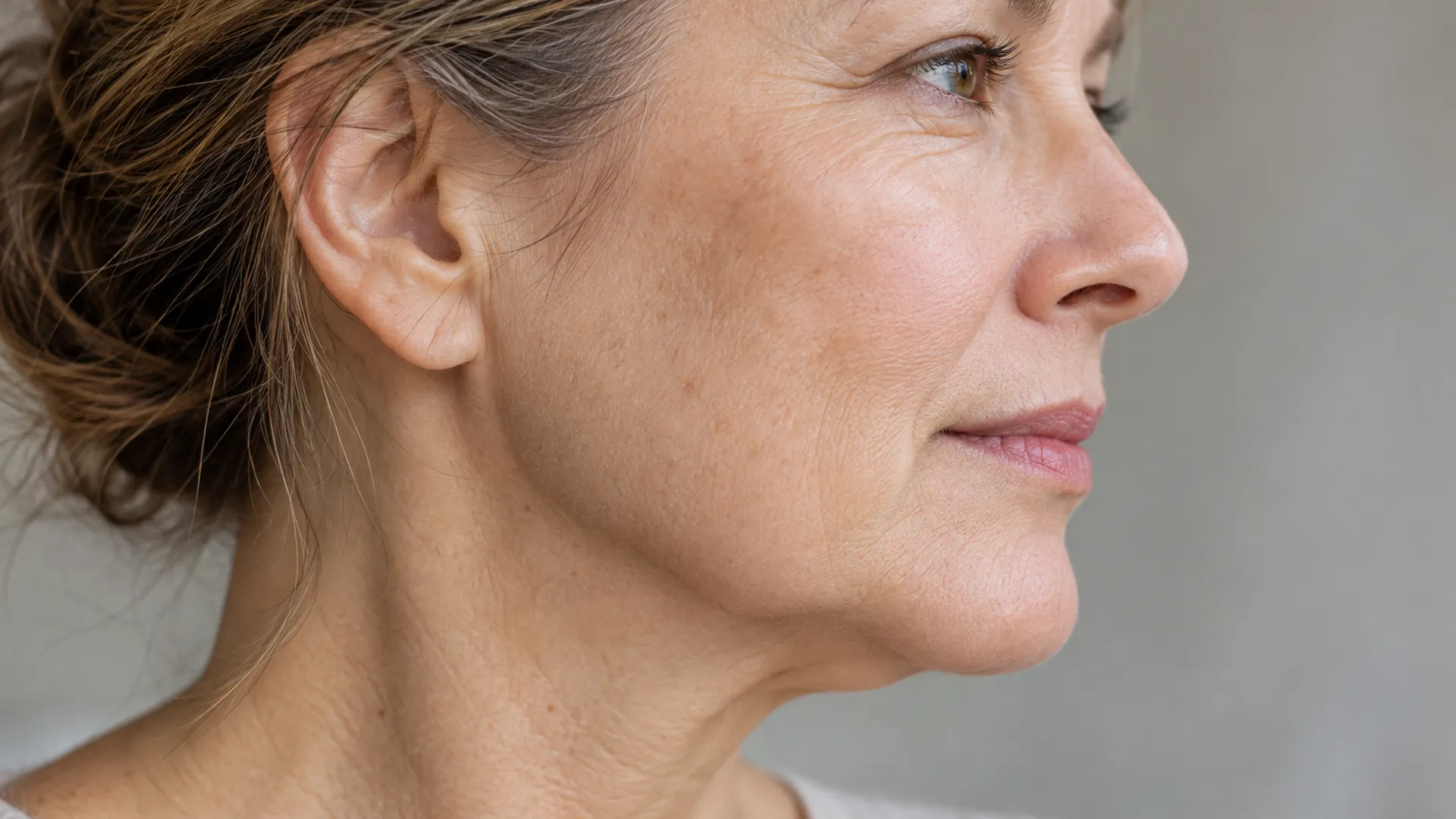
Look at a jowl in profile and it is obvious it is not a line in the skin. It is a small pouch of soft tissue that has settled just behind and below the corner of the mouth, breaking the straight edge of the jaw. Our marionette lines guide covers the crease that runs down from the mouth corner; that is a fold, and it can be filled. A jowl is the mass the fold sits beside, and it has to be moved, reduced or tightened, not filled in.
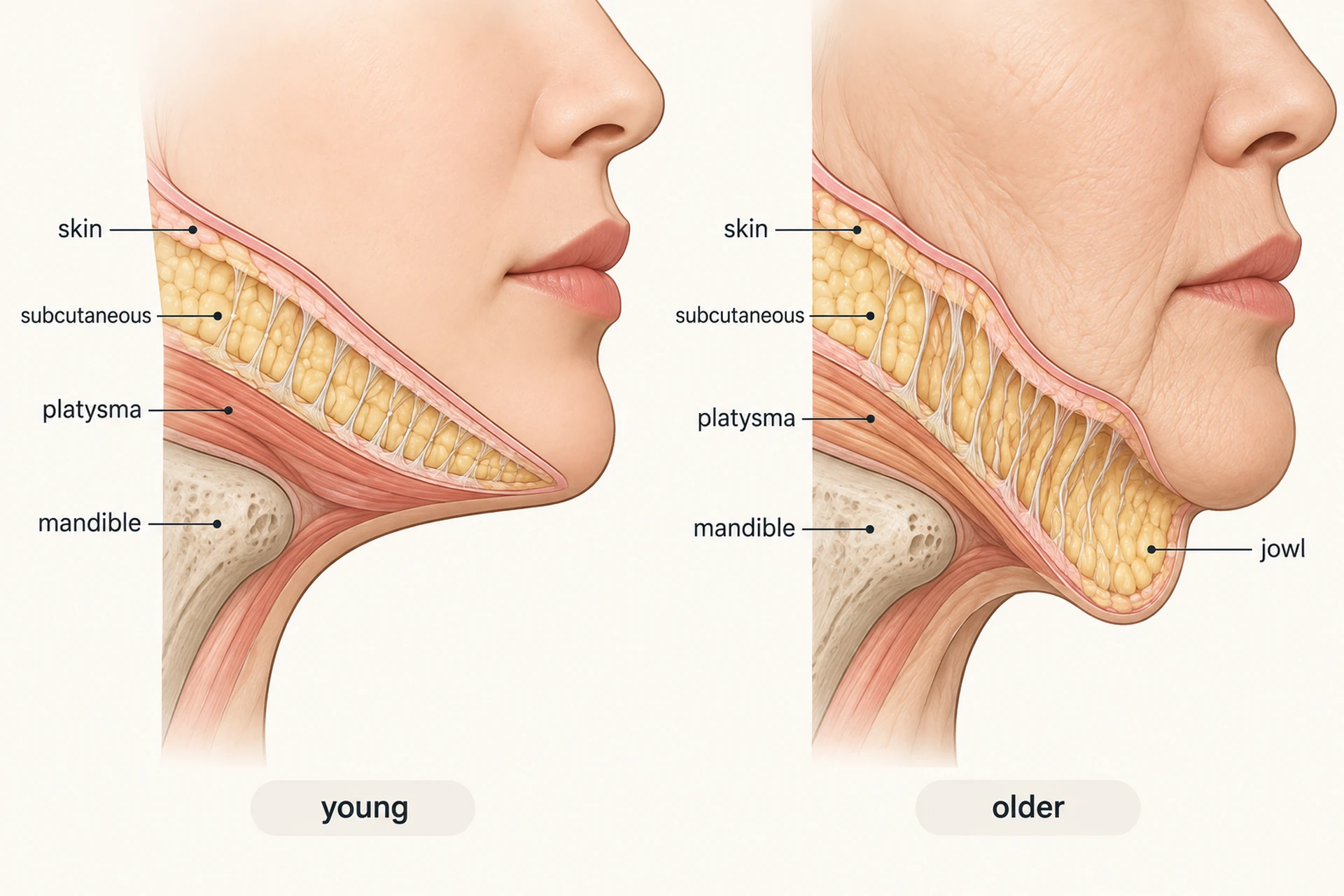
Where it comes from has been argued over for decades, and the most recent anatomical work changes the picture. A 2023 study dissected 49 cadaver heads (mean age 75), with histology, sheet plastination and micro-CT, to work out what actually forms the jowl. The jowl forms in the subcutaneous layer over the posterior part of the mandibular ligament. That ligament exists only in the deep plane, formed by the muscle attachments of the lower-lip depressors and the platysma to the jaw; it has no definite subcutaneous component. The mechanism the authors propose is functional: to open the jaw wide with a narrow mouth, the tissue over the jawline just beside the mouth corner has to be unusually mobile, and that mobility lives entirely in the subcutaneous layer. In youth, short elastic connective tissue allows the movement without laxity. With age that tissue lengthens, laxity follows, and the subcutaneous and dermal redundancy that results is the jowl.
Two older studies fill in the rest. A 2008 dissection series of 16 cadavers described the “premasseter space”, a natural cleavage plane over the lower masseter whose roof loses collagen density with age; expansion of that space, and the descent of the buccal fat beside it, contribute to the jowl and the fold in front of it. And the 2007 work that mapped the face's fat into separate compartments identified jowl fat as the lowest of the subcutaneous compartments, with the observation that the face does not age as one mass but as compartments that shift and shear against each other.
| Feature | What it is | Where | Treatment logic |
|---|---|---|---|
| Jowl | Lax soft tissue that has settled below the jawline | Beside the chin, in front of the jaw angle | Tighten, lift or resect; never fill |
| Marionette line | A fold from the mouth corner downward | Medial to the jowl | Filler at the fold; toxin to the depressor |
| Submental fullness | Fat and skin under the chin | Midline, under the jaw | Fat reduction or neck lift |
2. Which kind of jowl you have
The single most useful distinction comes, oddly, from a paper about a fat-dissolving injection. A 2024 systematic review of serious adverse events after deoxycholic acid for submental and jowl fat draws the line that every jowl consultation should start with: surgery is preferable for jowling caused by compartment displacement (ptosis), whereas fat-reducing treatments are contraindicated for jowling caused by subcutaneous tissue atrophy. In plain terms, some jowls are full — fat that has slid down — and some are empty — deflated, lax skin hanging over the jaw. Fat reduction in an empty jowl is contraindicated; in our reading, it removes what little volume is holding the skin up.
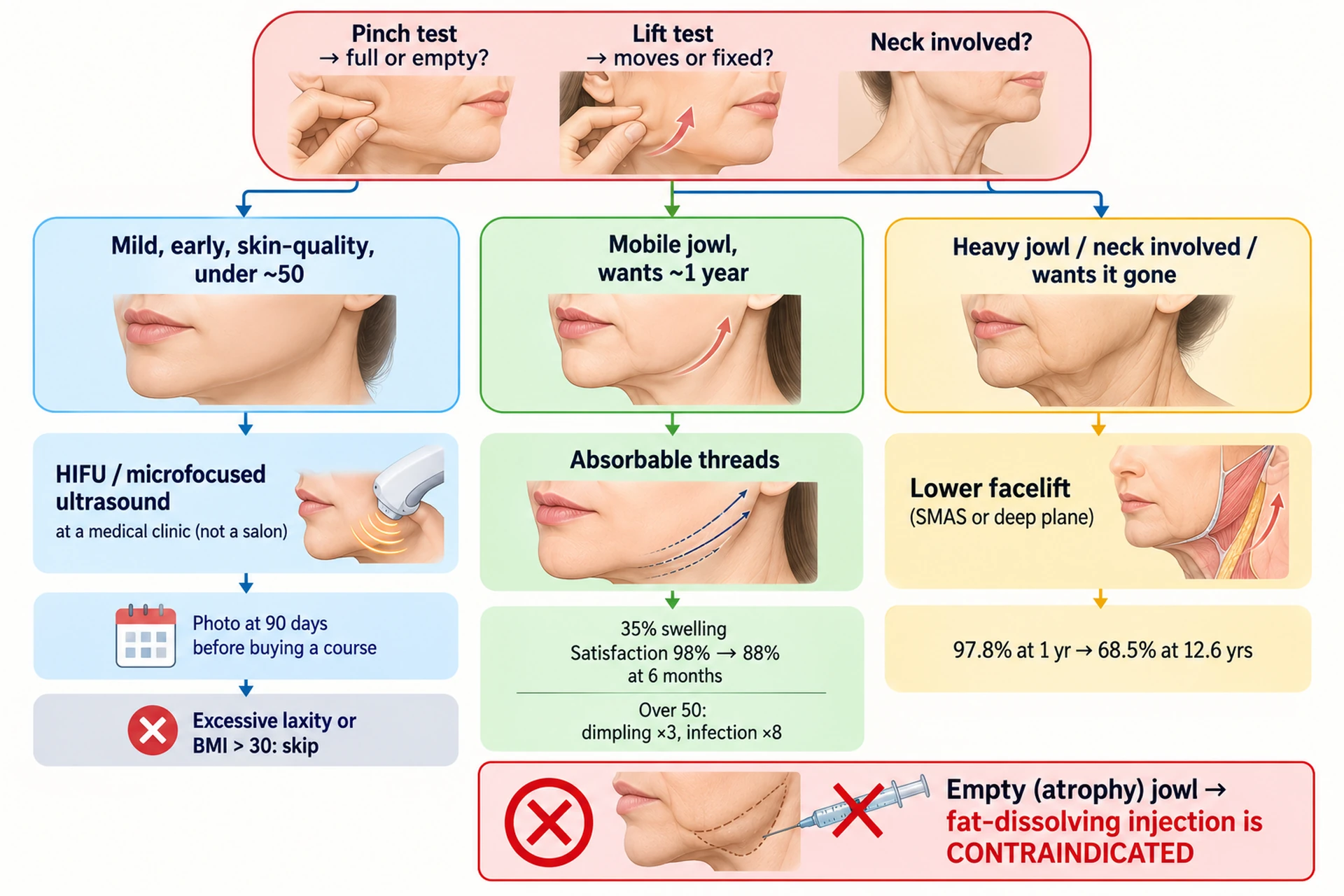
Our own version of that check takes two minutes. Stand side-on to a mirror. Pinch the jowl. A thick, soft pinch that feels like a pad is a full jowl; a thin pinch that is mostly skin is an empty one. Lift it. Put two fingers on the cheek in front of the ear and push upward and back a centimetre. If the jowl disappears and the jawline straightens, the tissue is mobile and a lifting procedure — threads or surgery — has something to work with. If it barely changes, the problem is more skin quality than position, and tightening or resurfacing is the conversation. Look at the neck. If there is loose skin or bands under the chin as well, the jowl is one part of a lower-face-and-neck problem, and treating it alone will look odd.
3. Energy devices: what “tightening” measures as
Microfocused ultrasound (Ultherapy and its peers) and HIFU are the same physical idea — focused ultrasound heating the deep dermis and the fibrous layer beneath it (Shonan's own Ultherapy page describes a double pass at 4.5 mm to the SMAS layer and 3.0 mm to the deep dermis) — and both are marketed in Japan as “lifting”. The trials measure something more modest.
A 2023 systematic review of microfocused ultrasound for facial tightening identified 693 studies and included 16, all of them in women. The objective results it could find were small: brow lifts of 0.47 to 1.7 mm, and submental reductions of 26 to 45 mm² on lateral photographs. Pooled investigator ratings at day 90 (n = 337) recorded 92% of patients as improved in tightening and/or wrinkles, continuing to one year; pooled patient ratings (n = 81) described the improvement as mild, rising from 42% at 90 days to 53% at 360 days. Treatment was moderately painful with transient redness, other adverse effects were rare at 2% (including numbness or hypersensitivity, bruising, mandibular burns and striations), and the review names excessive laxity and a BMI over 30 as relative contraindications, because results declined as either increased.
A 2020 meta-analysis of HIFU for the face and neck pooled 17 studies and 477 participants. On a five-point scale, the objective improvement score was 2.74 (95% CI 2.06–3.43) and the subjective satisfaction score 2.68 (95% CI 1.92–3.45); mean pain was 4.2 on a 0–10 scale. The authors call the effect moderate, note that long follow-up was not reported by most studies, and that no hyperpigmentation was reported.
Monopolar radiofrequency (the Thermage-type device; the 2004 abstract names only “a proprietary device”) has one small objective study worth knowing because it measured the jowl directly. Ten patients had one side of the face treated; at three months, the treated side's jowl showed a mean decrease of 22.6% in surface area on oblique photographs, with no change on the untreated side. Ten patients and three months is what it is; it is also one of the few trials that measured a jowl rather than a global impression.
| Modality | Evidence base | Effect | Caveat |
|---|---|---|---|
| Microfocused ultrasound | 16 studies, women only (2023 review) | 92% investigator-rated improved at day 90; patients rate it mild (42%→53%) | Relative contraindications: excessive laxity, BMI > 30. Adverse effects 2% |
| HIFU | 17 studies, 477 participants (2020 meta-analysis) | 2.74 / 5 objective, 2.68 / 5 subjective | Pain 4.2 / 10; long follow-up rarely reported |
| Monopolar radiofrequency | 10 patients, split-face, 3 months | Jowl surface area −22.6% | Tiny study; measured the jowl itself |
4. Threads: the honest numbers
Thread lifts are the treatment most often sold to the person who wants a jowl moved without surgery, and Japan's chains price them per thread from under ¥10,000. Two systematic reviews and a meta-analysis describe what you are buying.
The meta-analysis, from 2021, pooled 26 studies of facial thread lifting. Swelling occurred in 35%, skin dimpling in 10%, paraesthesia in 6%, thread visibility or palpability in 4%, infection in 2% and thread extrusion in 2%. Absorbable threads carried significantly lower risks of paraesthesia (3.1% vs 11.7%) and extrusion (1.6% vs 7.6%) than non-absorbable ones. Patients over 50 had significantly more dimpling (16% vs 5.6%) and infection (5.9% vs 0.7%) than younger patients. And the number that should be on every consent form: pooled satisfaction fell from 98% immediately after the procedure to 88% at six months, a significant drop, leading the authors to recommend that patients be told beforehand that the effect may not hold long-term.
A 2025 update reviewed the mid- and lower-face absorbable-thread literature from October 2018 to December 2022: 12 studies, 818 patients, mostly polydioxanone sutures followed by poly-L-lactic acid/polycaprolactone. Every scale used improved immediately after the procedure, complications were mild, and the longest follow-up in any study was two years; the authors' conclusion is that thread lifts are immediately effective, dangerous complications are rare, and long-term efficacy data are lacking. A separate 2021 safety review of 59 articles and 14,222 patients found the commonest recorded effects to be asymmetry, swelling and bruising, most of them transient, with the persistent problems being contour irregularities, injuries to vessels or glands, infections and inflammatory reactions.
| Complication | Pooled incidence | Modifier |
|---|---|---|
| Swelling | 35% | — |
| Skin dimpling | 10% | 16% over age 50 vs 5.6% younger |
| Paraesthesia | 6% | 3.1% absorbable vs 11.7% non-absorbable |
| Thread visible or palpable | 4% | — |
| Infection | 2% | 5.9% over age 50 vs 0.7% younger |
| Thread extrusion | 2% | 1.6% absorbable vs 7.6% non-absorbable |
| Satisfaction | 98% immediate → 88% at 6 months | — |
The reading we take from this: threads are a real, immediate, modest lift with a defined shelf life and a known dimpling-and-infection penalty over fifty. For a mobile jowl in someone under fifty who wants a year, absorbable threads are a coherent choice. For the person over fifty with a heavy jowl who wants it gone, they are a ¥100,000 way of finding out they need surgery. Our thread lift in Japan guide covers the thread types Japanese clinics use.
5. Surgery: the only thing that lasts, and its own honest numbers
The lower facelift is the treatment that actually repositions the tissue the anatomy says has slid, and the long-term data on it are unusually candid. A survey of patients who had a SMAS-platysma facelift from one surgeon between 1994 and 1999, contacted 10 to 15 years later, found that 97.8% had rated the improvement very good or beyond expectations at one year; after an average of 12.6 years, 68.5% still did, and the same proportion felt ten or more years had been added to their appearance. 31% reported disappointment with some aspect. The authors acknowledge recall bias on the one-year figure, and the sample is thin: of 394 original patients, 37% could be contacted at all, and 89 — 68% of those who agreed to take part — returned the survey. A follow-up analysis of the same survey found that patients under 50 at the time of surgery reported higher and longer-lasting satisfaction than older groups.
Two things temper the surgical numbers. A 2023 meta-analysis of early relapse after facelift found that relapse-related outcomes were reported in only 4.4% of the papers reviewed, with a weighted median rate of 2.4% in the first two years — the authors' point being that relapse is under-measured, not that it is rare. And in a 2025 series of 61 Asian patients undergoing a deep-plane facelift (mean age 52, mean follow-up 19 months), 98% reported being satisfied or highly satisfied, with complications of superficial epidermolysis behind the ears in 3%, hypertrophic scarring in 1.6% and temporary facial nerve weakness in 1.6% — a reminder that in experienced hands the complication rate is low but not zero. The marginal mandibular branch of the facial nerve runs close to the jowl, which is why lower-face surgery carries a nerve risk at all.
For a foreign patient the question is less whether a facelift works than whether to do one abroad. Our face lifting in Japan guide and how to choose a surgeon in Japan cover that; recovery hotels in Tokyo covers the two weeks after.
6. Doing this in Japan — what it costs
Jowl treatment in Japan is jiyu shinryo, private-pay, with published prices. The chain tier prices HIFU per shot count, threads per thread and surgery per named procedure, so the three tiers from the Direct Answer line up on one price list.
| Treatment | Price | What we checked |
|---|---|---|
| Chain HIFU, cheeks and under-chin | ¥25,000 (460 shots); a full-face “HIFU shower” at ¥19,800 (330 shots) | Shonan Beauty Clinic's lift-up menu, September 2026 |
| Ultherapy (microfocused ultrasound), cheeks and under-chin | ¥130,000; Ulthera Prime ¥140,000; add-ons for eyes and neck up to ¥220,000 | Shonan's Ultherapy page; it states the effect lasts about 6 months to a year |
| Thermage FLX, face or neck | ¥158,000 | Shonan's lift-up menu |
| Threads (chain), per thread | ¥9,600 (Prima Lift); ¥25,600 (Secret Lift); ¥29,600 (Tess Lift); ¥18,400 (VOV Lift) | Shonan's aging-care price list and lift-up menu; the number of threads is set per patient |
| Mini facelift (MACS-type) | ¥660,000 | Shonan's lift-up menu (“Natural Quick MACS Lift”) |
| SMAS face and neck lift | ¥1,200,000 | Shonan's lift-up menu |
| HIFU / Ultherapy / Thermage (all tiers) | ¥30,000–200,000 / ¥150,000–400,000 / ¥200,000–450,000 per session | Our March 2026 survey, pre-tax |
| Mini / SMAS facelift (all tiers) | ¥500,000–1,200,000 / ¥800,000–2,000,000 | Our March 2026 survey, pre-tax |
At roughly ¥157 to the dollar, chain HIFU is about $160, Ultherapy about $830, a six-thread session at the cheapest thread about $370, and the two surgical options about $4,200 and $7,600 — the surgery is where the Japan discount is largest against US or UK pricing, and where the case for travelling is strongest, provided you can stay for the recovery. Our HIFU in Tokyo guide covers the difference between branded Ultherapy and the unbranded HIFU that dominates Japanese menus, and how much plastic surgery costs in Japan puts the surgical tier in context.
7. What we would actually do, in order
This is our editorial sequence, built from the evidence above. It is not a protocol from any paper.
First, the two-minute check in section 2. Pinch, lift, look at the neck. Decide whether your jowl is full or empty, mobile or fixed, alone or part of a neck problem. That decides the tier.
Second, if it is early, mild and you are under fifty: one energy treatment, at a medical clinic, with a photograph at 90 days. HIFU or microfocused ultrasound if the skin is the issue; expect a mild improvement, not a lift, and do not buy a course until you have seen what one session did. A BMI over 30 or marked laxity are the review's own reasons not to bother.
Third, if the jowl is mobile and you want a visible change for about a year: absorbable threads, from an injector who will tell you the count and the type. Go in knowing the 35% swelling rate and the six-month satisfaction drop, and knowing that over fifty the dimpling rate roughly triples and the infection rate is about eight times higher.
Fourth, if the jowl is heavy, the neck is involved, or you have already done the above and want it gone: surgery, and a surgeon chosen for jowls and necks specifically. The long-term data are good and the honest disappointment rate is about a third; both are worth hearing before you book.
Never fat-dissolving injections into a jowl that is thin on the pinch test; the review that drew the ptosis-versus-atrophy line lists that as contraindicated.
If you are flying to Japan for this, HIFU and threads fit in a trip; a facelift needs two weeks minimum before you fly and a plan for follow-up at home. Our consultation guide covers what to expect in the room and cosmetic surgery in Tokyo the surgical clinics.
8. FAQ
Sources & Method
Every clinical claim here is sourced to a named, PubMed-indexed paper, and each PMID below was confirmed against the PubMed record by retrieving the abstract directly rather than quoting a secondary source; the figures in the text are taken from those abstracts as published. Japanese prices in section 6 are from the clinic's own published pages, accessed 26 September 2026, and from the ranges verified for our March 2026 Japan pricing survey; treat them as ranges, not quotes, and confirm with the clinic. The HIFU safety figures are from the Consumer Safety Investigation Commission's published report. The yen-to-dollar conversion uses roughly ¥157 to the dollar as of late September 2026. The three-neighbours table's “treatment logic” column, the pinch-lift-neck check and the “distinction that saves money” box in section 2 (including its under-fifty framing), the one-line description of how ultrasound devices work at the top of section 3, the marginal-mandibular-nerve note in section 5, the interpretation of the thread data at the end of section 4, the statement that the surgical tier is where the Japan discount is largest, the treatment sequence in section 7, the trip-timing advice, and the “about a year” planning figure for threads are our own editorial method and judgement, not findings from any single paper.
| Source | Used for |
|---|---|
| The Surgical Anatomy of the Jowl and the Mandibular Ligament Reassessed (PMID 36050569) Minelli et al., Aesthetic Plastic Surgery, 2023 · 49 cadaver heads · accessed 26 Sep 2026 | The subcutaneous-layer mechanism, the deep-plane-only mandibular ligament, and the lengthening-elastic-tissue explanation in the Direct Answer, section 1 and the FAQ |
| Surgical anatomy of the lower face: the premasseter space, the jowl, and the labiomandibular fold (PMID 18183455) Mendelson et al., Aesthetic Plastic Surgery, 2008 · 16 cadavers · accessed 26 Sep 2026 | The premasseter space, its roof's collagen loss with age, and the descent of buccal fat in section 1 and the FAQ |
| The fat compartments of the face: anatomy and clinical implications for cosmetic surgery (PMID 17519724) Rohrich et al., Plastic and Reconstructive Surgery, 2007 · 30 hemifacial dissections · accessed 26 Sep 2026 | Jowl fat as the most inferior compartment and the compartments-not-one-mass observation in section 1 and the FAQ |
| Management of Serious Adverse Events Following Deoxycholic Acid Injection for Submental and Jowl Fat Reduction (PMID 39247122) Shridharani et al., Aesthetic Surgery Journal Open Forum, 2024 · systematic review · accessed 26 Sep 2026 | The ptosis-versus-atrophy distinction and the contraindication of fat reduction for atrophy-type jowls in section 2 and section 7 |
| A Systematic Review of the Efficacy of Microfocused Ultrasound for Facial Skin Tightening (PMID 36674277) Contini et al., International Journal of Environmental Research and Public Health, 2023 · 16 studies · accessed 26 Sep 2026 | The 693 / 16 figures, the brow and submental measurements, the 92% IGAIS (n = 337) and 42%→53% SGAIS (n = 81) results, the 2% adverse-effect rate and its list, and the laxity and BMI > 30 contraindications in section 3 and the FAQ |
| Systematic review and meta-analysis of safety and efficacy of high-intensity focused ultrasound (HIFU) for face and neck rejuvenation (PMID 32026164) Ayatollahi et al., Lasers in Medical Science, 2020 · 17 studies, 477 participants · accessed 26 Sep 2026 | The 2.74 and 2.68 scores with their confidence intervals, the 4.2 pain score, and the no-hyperpigmentation and short-follow-up notes in section 3 and the FAQ |
| Objective changes in brow position, superior palpebral crease, peak angle of the eyebrow, and jowl surface area after volumetric radiofrequency treatments to half of the face (PMID 15171772) Nahm et al., Dermatologic Surgery, 2004 · 10 patients, split-face · accessed 26 Sep 2026 | The 22.6% jowl surface area decrease at three months in section 3 |
| A Meta-Analysis and Systematic Review of the Incidences of Complications Following Facial Thread-Lifting (PMID 33821308) Niu et al., Aesthetic Plastic Surgery, 2021 · 26 studies · accessed 26 Sep 2026 | All pooled complication rates, the absorbable-versus-non-absorbable and over-50 comparisons, and the 98%→88% satisfaction figures in section 4 and the FAQ |
| Update on Absorbable Facial Thread Lifts (PMID 39662017) Riopelle et al., Dermatologic Surgery, 2025 · systematic review, 12 studies, 818 patients · accessed 26 Sep 2026 | The thread materials, the immediate improvement on all scales, the two-year longest follow-up and the lack of long-term data in section 4 and the FAQ |
| Safety Profile of Thread Lifts on the Face and Neck: An Evidence-Based Systematic Review (PMID 34699439) Pham et al., Dermatologic Surgery, 2021 · 59 articles, 14,222 patients · accessed 26 Sep 2026 | The commonest recorded effects and the list of persistent problems in section 4 |
| The measure of face-lift patient satisfaction: the Owsley Facelift Satisfaction Survey with a long-term follow-up study (PMID 20224460) Friel et al., Plastic and Reconstructive Surgery, 2010 · 89 respondents, mean follow-up 12.6 years · accessed 26 Sep 2026 | The 97.8% one-year, 68.5% long-term, ten-years-added and 31% disappointment figures, the 37% contact rate, the 89-of-131 (68%) return rate and the recall-bias note in section 5 and the FAQ |
| Long-term results of face lift surgery: patient photographs compared with patient satisfaction ratings (PMID 22186515) Liu et al., Plastic and Reconstructive Surgery, 2012 · accessed 26 Sep 2026 | The finding that patients under 50 reported higher and longer-lasting satisfaction, in section 5 and the FAQ |
| A Systematic Review and Meta-Analysis of Early Relapse After Facelift (PMID 35534779) Kucukguven et al., Aesthetic Plastic Surgery, 2023 · accessed 26 Sep 2026 | The 4.4% reporting rate and 2.4% weighted median early-relapse figure in section 5 |
| Deep Plane Face Lift in Asian Patients (PMID 40183553) Wong et al., Plastic and Reconstructive Surgery, 2025 · 61 patients, mean follow-up 19 months · accessed 26 Sep 2026 | The 98% satisfaction and the 3% / 1.6% / 1.6% complication figures in section 5 |
| Source | Used for |
|---|---|
| Shonan Beauty Clinic — リフトアップ official menu page · accessed 26 Sep 2026 | HIFU ¥25,000 (460 shots) and ¥19,800 (330 shots), Ulthera ¥130,000, Thermage FLX ¥158,000, Prima Lift ¥9,600 per thread, MACS lift ¥660,000, SMAS face-and-neck lift ¥1,200,000 in section 6 and the FAQ |
| Shonan Beauty Clinic — ウルセラ official page · accessed 26 Sep 2026 | Ulthera ¥130,000 / Prime ¥140,000 and the ¥160,000–220,000 eye and neck add-on tiers, the stated 6-month-to-1-year duration, and the 4.5 mm / 3.0 mm double-pass description used in section 3, in section 6 |
| Shonan Beauty Clinic — 若返り・エイジングケアの費用・料金 official price list · accessed 26 Sep 2026 | Secret Lift ¥25,600, Tess Lift ¥29,600 and VOV Lift ¥18,400 per thread in section 6 |
| 消費者安全調査委員会 — エステサロン等でのHIFU(ハイフ)による事故 事故等原因調査報告書(2023年3月29日) Consumer Safety Investigation Commission, Consumer Affairs Agency · accessed 26 Sep 2026 | The 135 accident reports (November 2015–December 2022), the distribution across salons, self-service booths and clinics, the injury categories and the note on nerve and sensory injuries, the industry-body stance, and the absence of a unified ministry position at the time of the report, in section 3 and the FAQ |
| ClinicJapan — Japan Cosmetic Surgery Price List 2026 our March 2026 survey, updated quarterly | The all-tier ranges for HIFU, Ultherapy, Thermage and facelifts in section 6 and the FAQ |
| ClinicJapan editorial | The treatment-logic column of the three-neighbours table, the pinch-lift-neck check and the section 2 callout, the device-mechanism line, the nerve note in section 5, the reading of the thread data, the Japan-discount statement, the treatment sequence in section 7, the trip-timing advice, and the “about a year” thread figure. These are our judgement, not trial findings |
Related Guides
About this guide: ClinicJapan is editorially independent. Where a clinic named on this site is an advertising partner, that relationship is disclosed on the page where it appears; no clinic named above is a partner, and nobody paid to be included. Prices change and vary by clinic; confirm before booking. Energy-device, thread and surgical treatments are medical procedures requiring a qualified physician, and outcomes vary with anatomy and technique. Numbness, weakness or asymmetry of the mouth after any lower-face procedure should be assessed by the treating doctor promptly. Informational only; not medical advice, and not a substitute for consultation with a physician.