
1. What PDRN actually is
PDRN stands for polydeoxyribonucleotide: a mixture of DNA fragments with molecular weights between roughly 50 and 1,500 kDa, purified from the sperm DNA of salmon trout (Oncorhynchus mykiss) or chum salmon (Oncorhynchus keta). The purification process is designed to remove proteins and peptides that could provoke an immune reaction.
The proposed mechanism has two parts. PDRN engages the adenosine A2A receptor, which is where its anti-inflammatory and tissue-repair signalling is thought to originate. It also supplies nucleosides and nucleotides to what is called the salvage pathway — effectively handing cells pre-made building blocks rather than making them synthesise their own.
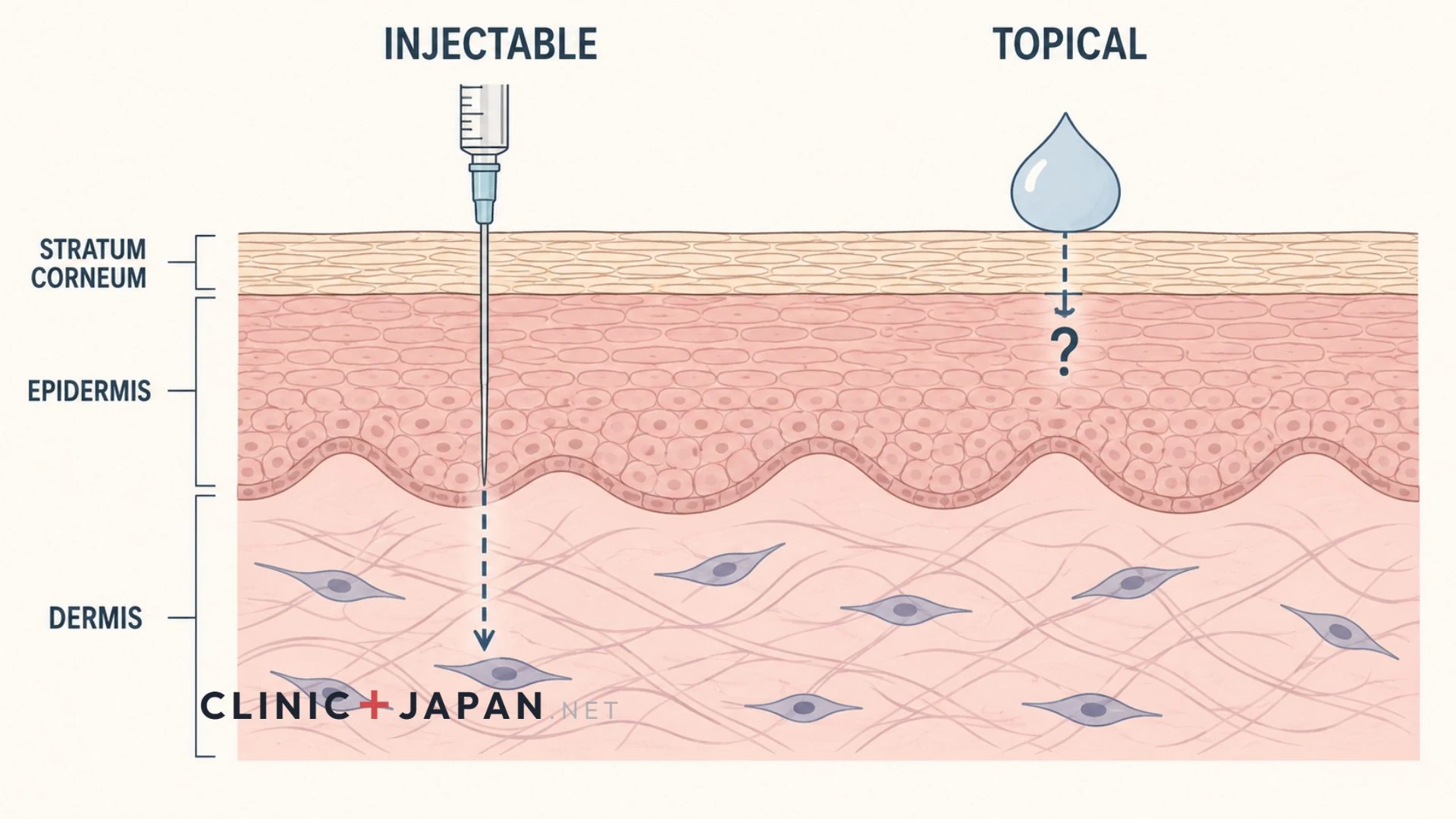
2. Topical and injectable are not the same product
This is the distinction the marketing collapses, and it is the whole article.
| Injectable PDRN / polynucleotides | Topical PDRN skincare | |
|---|---|---|
| What it is | A regulated drug in the markets where it is approved | A cosmetic ingredient in a serum, cream or mask |
| Delivery | Placed into the dermis directly | Applied to the stratum corneum and has to cross it |
| Evidence base | Published clinical trials, mostly wound healing | Thin. Mostly manufacturer studies and in-vitro work |
| Who administers | A physician | You, at your bathroom sink |
| Regulatory status | Varies sharply by country | Cosmetic in most markets |
3. What the evidence does and does not show
The foundational reference is a 2017 mini-review in Frontiers in Pharmacology by Squadrito and colleagues at the University of Messina. It remains the standard summary of PDRN's pharmacology — and reading it carefully is instructive, because it is a review of a drug, not of a serum.
For the injectable side, the useful reference is a systematic review by Lampridou and colleagues in the Journal of Cosmetic Dermatology. It found nine aesthetic studies covering 219 patients, published between 2014 and 2022, seven of them in Korea. Injections showed promising outcomes for wrinkles, texture and elasticity with statistically significant results in several studies — but the authors rated the evidence low to moderate quality, none of the studies achieved full marks on quality appraisal, and the variation in technique and outcome measures made meta-analysis impossible. That is a fair picture: real, encouraging, and not yet settled.
The topical picture changed in late 2025, and most English guides have not caught up. Two developments matter.
| Study | What it found | The catch |
|---|---|---|
| Peony PDRN Bak et al., IJMS, Dec 2025 | A low-molecular-weight PDRN from Paeonia lactiflora — a plant source, not salmon. Topical use cut transepidermal water loss in an SLS-damaged skin model over two weeks (n=10), and periorbital skin elasticity improved after four weeks | Small, single study, on a specific plant-derived low-MW material that is not what most products on the shelf contain. All six authors work for the company that makes it |
| PDRN-850K eye cream Ye et al., PLOS ONE, Jul 2026 | A randomised, double-blind, split-face trial of a 0.1% medium-length PDRN eye cream against an identically formulated 0.1% retinol cream over 28 days. Ultrasound showed roughly double the increase in dermal thickness and density versus retinol; crow's feet area fell about 20–23% against 6–7% for retinol. Penetration was separately assessed by confocal Raman spectroscopy | One 0.1% preparation capped at 850 kDa, in one eye cream, over 28 days, with the material supplied by a biotechnology company. Impressive design; narrow claim |
| Reasonably supported | Still not established |
|---|---|
| A2A receptor engagement as the mechanism | That an unspecified "PDRN serum" delivers enough to trigger it |
| Wound healing and anti-inflammatory effects when delivered into tissue | That injectable results transfer to any topical product |
| Injectable outcomes for wrinkles, texture and elasticity — at low to moderate evidence quality | Long-term topical outcomes; both topical trials ran four weeks |
| Two named topical preparations, in published human trials | That every product labelled "PDRN" contains a comparable material |
4. How to read a PDRN label without being fooled
"PDRN" on a box is not a regulated cosmetic claim in most markets, which means the word alone tells you very little — and the 2025–26 trials made that sharper, not softer, because they attached their results to specific materials rather than to the ingredient category. Five questions narrow it down.
| Ask | What a good answer looks like |
|---|---|
| Is it PDRN or PN? | Polynucleotide (PN) is a related but distinct, generally longer-chain material. Brands use the terms loosely; a clear answer signals a serious formulator |
| What concentration? | A stated percentage. "Contains PDRN" with no figure could mean a trace inclusion added for the ingredient list |
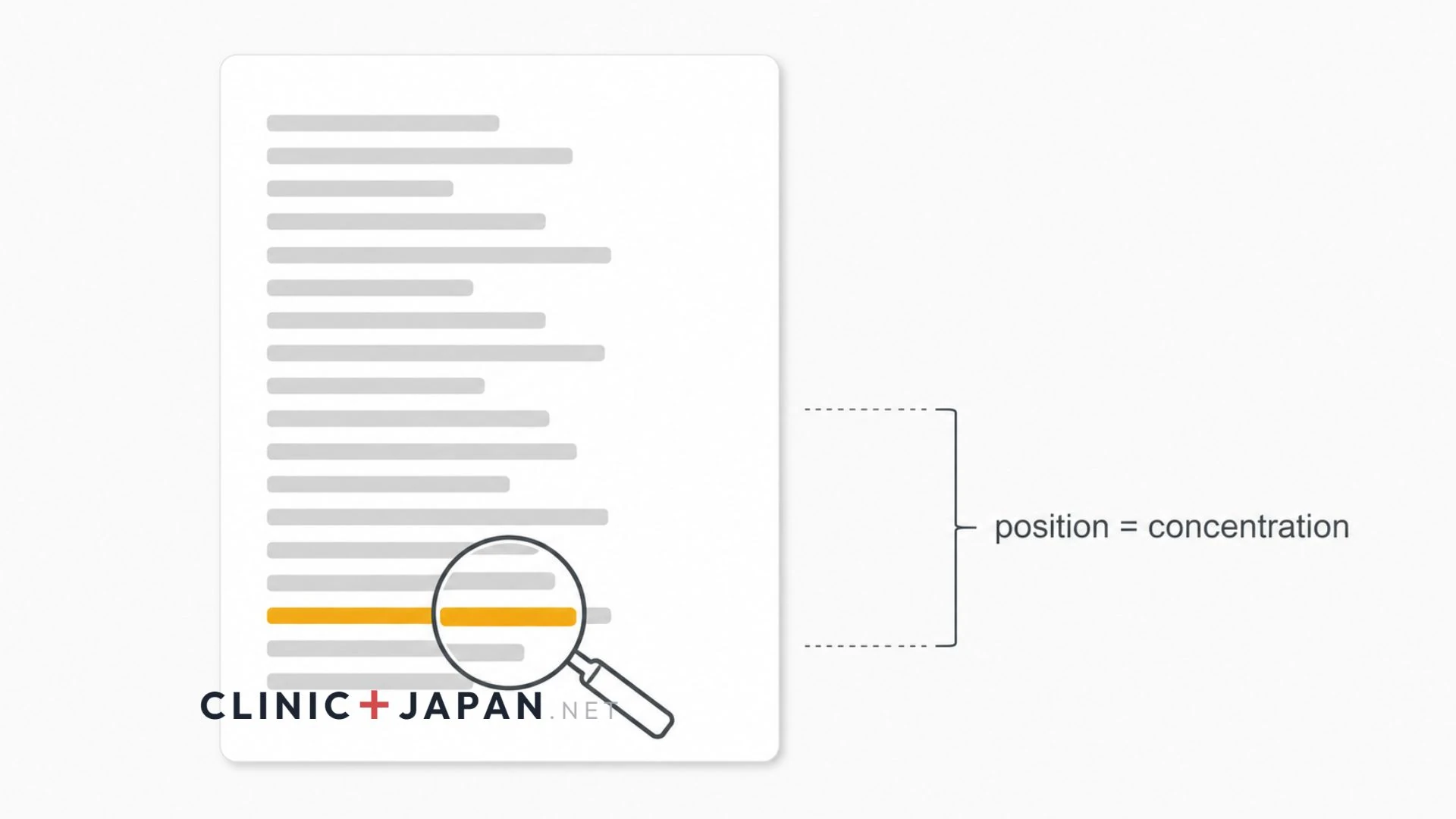
| Where does it sit in the INCI list? | Near the end means very little is present. This is the check nobody does and it is the most informative one |
| What molecular weight? | The single most useful question in 2026. The preparations with published topical human data are a low-MW plant-derived PDRN and a medium-length one capped at 850 kDa. A brand that cannot state a molecular weight cannot claim that evidence |
| Salmon or plant? | Not a quality ranking — a different material. Plant-derived low-MW PDRN is where the first topical clinical data came from, and it is a genuinely separate category from standard salmon PDRN |
| What is the delivery claim? | Any serious formulation will say something about how it addresses the size problem. Silence on this is the answer |
The market context matters too. PDRN reached global attention through Korean dermatology, where injectable use is widespread, and the topical category grew in that slipstream. That is a marketing lineage, not evidence transfer — the serum did not inherit the injectable's trial data by association.
5. The Japan angle: why this is a clinic conversation here
Japan regulates cosmetics, quasi-drugs and pharmaceuticals as three separate tiers, and a topical sold as a cosmetic cannot make a therapeutic claim. That framework is the reason a Japanese drugstore shelf looks conservative next to the claims you see on imported PDRN serums online — not because the ingredient is unavailable, but because the claim would not be permitted on a cosmetic.
Meanwhile the injectable side of regenerative aesthetics is well established in Japanese clinics under private-pay (jiyu shinryo) practice, where consultations are long and the doctor is paid for time rather than a reimbursed procedure code. Our guides to Rejuran and skin boosters in Japan cover that category with prices; Profhilo is the adjacent hyaluronic-acid version.
| Situation | Reasonable move |
|---|---|
| Curious, low budget, no urgency | A topical is a low-risk experiment. Judge it on comfort and barrier feel, not on promised regeneration |
| Post-procedure recovery | Ask the clinic that did the procedure. Do not self-prescribe a serum onto healing skin |
| You want the effect the studies describe | That is the injectable, and it is a physician conversation — not a shopping one |
| Sensitive or reactive skin | PDRN's anti-inflammatory framing is not a hypoallergenic guarantee. Patch test |
6. Our position
PDRN is a real molecule with real pharmacology and a genuine clinical literature behind it. None of that is hype. And as of 2026, topical PDRN is no longer an evidence-free category either — two named preparations have published human data, and one of them measured penetration rather than assuming it.
What remains hype is the transfer. A 0.1% medium-length PDRN in one eye cream, tested over 28 days, does not tell you what an unspecified salmon-derived serum does. The evidence attaches to a molecular weight, a source, a concentration and a formula — not to a four-letter ingredient name on a box. That distinction is the entire consumer problem, and it is the one the category's marketing is least interested in making.
So: a topical PDRN product is a reasonable thing to try, and more reasonable than it was a year ago. Ask which preparation, at what molecular weight and concentration. If the brand cannot answer, it is selling you the name.
7. What PDRN is competing against
The most useful context for any new ingredient is what it would replace, and the July 2026 trial made this unusually concrete by choosing retinol as its comparator rather than a placebo.
That was a deliberately hard test. Retinol has decades of published evidence for photoaging and is the reference topical active in dermatology — and a 0.1% medium-length PDRN eye cream outperformed an identically formulated 0.1% retinol cream on dermal thickness and crow's feet over 28 days. Taken at face value, that is a meaningful result.
| Point in PDRN's favour | Point against reading too much into it |
|---|---|
| Comparator was an active with real evidence, not a placebo | 28 days is short for retinol, which is generally assessed over months |
| Identical formulation on both sides — a clean comparison | 0.1% is a modest retinol concentration; higher-strength products exist |
| Penetration measured rather than assumed | One preparation, one formula, one trial, industry-supplied material |
| Tolerability reported as favourable in sensitive skin | Retinol's known irritation profile is exactly what a 28-day window highlights |
Where the money is better spent
Whatever the ingredient debate resolves to, the ranking of what actually affects skin over years is not seriously contested, and it is worth stating because it puts a ¥10,000 serum in perspective.
| Priority | Why it outranks a novel active |
|---|---|
| 1. Daily sunscreen | The single largest modifiable factor in visible skin ageing. Nothing in a serum competes — see Anessa, Skin Aqua, Biore UV |
| 2. A retinoid, if tolerated | The deepest evidence base of any topical anti-ageing active |
| 3. Barrier support | Unglamorous, cheap, and the thing most damaged skin actually needs |
| 4. Everything else, including PDRN | Worth exploring once the first three are in place. Not a substitute for any of them |
For structural change rather than surface support, the honest answer remains the clinic. Our guides to Rejuran, skin boosters and laser treatment in Japan cover what those procedures do and cost — and Japanese private-pay pricing makes several of them cheaper than a year of premium serums.
8. FAQ
Sources & Method
PDRN's definition, molecular weight range, source species, purification and proposed A2A-receptor mechanism are taken from the peer-reviewed pharmacology literature cited below, not from brand material. This page was substantially revised in August 2026: it previously described topical PDRN as lacking human clinical evidence, which two studies published between December 2025 and July 2026 changed for two specific preparations. We report both, including their funding relationships and their limits, and we link the 2022 corrigendum alongside the 2017 review so the conflict-of-interest correction is visible. We deliberately do not name, rank or price individual PDRN serums: the category is unstandardised and naming products would imply a comparison we have not run. The label-checking framework, the topical-vs-injectable table and our closing position are editorial judgement.
| Source | Used for |
|---|---|
| Pharmacological Activity and Clinical Use of PDRN (PMID 28491036) Squadrito et al., Frontiers in Pharmacology, 2017 · peer-reviewed mini-review · accessed 8 Aug 2026 | The 50–1,500 kDa range, the Oncorhynchus mykiss and Oncorhynchus keta source species, the purification removing immunogenic proteins and peptides, the A2A receptor mechanism, the salvage pathway, and the diabetic foot ulcer indication |
| Corrigendum: Pharmacological activity and clinical use of PDRN Squadrito et al., Frontiers in Pharmacology, 2022 · correction notice · accessed 8 Aug 2026 | The corrected conflict-of-interest statement and omitted patent disclaimers referenced in section 3, including the disclosed research support from a PDRN manufacturer |
| Applications of Marine Organism-Derived Polydeoxyribonucleotide: Its Potential in Biomedical Engineering Kim et al., Marine Drugs, 2021 · peer-reviewed review · accessed 8 Aug 2026 | Corroboration of the molecular weight range and source, and the framing of PDRN's established indications as wound healing and inflammation |
| The Effectiveness of Polynucleotides in Esthetic Medicine: A Systematic Review (PMID 39645667) Lampridou et al., Journal of Cosmetic Dermatology, 2025 · systematic review · n=219 · accessed 8 Aug 2026 | The nine studies covering 219 patients in section 3, the 2014–2022 publication window, seven of nine being Korean, the low-to-moderate quality rating, and the note that variation precluded meta-analysis |
| Anti-Aging Efficacy of Low-Molecular-Weight Polydeoxyribonucleotide Derived from Paeonia lactiflora Bak et al., International Journal of Molecular Sciences, December 2025 · peer-reviewed · industry-authored · accessed 8 Aug 2026 | The first topical human data cited in section 3 — reduced transepidermal water loss in an SLS-damaged model over two weeks (n=10) and improved periorbital elasticity at four weeks. All listed authors are affiliated with the company developing the ingredient, which we flag in the same section |
| Topical medium-length PDRN enhances dermal extracellular matrix repair in photodamaged skin (PLOS ONE 21(7): e0350905) Ye et al., PLOS ONE, July 2026 · randomised double-blind split-face · accessed 8 Aug 2026 | The 0.1% PDRN-850K vs 0.1% retinol split-face comparison over 28 days, the roughly two-fold dermal thickness and density differences on high-frequency ultrasound, the crow's feet figures (≈20–23% vs 6–7%), and the confocal Raman penetration assessment. Material supplied by a biotechnology company, which we flag |
| Source | Used for |
|---|---|
| Cosmetics and quasi-drugs policy pages Ministry of Health, Labour and Welfare (Japan) · primary · accessed 8 Aug 2026 | Japan's three-tier cosmetic / quasi-drug / pharmaceutical structure in section 5, and the principle that a cosmetic cannot carry a therapeutic claim |
| Source | Used for |
|---|---|
| The molecular-size objection, and its current limits ClinicJapan Research Team · Reasoning from published properties, updated August 2026 | Section 2. The barrier argument follows from PDRN's documented molecular weight. We no longer state that no penetration data exists — the PLOS ONE study assessed delivery by confocal Raman spectroscopy for one 850 kDa preparation. We have not found equivalent penetration data for standard salmon-derived PDRN in an ordinary serum, which is the case the objection still applies to |
| Why we updated this page Editorial note · Revision log · August 2026 | This guide originally described topical PDRN as lacking human evidence. Two studies published between December 2025 and July 2026 changed that for two specific preparations, and sections 2, 3 and 6 were rewritten accordingly. Our position on the transfer problem — that evidence attaches to a material, not to an ingredient name — is unchanged |
| The retinol comparison and the priority ranking ClinicJapan Research Team · Editorial framing of a cited trial · priority order is our own | Section 7. The comparison figures come from the PLOS ONE study cited above; the fair-reading table and the four-step priority order are our editorial position. That sunscreen is the largest modifiable factor in photoageing is general dermatological consensus rather than a finding from any paper cited here |
| Label-checking framework ClinicJapan Research Team · Editorial method | Section 4 in full. The four questions are our own consumer heuristic, not an industry standard |
| No products named or ranked Editorial note · Transparency item | Throughout. We take no commission from any PDRN brand and deliberately name none — the category is unstandardised and a product list would imply testing we have not done |
| Our closing position ClinicJapan Research Team · Editorial opinion | Section 6. Reasonable practitioners disagree about topical PDRN; this is our reading of the current public evidence, not a settled consensus |
Related Guides
About this guide: This is an independent guide. We receive no commission from any PDRN brand, clinic, or retailer, and nobody paid to be included. PDRN's regulatory status differs sharply between countries and changes over time — confirm locally. Injectable treatments are medical procedures requiring a qualified physician. Informational only; not medical advice, and not a substitute for consultation with a doctor.