1. Prices — and the gap between list and shelf
Skin Aqua is Rohto's sun-care line and sits at the value end of the Japanese drugstore aisle. Below are Rohto's own tax-inclusive list prices.
| Product | Size | List price |
|---|---|---|
| Tone Up UV Essence (all shades) | 70 g | ¥1,210 |
| Super Moisture Gel | 110 g | ¥1,155 |
| Super Moisture Gel, pump | 140 g | ¥1,375 |
| Super Moisture Barrier UV Essence | 70 g | ¥1,265 |
| Super Moisture Barrier UV Gel | 100 g | ¥1,265 |
| Hyaluron Serum UV | 70 g | ¥1,320 |
2. The Tone Up range is the reason this brand is famous
Skin Aqua's breakout product is the Tone Up UV Essence, and understanding it means understanding that it is doing two jobs. It is an SPF50+ / PA++++ sunscreen, and it is a colour-correcting base — the tinted shades are makeup, and Rohto labels the tone-up effect as a makeup effect rather than a skin change.
| Shade | Corrects for |
|---|---|
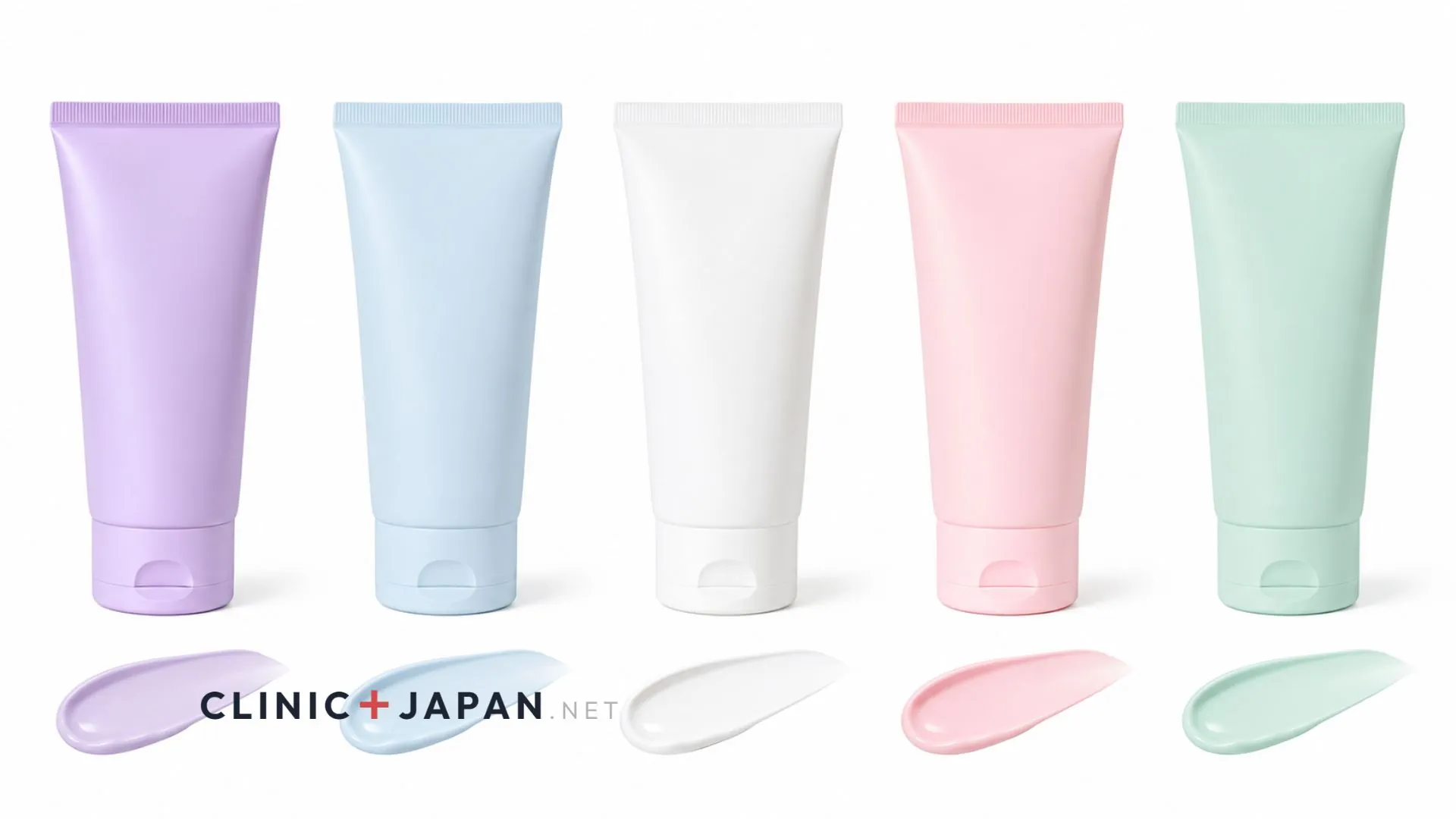
| Lavender | The default. Blue plus pink for general clarity — the one to buy if unsure |
| Blue | Cancels redness and flush. The strongest paling effect |
| White | Brightening without a colour cast |
| Pink | Adds warmth to sallow or tired-looking skin |
| Mint Green | Neutralises redness, gentler than blue |
| Latte Beige | A limited shade aimed at deeper skin tones |
3. SPF50+ PA++++ — what the label means
Every product above carries SPF50+ / PA++++, which is the ceiling on both Japanese scales. This confuses visitors comparing against SPF 60 or SPF 100 bottles at home, and the answer is regulatory rather than chemical.
| Mark | What it tells you |
|---|---|
| SPF50+ | UVB protection. Japan caps the printed claim here regardless of measured value, so a "50+" product may test well above it |
| PA++++ | UVA protection on Japan's four-level graded scale — the top grade. The US has no graded equivalent, only a Broad Spectrum pass or fail |
| What it does not tell you | Texture, water resistance, whether it suits your skin, or whether you will actually apply enough |
The comparison across markets is covered in more depth in our Shiseido sunscreen guide, which sets out why a Japanese SPF50+ PA++++ product is not weaker than a US SPF 60+ one.
4. Skin Aqua vs the rest of the Japanese aisle
Japan's drugstore sunscreen shelf is one of the most competitive retail categories on earth, and the three names an English-speaking visitor will recognise sit at genuinely different points.
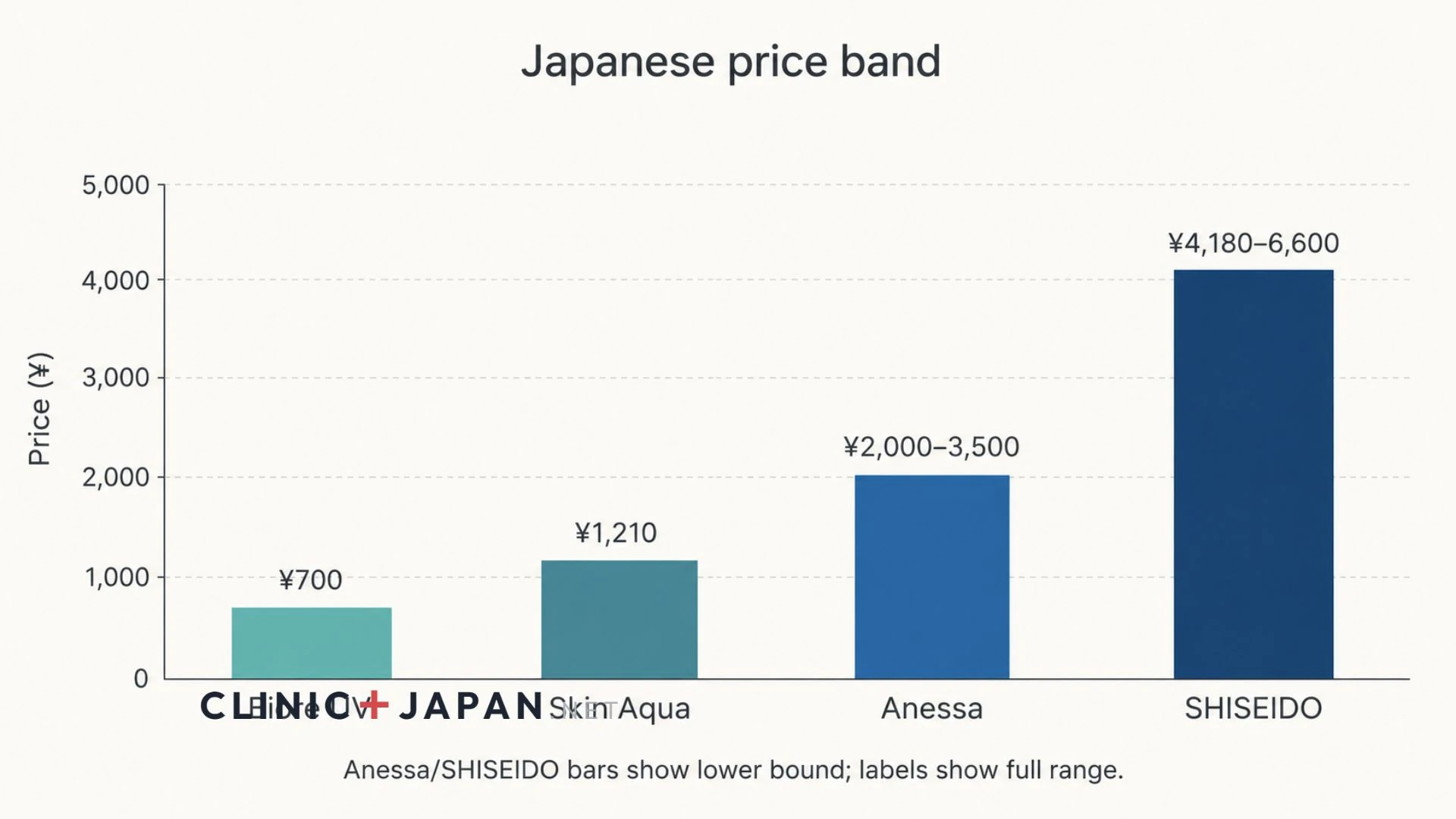
| Brand | Rough band | Buy it for |
|---|---|---|
| Biore UV | From around ¥700 | The cheapest credible daily sunscreen. Watery textures |
| Skin Aqua | ¥1,155–1,320 list, often far less | Tone-up and colour correction. Doubles as a makeup base |
| Anessa | Roughly ¥2,000–3,500 | High water resistance. The one for beaches and sweat |
| SHISEIDO house brand | ¥4,180–6,600 | Department store counter. The clear stick format |
Full comparisons are in our Biore UV and Anessa guides.
5. Buying it in Japan
| Where | Notes |
|---|---|
| Drugstore chains | Universal. Sunscreen is a loss-leader category in summer — discounts are the norm, not the exception |
| Don Quijote | Usually the lowest price. Multi-buys common |
| Convenience stores | Small sizes at poor value. Emergency only |
| Airport duty-free | Rarely stocks the value brands, and rarely worth it if it does |
Two practical points. Shade availability rotates — limited colours appear and disappear each season, so if you love a specific one, buy it when you see it. And sunscreens degrade with heat, so the tube that spent a summer in a car door is not the one to trust. Tax-free needs your passport and a per-store minimum spend, so consolidate cosmetics into one shop.
6. The verdict
Skin Aqua earns its shelf space for one specific reason: it is a competent SPF50+ PA++++ sunscreen that also works as a colour-correcting base, at a street price that is often under ¥700. If you want one product to do sun protection and makeup priming, this is the category leader and there is no serious argument against it.
Buy something else if you need real water resistance for swimming or heavy sweat — that is Anessa's job — or if your skin tone sits outside the range the tinted shades were formulated for, in which case the untinted products in the same line do the sun protection without the cast.
7. How to apply a tinted sunscreen without streaks
Tinted sunscreen is harder to apply well than clear sunscreen, and most complaints about tone-up products — patchiness, a visible jawline, uneven colour — are application problems rather than formula problems. Five rules fix nearly all of them.
| Rule | Why |
|---|---|
| 1. Shake the tube first | Pigment settles in a fluid base. An unshaken tube dispenses inconsistent colour from one press to the next |
| 2. Work in sections | Forehead, then each cheek, then nose and chin — blending each before moving on. Dotting the whole face and then blending is how streaks happen |
| 3. Build in thin layers | Two thin passes beat one thick one for both colour evenness and actual UV coverage. You can add; you cannot subtract |
| 4. Carry it past the jawline | Stopping at the jaw leaves a line of demarcation — the mask effect. Blend down onto the neck |
| 5. Give it a minute before makeup | Foundation applied onto a wet tinted layer drags and pills |
That tension is the honest structural problem with the whole tone-up category, and it is why we would steer anyone who is genuinely worried about UV toward the untinted products. The tinted ones are a cosmetic convenience that happens to carry SPF, not the other way round.
| Situation | Realistic approach |
|---|---|
| Office day, minimal outdoor time | Morning application is broadly adequate. Do not overthink it |
| Sightseeing, hours outdoors | Reapplication matters more than the SPF number. A powder or stick over makeup is the practical route |
| Sweating or swimming | This is not the product. Water-resistant formulas exist for a reason — see Anessa |
| Over makeup | Reapplying a tinted liquid over foundation does not work. Switch formats for the top-up |
Japanese summer humidity is a genuine factor here that guides written for temperate climates skip. A sunscreen that behaves perfectly in a dry spring will slide in August, and that is the season most visitors experience — our guide to when to visit Japan covers what each month actually feels like.
8. FAQ
Sources & Method
List prices are Rohto's own tax-inclusive prices from its Japanese online store, checked on 8 August 2026. The under-¥700 street figure is a lowest tracked price on a Japanese price-comparison site rather than a price we observed in a shop — we cite it to show the size of the list-to-shelf gap, not as a price you will be charged. Shade composition and the makeup-effect labelling are Rohto's own. Competitor price bands are carried over from our Biore, Anessa and Shiseido guides and were not re-surveyed here. The shade recommendations, the cast warning and the verdict are our own editorial position.
| Source | Used for |
|---|---|
| Skin Aqua product list (Japanese online store) ROHTO Pharmaceutical Co., Ltd. · primary · accessed 8 Aug 2026 | Every list price in section 1, plus sizes and the composition of the range |
| Tone Up UV series product pages ROHTO Pharmaceutical Co., Ltd. · primary · accessed 8 Aug 2026 | Shade line-up and colour-correction descriptions in section 2, the SPF50+ / PA++++ rating, and Rohto's own labelling of the tone-up effect as a makeup effect |
| ROHTO Pharmaceutical product information site ROHTO Pharmaceutical Co., Ltd. · primary · accessed 8 Aug 2026 | Brand positioning and range structure |
| Source | Used for |
|---|---|
| Skin Aqua Tone Up UV Essence price comparison Kakaku.com · aggregator · lowest tracked price · accessed 8 Aug 2026 | The under-¥700 street figure in section 1 and the FAQ. This is a tracked lowest listing, not a price we verified in a physical shop |
| Source | Used for |
|---|---|
| The white-cast warning ClinicJapan Research Team · Our own assessment, not a manufacturer statement | Sections 2 and 6 and the FAQ. Rohto makes no claim about performance across skin tones. The observation that paler-direction tinting can read ashy on medium and deeper skin is our editorial reading, and it is consistent with widely reported user experience across review sites — but it is not a manufacturer statement or a measured test |
| Competitor price bands ClinicJapan Research Team · Carried over from our other guides, not re-surveyed | Section 4. Sourcing for the Biore, Anessa and Shiseido figures is on their respective pages |
| The application-density argument ClinicJapan Research Team · General sun-protection science | Section 4. The conclusion that a cheaper sunscreen applied generously beats an expensive one rationed is our editorial reasoning from the known gap between tested and real-world application |
| Shade recommendations ClinicJapan Research Team · Editorial opinion | Section 2. Which shade suits which concern is our reading of the colour theory, not a Rohto recommendation |
| Application method ClinicJapan Research Team · Editorial method | Section 7 in full. The five rules are our own synthesis of how tinted fluid sunscreens behave; Rohto publishes usage directions but not this framework |
Related Guides
About this guide: This is an independent guide. We receive no commission from Rohto, any retailer, or any brand named or linked above, and nobody paid to be included. Prices, shades and formulations change constantly in this category — confirm before buying. Sunscreen selection for a diagnosed skin condition or photosensitivity is a question for a dermatologist. Informational only; not medical advice.