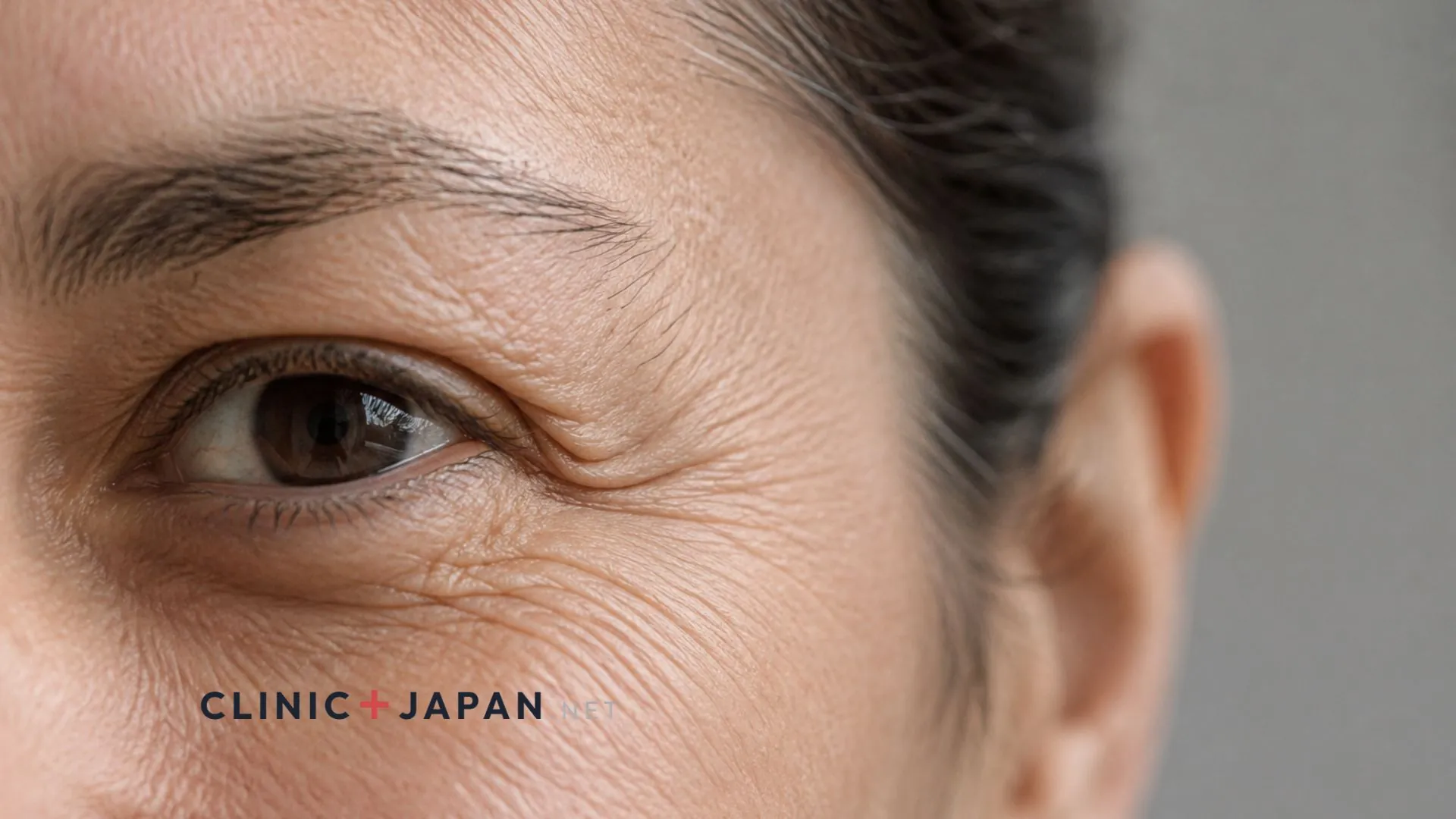
1. What crow's feet actually are
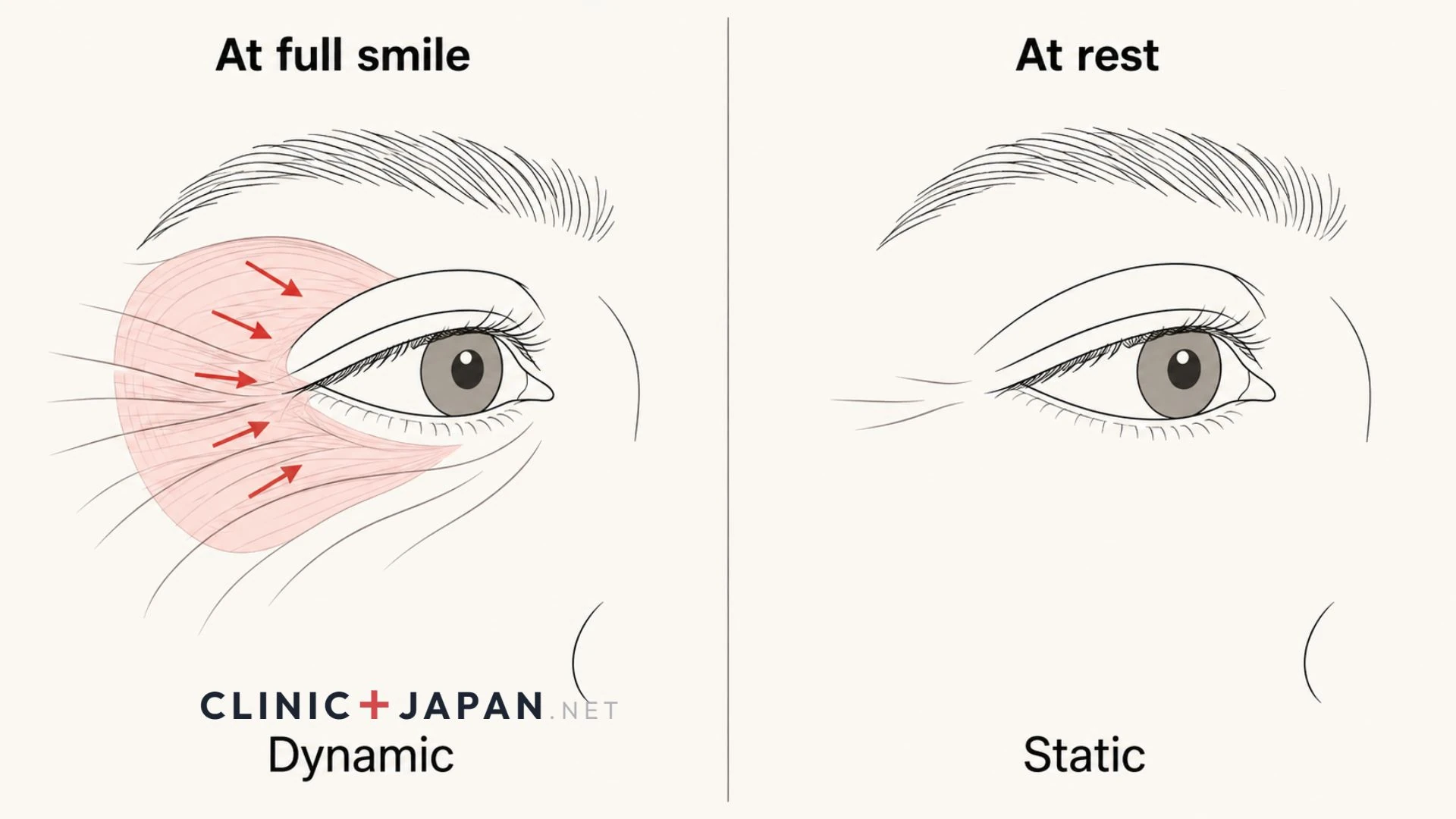
The lines fanning out from the outer corner of the eye have a clinical name — lateral canthal lines — and a single mechanical cause. The orbicularis oculi is a ring of muscle around the eye socket, and every time you smile, squint or laugh, its outer fibres pull the skin into folds perpendicular to the direction of pull. Do that a few hundred thousand times against skin that is thin to begin with and progressively loses elastin, and the fold stops unfolding.
| Dynamic lines | Static lines | |
|---|---|---|
| When you see them | Only at maximum smile | At rest, in a neutral expression |
| What is causing them | Muscle contraction folding the skin | Structural change in the dermis after years of folding, plus photoageing |
| What responds | Botulinum toxin, well and predictably | Resurfacing, retinoids, sun protection — toxin only partially |
| Realistic outcome | Near-complete softening for months at a time | Gradual improvement over months, never a reset |
2. The evidence gap nobody mentions
Botulinum toxin type A is the most-studied cosmetic intervention in existence, and the Cochrane review of it for facial wrinkles — 65 randomised trials, 14,919 participants — is as good a summary as the field has. Read its breakdown of which region was actually treated, though, and something worth knowing emerges.
The Cochrane authors' own conclusion is deliberately plain: toxin reduces wrinkles within four weeks of treatment, and probably increases the risk of eyelid ptosis. They also flag what is missing from the whole literature — evidence on multiple treatment cycles, on the frequency of major adverse events, and on duration of effect. Anyone telling you a confident number for how long your third round will last is going beyond what has been published.
3. Dose and duration: what the crow's-feet trials actually found
The good news is that this is one area where the specific studies exist and are unusually clear.
Dose. A double-blind, randomised, placebo-controlled dose-response study compared 3, 6, 12 and 18 units per side against placebo. Every dose beat placebo, higher doses lasted longer and worked harder — but 18 units did not clearly separate from 12, and the authors concluded that 12 units per side is the appropriate dose. That is a useful benchmark to hold when a clinic quotes you a unit count.
Duration. Two multicentre randomised trials followed responders who received 24 units in the crow's feet area. Median duration of response was 125 to 148 days for dynamic lines and static lines in the longer trial, and 119 to 121 days in the second. In other words: four to five months, not three. The three-month figure that circulates online is closer to the glabella experience than to the published crow's-feet data.
| Question | What the published data says | Source strength |
|---|---|---|
| How many units per side? | 12 units, per a dose-response RCT that tested four doses; 18 units gave no clear additional benefit | Single dedicated dose-ranging trial |
| How long does it last? | Median 119–148 days across two multicentre RCTs of 24-unit treatment — four months or more | Two RCTs, 833 treated subjects |
| Does treating the whole upper face last longer? | A meta-analysis of 14 RCTs covering 8,369 subjects found the approved 64-unit cumulative dose across glabella, crow's feet and forehead took a median 182 days to return to non-responder status | Meta-analysis with trial sequential analysis |
| Does it work on static lines too? | Partially. The duration trials report static-line outcomes separately, and they are real but weaker than the dynamic-line results | Same two RCTs |
4. Safety, and one finding that matters in Asia
The largest controlled safety analysis of onabotulinumtoxinA for facial lines pooled individual patient data from 1,678 participants across nine studies — six randomised, double-blind and placebo-controlled, three open-label. Two of the double-blind studies were specifically for lateral canthal lines at 3 to 18 units per side.
| Finding | Detail |
|---|---|
| Overall adverse event rate | Did not differ significantly between toxin and placebo in the double-blind studies |
| Eyelid sensory disorder | 2.5% vs 0.3% for placebo — described by participants as tightness, pressure, heaviness or a feeling of droopiness. Present only in the glabellar studies |
| Eyelid ptosis | 1.8% vs 0% — again, only in the glabellar studies |
| Treatment-related events overall | 24% vs 16% for placebo |
| Across repeat cycles | Incidence of all three of those events fell significantly as the number of treatment cycles increased |
| Ethnicity | The cohort was 52% Asian and 43% non-Hispanic white. Eyelid sensory disorder and eyelid oedema were more common in Asian participants |
Two things follow from that. The ptosis risk that dominates every consent form is a glabellar phenomenon in this dataset, not a crow's-feet one — which is reassuring if crow's feet are all you are treating, and relevant if you are treating both. And the ethnicity finding is worth raising with a Japanese injector directly: eyelid heaviness and oedema were reported more often in Asian participants, so if you have a lid anatomy that already sits heavy, say so at the consultation rather than after.
5. The static half of the problem
Toxin will not resurface skin. For the lines that are visible at rest, the interventions are the ones that change the dermis, and they work on a scale of months.
| Option | What the evidence looks like | Honest expectation |
|---|---|---|
| Topical tretinoin | A systematic review of randomised controlled trials of tretinoin for photoageing is the reference point — the best-evidenced topical in dermatology | Slow, cumulative, irritating at the start. The eyelid area needs the lowest strength and the shortest contact time |
| Non-ablative fractional laser | Multiple randomised periorbital trials exist, including split-face and comparative designs against focused ultrasound | Several sessions, real texture improvement, some downtime. Sun protection is not optional afterwards |
| Sun protection | The intervention with the largest effect on the rate at which new static lines form, and the least interesting to sell | Prevention, not correction. Start now regardless of what else you do |
| Filler in the crow's feet themselves | Not a mainstream indication — the skin here is too thin and the area too mobile | Be sceptical of an offer to fill this specific area |
The sequencing that makes sense: toxin first, because it removes the folding force and lets everything else work on a surface that is not being creased forty times an hour. Resurfacing second, once you can see what remains at rest.
6. Crow's feet treatment in Japan
Japan has a regulatory quirk worth understanding before you compare prices. The Ministry of Health, Labour and Welfare has approved exactly one botulinum toxin product for cosmetic use — Allergan's Botox Vista. Korean-made toxins are widely used in Japanese clinics and are not MHLW-approved for this indication, which is legal under private-pay practice but is the entire explanation for the price spread you will see.
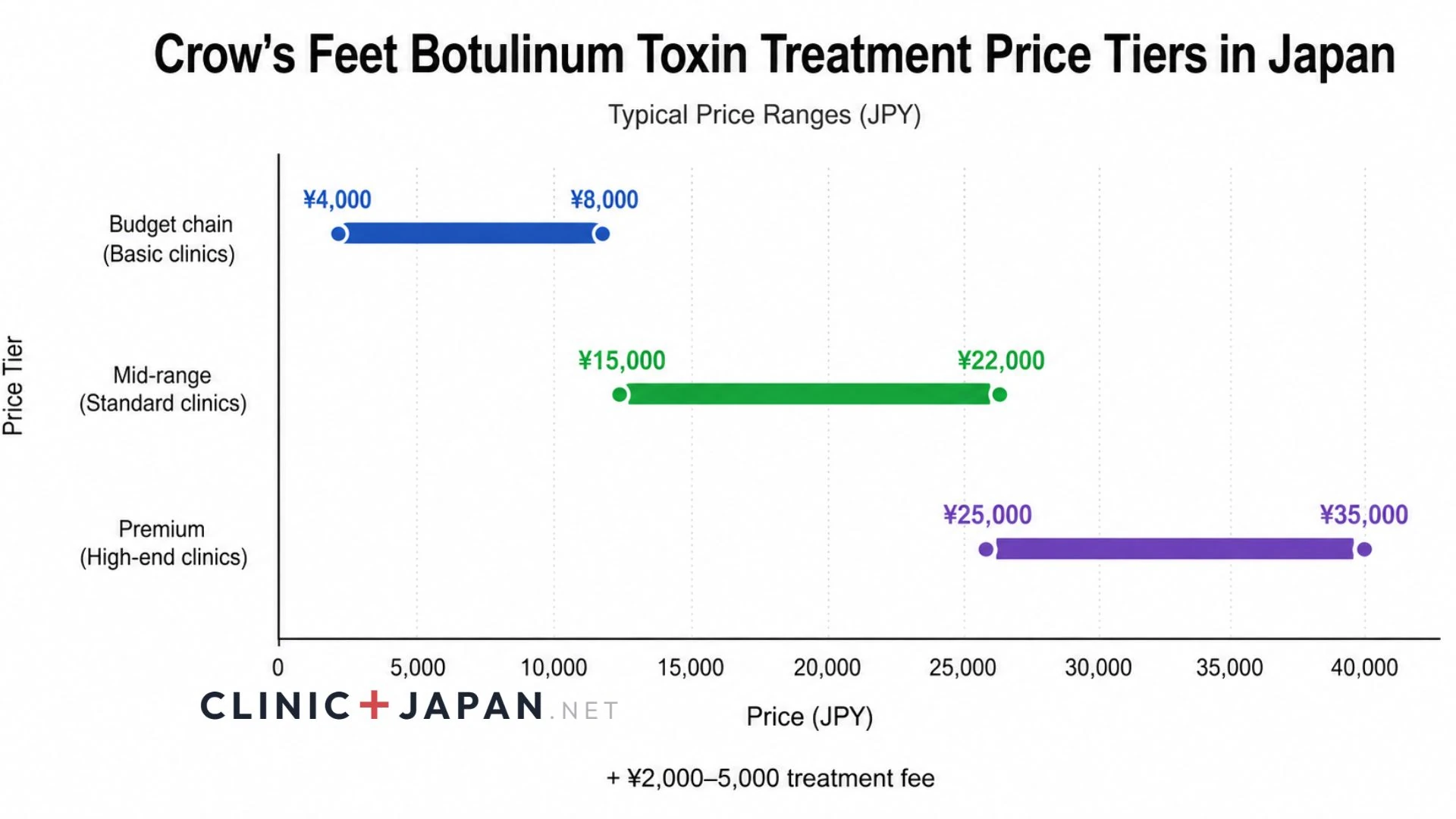
| Tier | Price per area | What you are getting |
|---|---|---|
| Budget chain | ¥4,000–8,000 | Almost certainly a Korean-made toxin. Same active molecule, different product, no MHLW cosmetic approval |
| Mid-range | ¥15,000–22,000 | Often Xeomin/Bocouture or entry-level Allergan pricing |
| Premium | ¥25,000–35,000 | Botox Vista by name, plus a longer consultation |
| Treatment fee | ¥2,000–5,000 | Charged separately at many premium clinics — ask whether the quote includes it |
If the product matters to you, the phrase to use is "ボトックスビスタ" (Botox Vista) — asking for "Botox" generically will get you whatever the clinic stocks. Our detailed pages cover Botox in Japan, the brands actually in use, what it costs and how that compares in Japan versus the US. For same-day availability, walk-in Botox in Tokyo is the practical guide.
7. Our position
Crow's feet are the treatment where the gap between what is proven and what is promised is unusually narrow — which is refreshing. Toxin works for the dynamic component, the appropriate dose has been established in a dedicated trial, and the duration data says four to five months rather than the three you will hear quoted.
What we would push back on is the framing. Crow's feet are the lines a face makes when it is happy, and the anatomy that produces them is the same anatomy that makes a smile legible. The published complication data is reassuring for this area specifically; the aesthetic risk of over-treatment is not something a trial measures. Start under-dosed, review at two weeks, and treat the static component with resurfacing and sun protection rather than by adding units.
And if you are choosing where to spend a limited budget across the upper face: the meta-analysis showing about six months of effect from treating all three upper-face areas at the approved cumulative dose is the single most useful economic fact on this page.
8. FAQ
Sources & Method
Every clinical figure on this page is sourced to a named, PubMed-indexed study, and each PMID below was confirmed against the PubMed record rather than taken from a secondary summary. Where we give a duration or a dose, we state the trial design and the number of participants it came from. The observation about how few Cochrane trials treated crow's feet comes from the review's own description of its included studies. Japanese prices are the ranges verified for our Botox pricing guides in March 2026 and cross-checked against published clinic price lists; treat them as ranges and confirm with the clinic. The treatment sequencing advice and the caution about under-dosing on a first round are our editorial position, not trial findings.
| Source | Used for |
|---|---|
| Botulinum toxin type A for facial wrinkles (PMID 34224576) Camargo et al., Cochrane Database of Systematic Reviews, 2021 · Cochrane review, 65 RCTs / 14,919 participants · accessed 14 Aug 2026 | Section 2 in full — the 65-trial, 14,919-participant scope, the breakdown showing 43 glabella trials against seven crow's feet trials, the conclusion that toxin reduces wrinkles within four weeks but probably increases ptosis risk, and the authors' statement that evidence on multiple cycles, adverse event frequency and duration of effect is lacking |
| Dose-response study of botulinum toxin type A in subjects with crow's feet (PMID 15841623) Lowe et al., Dermatologic Surgery, 2005 · double-blind, randomised, placebo-controlled dose-ranging RCT · accessed 14 Aug 2026 | The dose figures in section 3 and the FAQ — 3, 6, 12 and 18 units per side tested, all beating placebo, a dose-dependent effect on magnitude and duration, no clear separation between 18 and 12 units, and the authors' conclusion of 12 units per side |
| Duration of Clinical Efficacy of OnabotulinumtoxinA in Crow's Feet Lines (PMID 27110893) Baumann et al., Dermatologic Surgery, 2016 · two multicentre RCTs, 833 treated subjects · accessed 14 Aug 2026 | The duration figures in section 3 — median 125 and 144 days for dynamic lines and 137 and 148 days for static lines in the first study, 119 to 121 days in the second, and the separate reporting of dynamic and static outcomes referenced in sections 1 and 5 |
| Efficacy and Duration of OnabotulinumtoxinA With 64-Unit Dose Optimization (PMID 36099476) Rahman et al., Aesthetic Surgery Journal, 2023 · systematic review and meta-analysis, 14 RCTs / 8,369 subjects · accessed 14 Aug 2026 | The upper-face finding in section 3, the tip box and section 7 — median 182 days to return to non-responder status when glabella, crow's feet and forehead lines are treated simultaneously at the approved 64-unit cumulative dose |
| Safety and tolerability of onabotulinumtoxinA in facial lines: meta-analysis of individual patient data (PMID 19744746) Brin et al., Journal of the American Academy of Dermatology, 2009 · individual patient data meta-analysis, 1,678 participants · accessed 14 Aug 2026 | The whole of section 4 — the nine-study pooled design including two lateral canthal line studies at 3 to 18 units per side, the 2.5% vs 0.3% eyelid sensory disorder and 1.8% vs 0% ptosis rates occurring only in glabellar studies, the 24% vs 16% treatment-related event rate, the fall in incidence across treatment cycles, and the finding that eyelid sensory disorder and oedema were more common in the 52% Asian cohort |
| Topical tretinoin for treating photoaging: a systematic review of randomized controlled trials (PMID 35620028) Sitohang et al., International Journal of Women's Dermatology, 2022 · systematic review of RCTs · accessed 14 Aug 2026 | Section 5's characterisation of topical tretinoin as the best-evidenced topical option for photoageing |
| 1550-nm fractional photothermolysis versus intense focused ultrasound for periorbital wrinkles (PMID 38211707) Koza et al., Journal of the American Academy of Dermatology, 2024 · randomised controlled trial · accessed 14 Aug 2026 | Section 5's statement that randomised periorbital resurfacing trials exist, including comparative designs against focused ultrasound |
| Source | Used for |
|---|---|
| Botox Japan ClinicJapan · our own price research, verified March 2026 | The crow's feet price tiers in section 6 (¥4,000–8,000 budget, ¥15,000–22,000 mid-range, ¥25,000–35,000 premium), the separate ¥2,000–5,000 treatment fee, and the MHLW approval status of Botox Vista |
| Botox Brands Japan ClinicJapan · our own price research, verified March 2026 | Section 6's account of which products sit at which price tier in Japanese clinics |
| Source | Used for |
|---|---|
| The glabella-vs-crow's-feet evidence observation ClinicJapan Research Team · Our reading of the Cochrane review, not a claim the review makes | Section 2. The trial counts are Cochrane's own; the inference that widely quoted efficacy figures therefore rest on glabellar data is ours, and it is an argument about where numbers come from, not a claim that toxin fails on crow's feet |
| Under-dose first, review at two weeks ClinicJapan Research Team · Editorial position, not a trial finding | Sections 4 and 7. No cited study tests this strategy. It follows from the dose-response relationship plus the fact that toxin cannot be reversed, and it is a judgement about aesthetic risk that clinical trials do not measure |
| Treatment sequencing ClinicJapan Research Team · Editorial method | Sections 5 and 7. Treating dynamic lines before resurfacing static ones is our recommended order; it is a practical inference rather than a comparison any trial has run |
| Yen-per-unit comparison advice ClinicJapan Research Team · Editorial method | The tip box in section 6. Clinics price by area rather than by unit, so the comparison method is ours |
Related Guides
About this guide: This is an independent guide. We receive no commission from Allergan, any toxin manufacturer, any clinic, or any brand named or linked above, and nobody paid to be included. Botulinum toxin is a prescription medical treatment that must be administered by a qualified physician; unit counts and product selection are clinical decisions and the figures here are benchmarks for comparison, not recommendations for your face. Prices change and vary by clinic. Regulatory approval status differs by country and can change. Informational only; not medical advice, and not a substitute for consultation with a doctor.