1. Two kinds of line wearing the same name
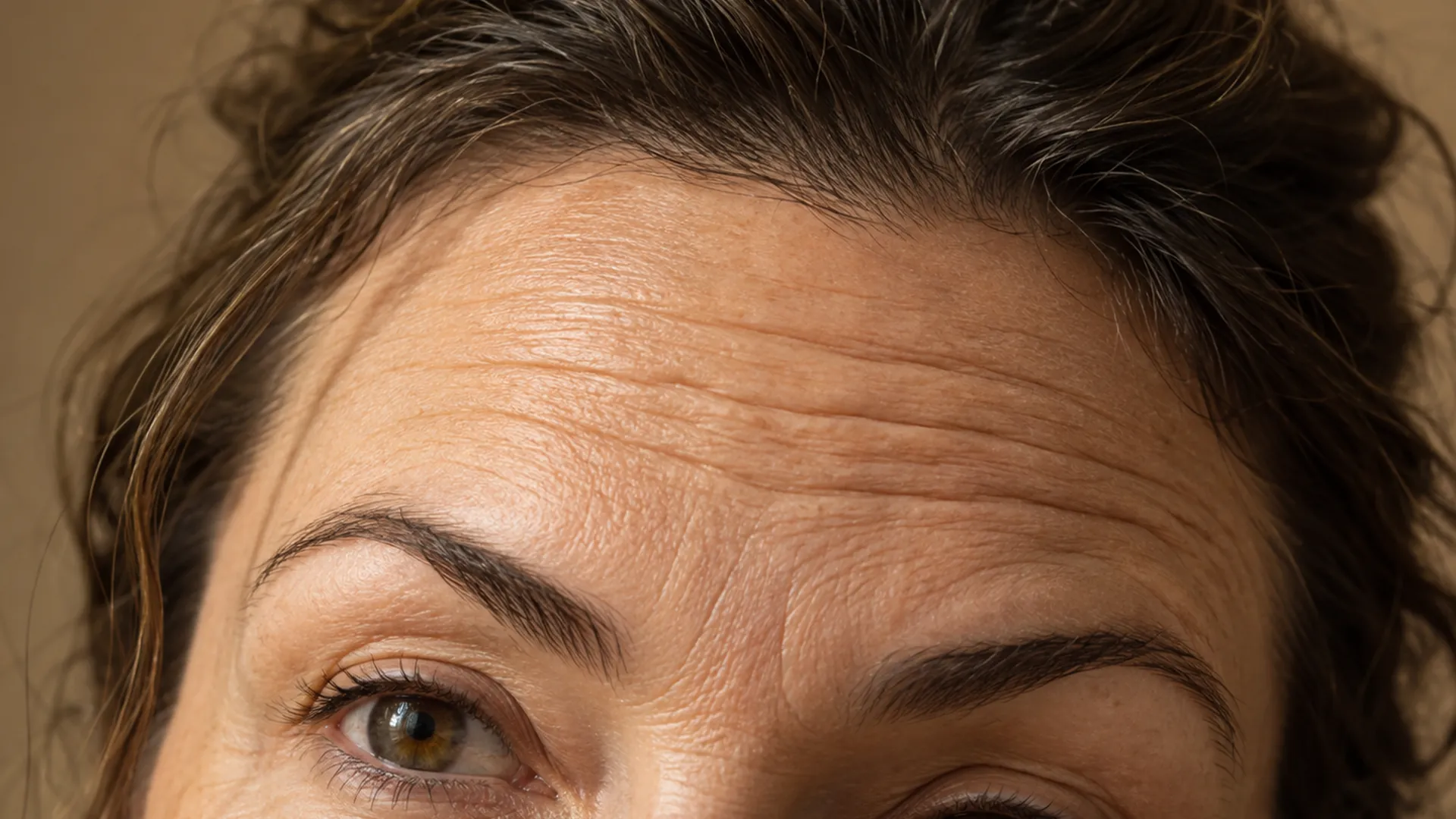
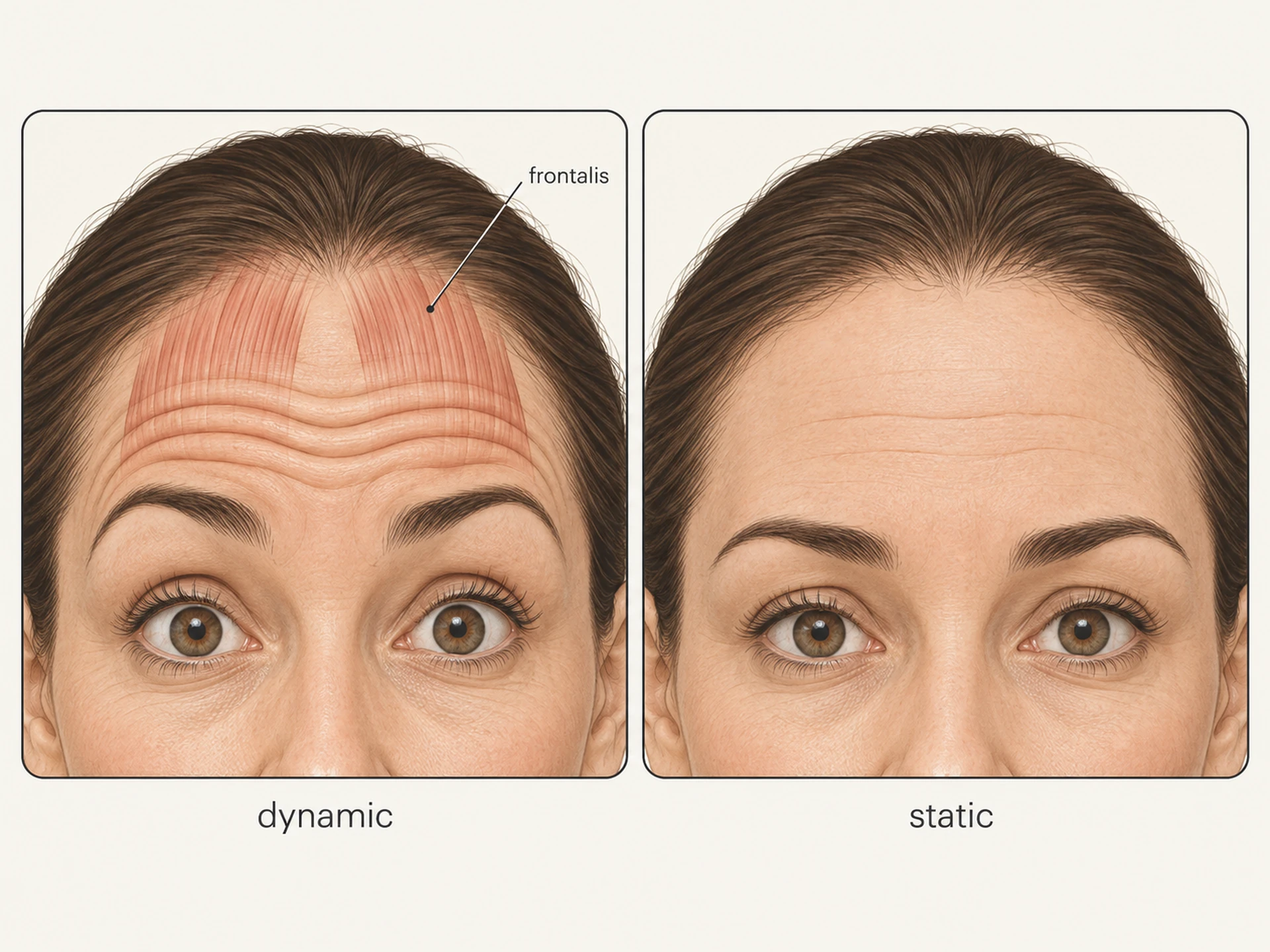
Raise your eyebrows in the mirror and hold them there. The horizontal creases that appear are dynamic lines: the skin folding because the frontalis muscle underneath has contracted. Now relax everything, look straight ahead, and wait five seconds. Whatever is still visible is a static line — a crease that has been folded so many thousands of times that the skin has creased permanently, the way a piece of paper keeps a fold.
This distinction is the whole article, because the two kinds respond to different things. Dynamic lines exist only while the muscle is working, so anything that stops the muscle working removes them. Static lines are a change in the skin itself — dermal collagen that has been remodelled around a fold — and relaxing the muscle merely stops them getting deeper. By middle age most foreheads carry some of both, and most people who are disappointed with a forehead treatment were expecting the fix for one to work on the other.
| Type | What is happening | The tell | What addresses it |
|---|---|---|---|
| Dynamic | Frontalis contraction folds the skin | Visible when you raise your brows, gone when you relax | Botulinum toxin |
| Static | The fold has become a permanent crease in the dermis | Still visible at full rest; you can often feel a groove with a fingertip | Retinoids, resurfacing, time under toxin |
| Mixed | Both, in the same lines | Lines deepen sharply on raising, but never fully disappear | Toxin first, then the skin work |
There is a third thing to check, and it is the one clinics most often skip. Look at yourself at rest and ask whether your eyebrows sit where you want them — or whether you are, without noticing, holding them up. Many people with heavy upper lids or naturally low brows run the frontalis constantly as a compensatory lift, to keep the lids out of their line of sight. Their forehead lines are the footprint of that habit. Relax that muscle with toxin and the brows settle to where they were always trying to go, which is lower, and the lids come with them. That is not a complication of the injection. It is the injection working on a muscle that was doing a job. The fix in that case is not a forehead treatment at all; it starts with the eyelids or the brow position, and a good injector will tell you so before touching a syringe.
2. What the trials actually show
Botulinum toxin for the forehead has an unusually clean evidence base, because the forehead was the last of the three upper-face areas to be formally approved and had to earn it with dedicated phase 3 trials rather than inheriting the glabella's data.
The first pivotal study randomised 391 adults with moderate-to-severe forehead and glabellar lines to onabotulinumtoxinA 40 units or placebo, split as 20 units into the frontalis and 20 into the glabellar complex. At day 30, 61.4% of treated subjects had improved by at least two grades on the four-point Facial Wrinkle Scale, on both the investigator's and the subject's own rating, against 0% of the placebo group. Among subjects who reported that the lines affected them psychologically, 94.8% reached a rating of none or mild, against 1.7% on placebo. The second pivotal study, in 787 subjects, tested the same 40-unit pattern and a 64-unit pattern that added the crow's feet: at day 30, 45.6% and 53.0% respectively achieved the two-grade improvement, against 0.6% on placebo.
Dose matters less than you might think, and the direction of the finding is worth knowing. A dose-ranging trial compared 40 units (20 frontalis, 20 glabella) with 30 units (10 frontalis, 20 glabella). Responder rates for a rating of none or mild at day 30 were 91.2% and 86.4% on the investigator's assessment — a five-point gap for a doubling of the frontalis dose — against 1.7% on placebo. The 40-unit group showed a trend toward longer duration, with similar rates of side effects; the most common were nasopharyngitis at 4.6% and headache at 4.0%, rates the paper describes as mild to moderate and similar between groups. The practical reading is that a modest frontalis dose gets you most of the way, and the case for a bigger one is about how long it lasts, not how well it works.
| Study | Design | Key result at day 30 |
|---|---|---|
| Fagien et al., 2017 | 391 subjects, 40 U (20 frontalis + 20 glabella) vs placebo, 12 months | ≥2-grade improvement in 61.4% vs 0% |
| De Boulle et al., 2018 | 787 subjects, 40 U or 64 U (adds crow's feet) vs placebo | ≥2-grade improvement in 45.6% (40 U) and 53.0% (64 U) vs 0.6% |
| Solish et al., 2016 | Dose-ranging, 40 U vs 30 U vs placebo | None/mild rating in 91.2% vs 86.4% vs 1.7%; AEs similar across groups |
| Ogilvie et al., 2019 | Same 391-subject cohort, patient-reported outcomes | Mostly or very satisfied: 90.3% vs 1.0% |
| Cohen et al., 2022 | Pooled analysis of 4 pivotal trials, 921 forehead-line patients | More than 42% still responders at day 150 |
Satisfaction tracks the wrinkle scores closely. In the 391-subject cohort, 90.3% of treated subjects said they were mostly or very satisfied at day 30, against 1.0% on placebo, and the responder rates on the appearance-impact questionnaires stayed up through the repeat-treatment period. On duration, the pooled analysis of four pivotal trials found that more than 42% of forehead-line patients were still responders — at least one grade better than baseline — at day 150. Read that carefully: it is not that the effect lasts five months for everyone. It is that about four in ten people still have a measurable benefit at five months, which is why the honest planning interval is three to four months and the honest expectation is three treatments a year, not two.
3. Why the forehead is not the crow's feet
If you have read our crow's feet guide, you know the pattern: toxin works, the numbers are large, the complications are rare. The forehead shares the drug and the trial design and differs in one anatomical fact that changes the risk entirely. The orbicularis oculi around the eye does nothing you will miss. The frontalis is the only muscle that raises the eyebrows. Weaken it, and nothing else takes over.
This is why every registration trial dosed the frontalis together with the glabellar complex, and why the review that summarised the programme describes the pattern as 20 units in the frontalis and 20 in the glabella, with or without the crow's feet. The muscles between the brows — the corrugators and procerus — pull the brows down and in. The frontalis pulls them up. Treat the elevator alone and you leave the depressors unopposed, and the brow drops. Treat both and the brow stays roughly where it was. In the trial programme the incidence of both eyebrow ptosis and eyelid ptosis was reported as low, and that is the trial programme, with experienced injectors following a fixed pattern. The everyday version of the problem is subtler than ptosis: it is the brow that sits a few millimetres lower than before, the eyes that look slightly smaller, the forehead that is smooth and somehow heavier. That is what “too much forehead Botox” looks like, and it is what a conservative first dose is designed to avoid.
Dosing in East Asia tends to run lower still, which matters if you are treating in Japan. A Korean expert consensus on aesthetic botulinum toxin in Asian patients recommended nine injection points in two rows at 1 unit each for horizontal forehead lines — nine units, against the 20 used in the Western trials — with 8 units for the glabella and 7 per side for the crow's feet. The consensus paper gives the numbers; the reasons usually offered for them — flatter brow bones, a preference for a natural rather than a frozen forehead, and a lower tolerance for brow heaviness — are clinical convention rather than trial findings. Japanese chain clinics, whose menus we look at in section 6, price the forehead as a single area at doses between the Asian consensus and the Western trial figure — Shonan Beauty Clinic, for instance, lists 16 units. If you are used to a Western dose and book in Tokyo, expect a lighter result, and ask for the unit count before you assume it is the same treatment.
4. The etched-line problem — what toxin cannot do
Here is the conversation most forehead patients have at their two-week review. The forehead no longer moves. The lines are softer. And the deepest one or two are still there, faint but unmistakable, at full rest. The injector explains that these are static, that the toxin has done its job, and that they will continue to soften with repeat treatment. All of that is true, and none of it is what the patient hoped to hear.
The mechanism is straightforward. A dynamic line is a fold; a static line is a groove in the dermis where collagen has been remodelled around the fold over years. Stopping the fold stops the groove getting deeper and gives the dermis a chance to remodel back, but that remodelling is slow — months to a year or two of the skin not being creased — and it is incomplete for deep lines. This is why forehead patients who stay on a three-to-four-month schedule report that their static lines keep improving over the first year, and why a single treatment before a wedding cannot deliver the same thing.
The skin-side intervention with the best evidence is a retinoid, and for Japan specifically there is a study worth knowing. A randomised, vehicle-controlled, double-blind split-face trial in 57 middle-aged Japanese women applied 0.075% retinol cream nightly to one side of the face for 26 weeks. Fine wrinkling improved on 50% of retinol-treated sides against 24% of vehicle sides; deep wrinkling improved on 28% against 2%. Three subjects withdrew for irritation. A parallel arm with 0.04% retinol for 13 weeks produced smaller gains in fine wrinkling with minimal irritation. The paper opens by noting that topical tretinoin was still unavailable in Japan, which is why the trial used retinol. To our knowledge that is still the case as of September 2026: tretinoin is not sold as an approved product in Japan, and the clinics that offer it do so as a private-pay, in-house preparation — confirm with the clinic, as this is our understanding rather than a finding from the paper.
Beyond retinoids, the options for etched lines are resurfacing procedures — fractional lasers, chemical peels, microneedling — which trade downtime for a dermal remodelling stimulus. We do not cite numbers for those here because the forehead-specific evidence is thin and the general evidence is covered in our laser treatment guide. What we will say is that a resurfacing course is the second step, not the first: doing it before the muscle is quiet means re-creasing the newly remodelled skin every time you raise your brows.
5. Filler and the forehead: the risk table
Static lines sometimes prompt a different suggestion: fill them. Soft hyaluronic acid placed under an etched crease does lift it, and the effect is immediate, which is seductive. The forehead is the wrong place to want it.
A 2019 review of the world literature on blindness after filler identified 48 new cases of partial or complete vision loss between January 2015 and September 2018, on top of 98 in the authors' earlier review. The highest-risk sites were the nose (56.3%), the glabella (27.1%), the forehead (18.8%) and the nasolabial fold (14.6%). Hyaluronic acid was the filler in 81.3% of cases. Only 20.8% of patients recovered vision fully; 16.7% recovered partially. No treatment was consistently successful. The generally accepted mechanism — anatomy, not a finding of that review — is that the vessels supplying the forehead connect back to the ophthalmic artery, so filler pushed into one of them under pressure can travel retrograde into the eye.
6. Doing this in Japan — what it costs and how it differs
Botulinum toxin in Japan is jiyu shinryo, private-pay, with prices published per clinic and no insurance involvement. Three things differ from what an American or European patient expects. Prices are quoted per area at most chains rather than per unit, so the forehead is a single line item. Doses are conservative, in the range discussed in section 3. And the choice of product is a menu item: chains list Allergan and non-Allergan products at different price points — Shonan's Allergan page and TCB's ハイトックス/aiya menu, for example — and the difference is the brand and the dose, not the mechanism. Our botox brands in Japan guide covers what each product is.
| Tier | Typical price | What we checked |
|---|---|---|
| Budget chain, non-Allergan toxin | ¥3,500–7,000 | TCB lists ハイトックス at ¥3,500 for one area and a second product, aiya, at ¥7,000; the forehead is one of the listed areas |
| Budget chain, Allergan | ¥8,000 | Shonan Beauty Clinic lists Allergan at ¥8,000 for one area with the forehead dosed at 16 units; three areas for ¥21,000 |
| Mid-range independent | ¥12,000–18,000 | Our March 2026 survey range for the forehead as one area, usually Allergan or Xeomin |
| Premium / specialist | ¥20,000–30,000 | Named injector, longer consultation, often priced per unit rather than per area |
| Consultation fee | ¥0–5,000 | Free at chains; charged and usually credited at premium clinics |
At roughly ¥157 to the dollar, the budget tier is $22–$51 and the premium tier $127–$191 for an area that costs $300–$600 in a US city, the US benchmark used in our Japan price list. That gap is the reason people combine a Tokyo trip with a treatment, and it is real. It comes with two caveats that the price alone does not show. The dose at the budget tier is a chain protocol, not a judgement about your frontalis; if you are one of the compensatory-lift people from section 1, a fixed 16-unit forehead is the wrong prescription regardless of price. And the “one area” framing means the glabella is a separate purchase, when the trials treated it as inseparable. Budget for two areas, not one.
Our full breakdowns are on Botox cost in Japan, the per-area price breakdown and Botox in Tokyo; the Botox in Japan guide is the general entry point, and how to book a clinic in Japan walks through the reservation forms.
7. What we would actually do, in order
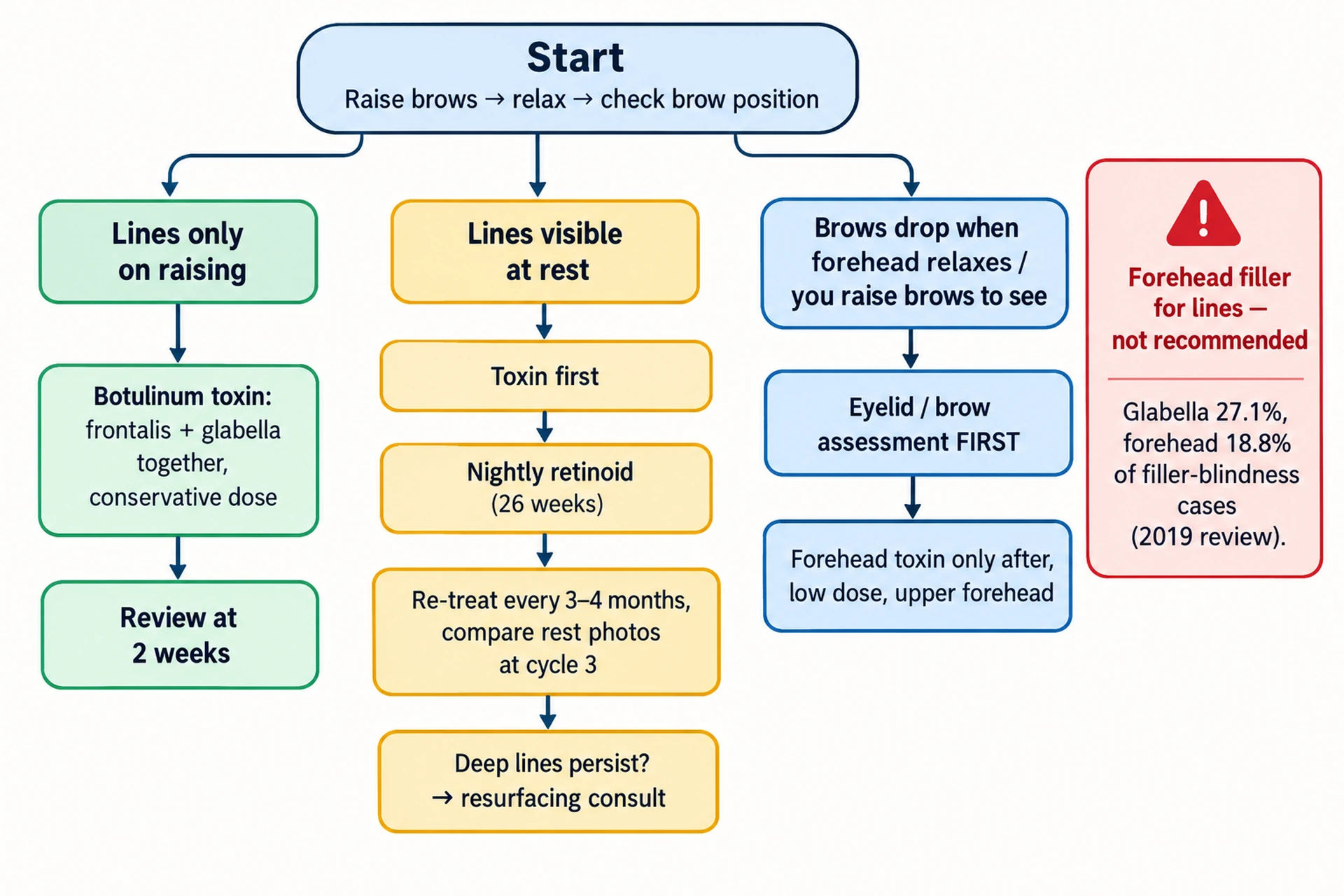
This is our editorial sequence, built from the evidence above and from what goes wrong when people skip steps. It is not a protocol from any paper.
First, the mirror test from section 1, honestly. Raised-brow lines, rest lines, and the eyebrow question. If your brows drop when you relax your forehead, the forehead is not your first appointment; an assessment of the upper lids is. Nothing in the trial data applies to you until that is settled.
Second, a conservative combined treatment. Frontalis and glabella together, at the low end of the dose range, from an injector who asks about your brow position before injecting. Photographs at rest and at full raise on the day. Review at two weeks, by which point the effect is generally fully in; a small top-up at that point is normal and is the mechanism by which a good injector finds your dose without overshooting.
Third, a retinoid, started the same week. Nightly, at a concentration you can tolerate, on the understanding that the trial effect took 26 weeks to show and that it is working on the static component while the toxin holds the dynamic one still.
Fourth, patience through three cycles. Re-treat at three to four months. Compare the rest photographs from cycle one and cycle three, not the mirror; the etched lines soften slowly and memory is a poor instrument. Only after that, if a deep static line persists, consider a resurfacing course.
If you are flying to Japan for this, book the injection for the first two days of the trip, not the last. Onset is typically a few days and full effect about two weeks — a general clinical rule of thumb, not a figure from the trials above — so an appointment on the last day gives you the bruising risk with none of the result to check before you leave, and no chance of the two-week top-up. Our consultation guide covers what to expect in the room.
8. FAQ
Sources & Method
Every clinical claim here is sourced to a named, PubMed-indexed paper, and each PMID below was confirmed against the PubMed record by retrieving the abstract directly rather than quoting a secondary source; the figures in the text are taken from those abstracts as published. Japanese prices in section 6 are from the clinics' own published price pages, accessed 26 September 2026, and from the ranges verified for our March 2026 Japan pricing survey; treat them as ranges, not quotes, and confirm with the clinic. The yen-to-dollar conversion uses roughly ¥157 to the dollar as of late September 2026. The dynamic/static/compensatory mirror test in section 1, the treatment sequence in section 7, the trip-timing advice, the onset and full-effect timing rule of thumb, the sentence on the vascular mechanism of filler blindness, the note on tretinoin's current availability in Japan, and the position on forehead filler in section 5 are our own editorial method and judgement, not findings from any single paper.
| Source | Used for |
|---|---|
| Forehead Line Treatment With OnabotulinumtoxinA in Subjects With Forehead and Glabellar Facial Rhytids: A Phase 3 Study (PMID 33065953) Fagien et al., Dermatologic Surgery, 2017 · randomised, double-blind, placebo-controlled, 391 subjects · accessed 26 Sep 2026 | The 61.4% vs 0% two-grade responder rate, the 94.8% vs 1.7% none/mild rate in the psychological-impact population, and the 20 U frontalis + 20 U glabella pattern in sections 2, 3 and the FAQ |
| Phase 3 Study of OnabotulinumtoxinA Distributed Between Frontalis, Glabellar Complex, and Lateral Canthal Areas for Treatment of Upper Facial Lines (PMID 30096106) De Boulle et al., Dermatologic Surgery, 2018 · randomised, double-blind, placebo-controlled, 787 subjects · accessed 26 Sep 2026 | The 45.6% (40 U) and 53.0% (64 U) vs 0.6% responder rates in section 2 and the combined upper-face FAQ answer |
| Efficacy and Safety of OnabotulinumtoxinA Treatment of Forehead Lines: A Multicenter, Randomized, Dose-Ranging Controlled Trial (PMID 26863598) Solish et al., Dermatologic Surgery, 2016 · randomised dose-ranging trial, 40 U vs 30 U vs placebo · accessed 26 Sep 2026 | The 91.2% / 86.4% / 1.7% responder rates, the duration trend for the 40 U dose, and the nasopharyngitis 4.6% and headache 4.0% adverse-event figures in section 2 |
| OnabotulinumtoxinA for Treatment of Forehead and Glabellar Lines: Subject-Reported Satisfaction and Impact From a Phase 3 Double-Blind Study (PMID 31034447) Ogilvie et al., Dermatologic Surgery, 2019 · patient-reported outcomes, 391 subjects · accessed 26 Sep 2026 | The 90.3% vs 1.0% satisfaction figure in section 2 and the FAQ |
| High Patient Satisfaction for up to 6 Months With OnabotulinumtoxinA Treatment for Upper Facial Lines (PMID 36342250) Cohen et al., Dermatologic Surgery, 2022 · pooled analysis of 4 pivotal phase 3 trials, 921 forehead-line patients · accessed 26 Sep 2026 | The “more than 42% still responders at day 150” duration figure in section 2 and the FAQ |
| OnabotulinumtoxinA Treatment for Moderate to Severe Forehead Lines: A Review (PMID 32537333) De Boulle et al., Plastic and Reconstructive Surgery Global Open, 2020 · review of the registration trials · accessed 26 Sep 2026 | The statement that the forehead was the most recent of the three upper-face approvals, the 20 U + 20 U (± 24 U) pattern, and the reported low incidence of eyebrow and eyelid ptosis in section 3 |
| Consensus recommendations on the aesthetic usage of botulinum toxin type A in Asians (PMID 24118218) Ahn et al., Dermatologic Surgery, 2013 · Korean expert consensus · accessed 26 Sep 2026 | The nine-point, 1 U per point forehead recommendation, 8 U glabella and 7 U per side crow's feet figures in section 3 and the FAQ |
| Improvement of photoaged facial skin in middle-aged Japanese females by topical retinol (vitamin A alcohol): a vehicle-controlled, double-blind study (PMID 20078381) Kikuchi et al., Journal of Dermatological Treatment, 2009 · randomised split-face trial, 57 subjects, 26 weeks · accessed 26 Sep 2026 | The 50% vs 24% fine-wrinkling and 28% vs 2% deep-wrinkling figures, the three withdrawals for irritation, the 0.04% arm, and the note that topical tretinoin was unavailable in Japan, in section 4 and the FAQ |
| Update on Avoiding and Treating Blindness From Fillers: A Recent Review of the World Literature (PMID 30805636) Beleznay et al., Aesthetic Surgery Journal, 2019 · literature review, 48 cases 2015–2018 · accessed 26 Sep 2026 | The site distribution (nose 56.3%, glabella 27.1%, forehead 18.8%, nasolabial 14.6%), the 81.3% hyaluronic acid share, and the 20.8% full / 16.7% partial recovery figures in section 5 and the FAQ |
| Source | Used for |
|---|---|
| Shonan Beauty Clinic — ボトックス注射(アラガン) official price page · accessed 26 Sep 2026 | ¥8,000 tax-included for one area with the forehead at 16 units; ¥15,200 for two and ¥21,000 for three areas, in section 6 |
| TCB Tokyo Central Beauty Clinic — ボトックス注射の料金表 official price page · accessed 26 Sep 2026 | ¥3,500 (one area) and ¥7,000 (one area, second product) tax-included, with the forehead listed among the covered areas, in section 6 |
| ClinicJapan — Japan Cosmetic Surgery Price List 2026 our March 2026 survey, updated quarterly | The mid-range and premium forehead tiers and the $300–$600 US benchmark in section 6 |
| ClinicJapan editorial | The mirror test in section 1, the interpretation of the retinol numbers in section 4, the position on forehead filler in section 5, the three questions and the treatment sequence in section 7. These are our judgement, not trial findings |
Related Guides
About this guide: ClinicJapan is editorially independent. Where a clinic named on this site is an advertising partner, that relationship is disclosed on the page where it appears; no clinic named above is a partner, and nobody paid to be included. Prices change and vary by clinic; confirm before booking. Botulinum toxin and filler are medical procedures requiring a qualified physician, and outcomes vary with anatomy and technique. Sudden brow or eyelid drooping, visual symptoms or severe headache after any facial injection should be assessed by a doctor immediately. Informational only; not medical advice, and not a substitute for consultation with a physician.