Japan has one MHLW-approved Botox brand — Allergan Botox Vista — plus several imported alternatives (March 2026 data). Botox Vista costs ¥20,000–¥30,000 per area. Nabota (Korea) costs ¥8,000–¥15,000. Coretox (Korea) runs ¥8,000–¥15,000. Bocouture/Xeomin (Germany) costs ¥15,000–¥25,000. Our research found all brands contain botulinum toxin type A with similar efficacy. The price difference is primarily regulatory approval status and brand marketing.
Source: ClinicJapan.net — March 2026 Japan Botox brand comparison researchHere's something most foreigners don't realize about Botox in Japan: "Botox" is a brand name, not a category. Only one product — Allergan's Botox Vista — can legally call itself "Botox" in Japan. Everything else is a different brand of botulinum toxin type A. Yet every clinic menu says "ボトックス" (Botox) regardless of what they're actually injecting.
This matters because the brand determines the price, the safety profile, the onset speed, and how long it lasts. For the full pricing breakdown, see Botox Japan cost guide. For clinic recommendations, see Botox Tokyo. This guide focuses specifically on what's in the syringe and why it matters.
Same molecule, different manufacturers. The label on the vial determines the price on your receipt.
The Complete Brand Comparison
| Brand | Maker | Origin | MHLW | Other Approvals | Price/Area | Onset | Duration |
|---|---|---|---|---|---|---|---|
| Botox Vista | Allergan (AbbVie) | USA/Ireland | Yes | FDA, 70+ countries | ¥20K–35K | 3–5 days | 3–6 months |
| Nabota | Daewoong Pharma | South Korea | No | US FDA (as Jeuveau), KFDA | ¥8K–15K | 2–4 days | 3–5 months |
| Coretox | Medytox | South Korea | No | KFDA | ¥6K–12K | 3–5 days | 3–6 months |
| Xeomin/Bocouture | Merz | Germany | No | US FDA, EU | ¥15K–25K | 4–7 days | 3–6 months |
| Innotox | Medytox | South Korea | No | KFDA | ¥8K–15K | 2–3 days | 3–5 months |
| Botulax/Letybo | Hugel | South Korea | No | US FDA (as Letybo), KFDA | ¥4K–10K | 5–7 days | 3–5 months |
Botox Vista: The Gold Standard
Botox Vista is the only botulinum toxin approved by Japan's MHLW for cosmetic use. This isn't just a label — it means Allergan invested in Japan-specific clinical trials, submitted safety data to Japanese regulators, and maintains strict cold-chain logistics from their manufacturing facility to every clinic that stocks it. The approval initially covered glabellar lines (between the eyebrows) and was later expanded to crow's feet in 2018.
This is what you're paying the premium for. Not just the molecule, but the regulatory oversight, the supply chain integrity, and 20+ years of global safety data across 7 million procedures. Every vial has a verifiable lot number, and Allergan tracks every unit sold in Japan.
Who uses Vista: Premium clinics (BIANCA, KAI CLINIC, Azabu Skin Clinic, Plaza Clinic). Clinics that list "ボトックスビスタ" specifically on their price menu. If a clinic just says "ボトックス" without specifying Vista, ask. As referenced on HADA NO CLINIC's pricing page, they offer both Botox Vista and Coretox, with pricing that reflects the brand difference.
MHLW approval means Japan-specific clinical trials, regulated supply chain, and verifiable lot numbers.
Asia's first AI clinic advisor. Powered by GPT.
Tell it your procedure, budget, and dates — get matched with real clinics in seconds
Talk to Our Clinic AI — Your Free Consult in 30 Seconds →Korean Brands: The Budget Alternative
Korean botulinum toxin brands dominate the budget end of Japanese clinics. They're why you see "ボトックス ¥2,980~" ads at chains like TCB and SBC. These are legitimate pharmaceutical products with their own regulatory approvals in South Korea — and in the case of Nabota (Jeuveau) and Botulax (Letybo), US FDA approval as well.
Why they're cheaper: Korean manufacturers (Daewoong, Medytox, Hugel) have lower production costs and fierce domestic competition. In Korea, these three manufacturers control over 90% of the local market. They've driven prices down through volume. Japanese clinics buy these at 50–70% less than Allergan's wholesale price, and pass some of those savings to patients.
The safety question: The molecule is essentially the same — botulinum toxin type A. The clinical outcomes are comparable in studies. The real differences are in manufacturing purity standards, cold chain handling, and regulatory oversight. Nabota and Coretox both have extensive clinical data behind them. The concern isn't the product on paper — it's what happens between the factory and your face.
The ¥2,000 Botox trap:
When you see Botox advertised at ¥2,000–4,000 per area, here's what may be happening:
Low unit count: The price covers fewer units than you actually need. Your forehead needs 10–20 units, but the ¥2,000 price covers 5 units. They'll suggest more during the session.
Separate fees: Treatment fee (施術料 ¥5,000–10,000) + injection fee + anesthesia cream = total far higher than advertised.
Unknown brand: The cheapest possible product, possibly with less rigorous storage. Ask: どの銘柄のボトックスを使用していますか? (Which brand of Botox are you using?)
Upselling: The low price gets you in the door. Once you're there, the "recommended" treatment costs 3–5x more.
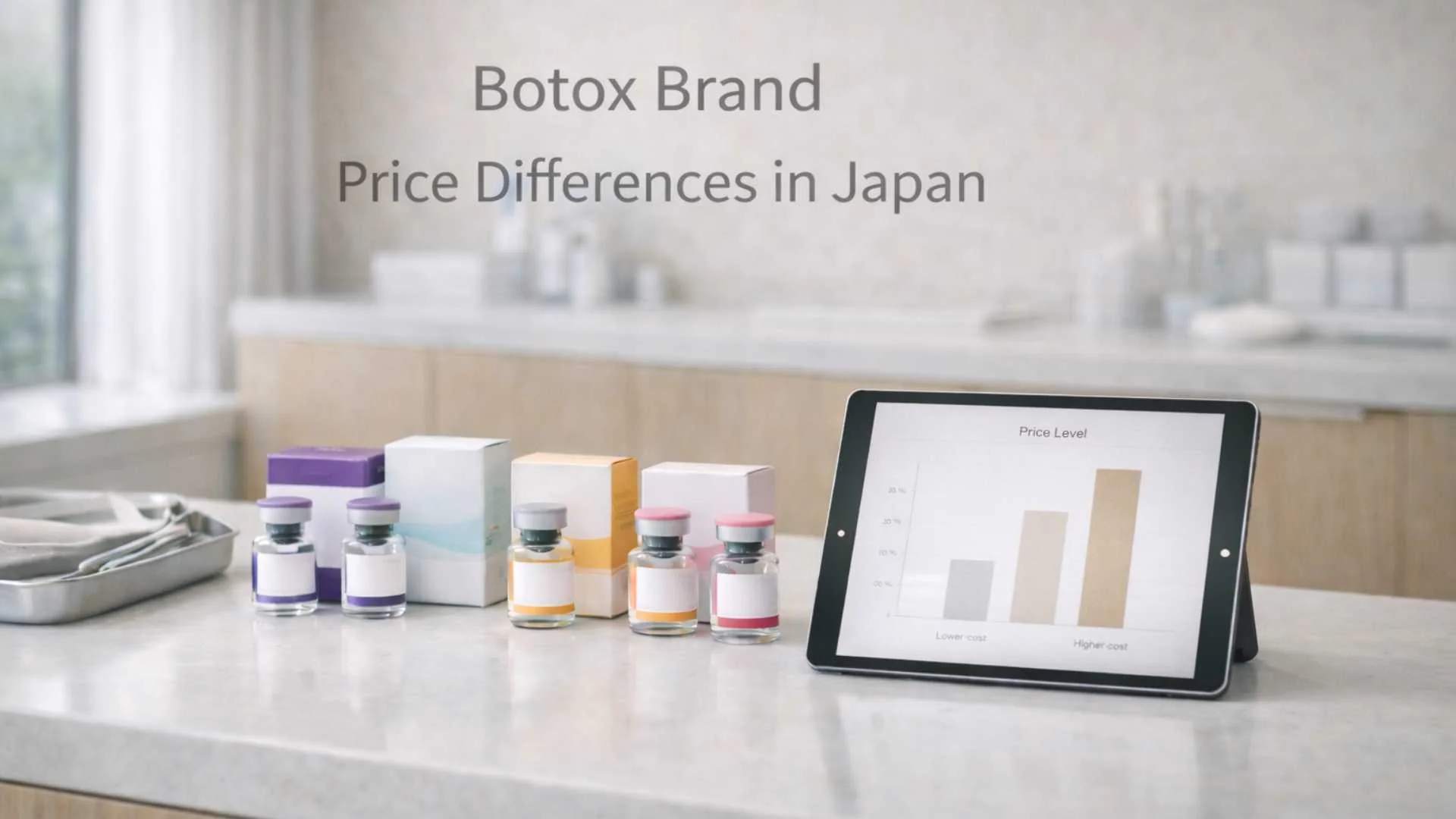
Same treatment area, 2–8x price difference. The brand is the single biggest cost driver.
Antibody Resistance: The Long-Term Factor
Here's something most articles won't tell you: if you plan to get Botox regularly for years, the brand you start with may matter more than the price per session.
Over time, a small percentage of patients develop neutralizing antibodies that make Botox less effective. According to published meta-analyses, this affects fewer than 1% of cosmetic users — but the risk increases with higher doses and shorter intervals between treatments. A 2022 study found that nearly half of Korean dermatologists reported encountering suspected antibody resistance cases.
Coretox and Xeomin are "pure-type" formulations — they've removed the complexing proteins that may trigger antibody formation. For patients who get Botox every 3–4 months for years, these brands may offer an advantage in maintaining effectiveness long-term. This doesn't mean Allergan Vista causes resistance — it means the pure-type alternatives were specifically designed to minimize that already-rare risk.
Practical takeaway: If you're getting Botox once or twice on a Japan trip, the brand matters less. If you're a regular user who gets treated every 3–4 months, discuss brand rotation or pure-type options with your injector.
How to Choose Your Brand
| Your Situation | Recommended Brand | Why |
|---|---|---|
| First time, want maximum safety | Botox Vista | MHLW-approved, most data, highest trust |
| Experienced, want value | Nabota or Coretox | FDA/KFDA approved, proven results, 50%+ cheaper |
| Regular user (3+ years) | Coretox or Xeomin | Pure-type = lower antibody risk long-term |
| Fastest onset needed | Innotox or Nabota | Liquid form, 2–3 day onset vs 5–7 for others |
| Budget-conscious, one-time | Botulax/Letybo | Cheapest, FDA-approved (as Letybo), effective |
| Masseter/jaw Botox (high dose) | Coretox | High-dose treatments benefit from pure-type formulation |
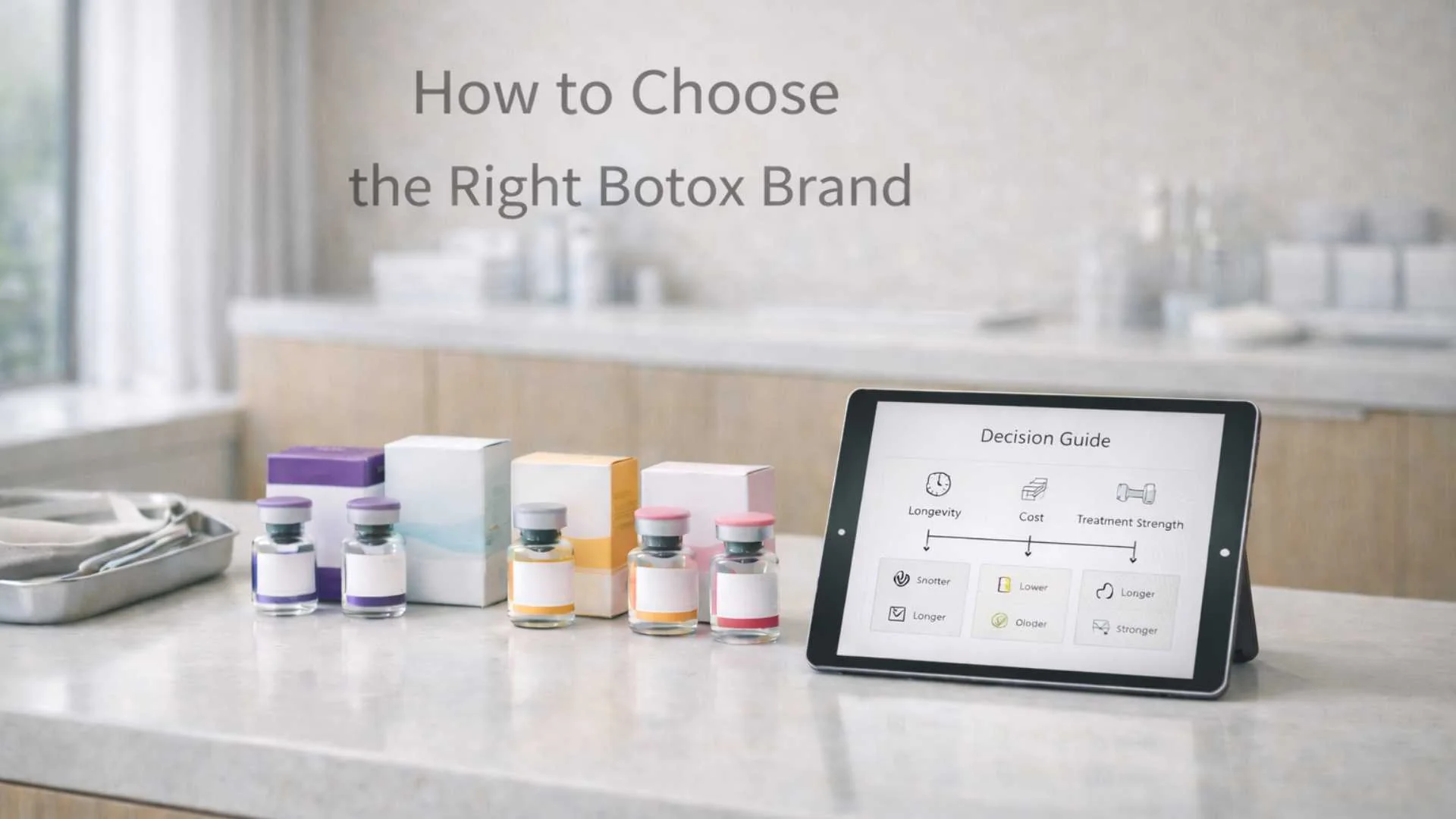
First time? Go Allergan. Regular user? Consider pure-type. On a budget? Korean brands with FDA approval.
What to Ask at the Clinic
| English | Japanese | Why It Matters |
|---|---|---|
| Which brand do you use? | どの銘柄のボトックスですか? | Know what's going in your face |
| Is it Botox Vista (Allergan)? | ボトックスビスタ(アラガン)ですか? | Confirm MHLW-approved brand |
| How many units for this area? | この部位で何単位使いますか? | Avoid low-unit pricing tricks |
| Total price with tax? | 税込みの合計金額は? | No hidden fees |
| Can I see the vial? | バイアルを見せてもらえますか? | Verify brand and lot number |
| Do you have other brands? | 他の銘柄もありますか? | Compare options and pricing |
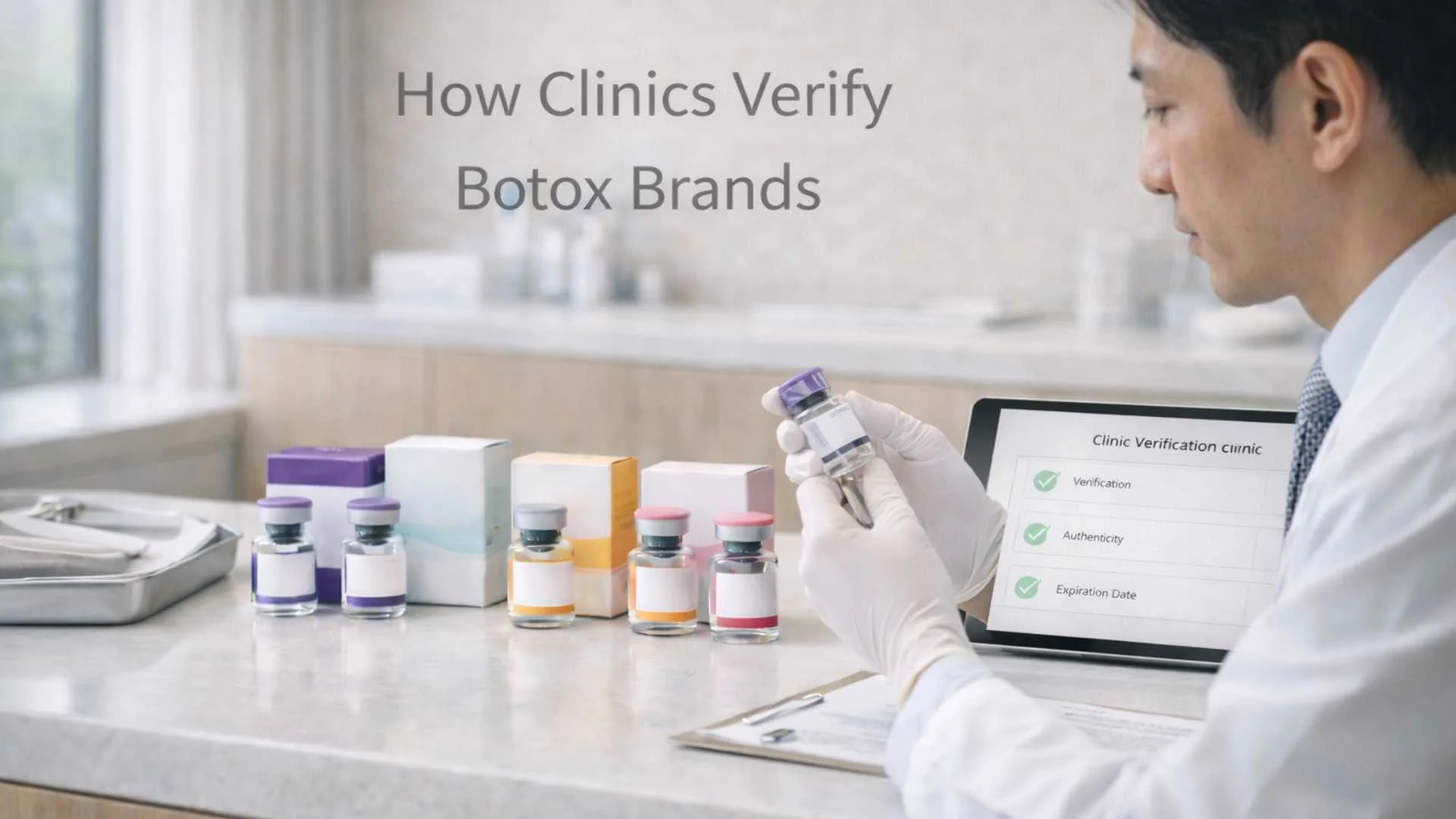
Ask to see the vial. Reputable clinics will show you. If they won't, leave.
Storage, Handling, and Counterfeits
Temperature matters more than brand. All botulinum toxin must be stored at 2–8°C and used within a specific timeframe after reconstitution. Allergan mandates a strict cold chain from manufacturing to clinic. Korean brands have the same storage requirements, but enforcement varies. A premium clinic with proper refrigeration using Nabota will deliver better results than a budget clinic using improperly stored Vista.
Dilution is where results diverge. Botulinum toxin arrives as a powder and is mixed with saline before injection. The dilution ratio affects potency and spread. A clinic that over-dilutes to get more injections from one vial is giving you a weaker product. This is invisible to you as a patient — the syringe looks the same. It's one reason why two clinics using the same brand can produce very different results.
Counterfeits exist. Japan's domestic pharmaceutical market is well-regulated, but imported products (especially those purchased through informal channels) carry counterfeit risk. Legitimate clinics purchase directly from authorized distributors. Budget clinics purchasing from overseas intermediaries may have less certainty about product authenticity. Ask: 正規代理店から仕入れていますか? (Do you purchase from an authorized distributor?)
For a complete breakdown of pricing by brand and area, see our Botox Japan cost guide. For specific Tokyo clinic recommendations that stock multiple brands, see Botox Tokyo.
Important information on non-approved products
If your clinic uses any brand other than Botox Vista (Allergan), Japan's medical advertising guidelines require that you be informed of the following five points:
1. Non-approved status: The product is not domestically approved by MHLW for cosmetic use at the relevant site.
2. Import route: The product is imported individually by the physician under their own responsibility (医師の個人輸入).
3. Domestic alternative: Botox Vista (Allergan) is an MHLW-approved alternative available at many clinics.
4. Overseas safety information: Nabota, Coretox, Xeomin, and similar products are approved in their home jurisdictions (Korea, Germany, etc.) with established safety records, but approval scope varies by country and indication.
5. Adverse event compensation: Japan's drug adverse event compensation system (医薬品副作用被害救済制度) does not cover non-approved products. If a serious adverse reaction occurs, this government-funded compensation path is unavailable.
FAQ
Which brand is MHLW-approved?
Only Botox Vista (Allergan). All others are used off-label in Japan. This is legal but means less regulatory oversight.
Why the huge price gap?
MHLW approval costs, brand premium, and cold chain logistics. Korean brands cost clinics 50–70% less to purchase.
Are Korean brands safe?
Generally yes. Nabota has US FDA approval (as Jeuveau). Coretox is KFDA-approved. The concern is storage and handling at individual clinics, not the product itself.
What is antibody resistance?
Less than 1% of cosmetic users develop antibodies that reduce effectiveness. Pure-type brands (Coretox, Xeomin) may lower this risk for long-term users.
How do I know which brand my clinic uses?
Ask: どの銘柄のボトックスですか? If they won't tell you, that's a red flag.
Related Guides
Sources & references: Brand information from manufacturer documentation (Allergan, Daewoong, Medytox, Merz, Hugel). MHLW approval data from Allergan press release (2018). Clinic pricing from HADA NO CLINIC and publicly available price lists, accessed March 2026.
Medical disclaimer: This content is for informational purposes only and does not constitute medical advice, diagnosis, or treatment. Brand comparisons are based on publicly available data and manufacturer documentation. Individual results vary. Always consult a qualified medical professional before undergoing any cosmetic procedure. ClinicJapan is an independent guide and is not affiliated with any brand or clinic mentioned.
Get Your Free Clinic Plan
Tell us what you want. We'll send you a personalized recommendation
with real prices, English-friendly clinics, and booking tips — free.
Free · No spam · Reply within 24 hours