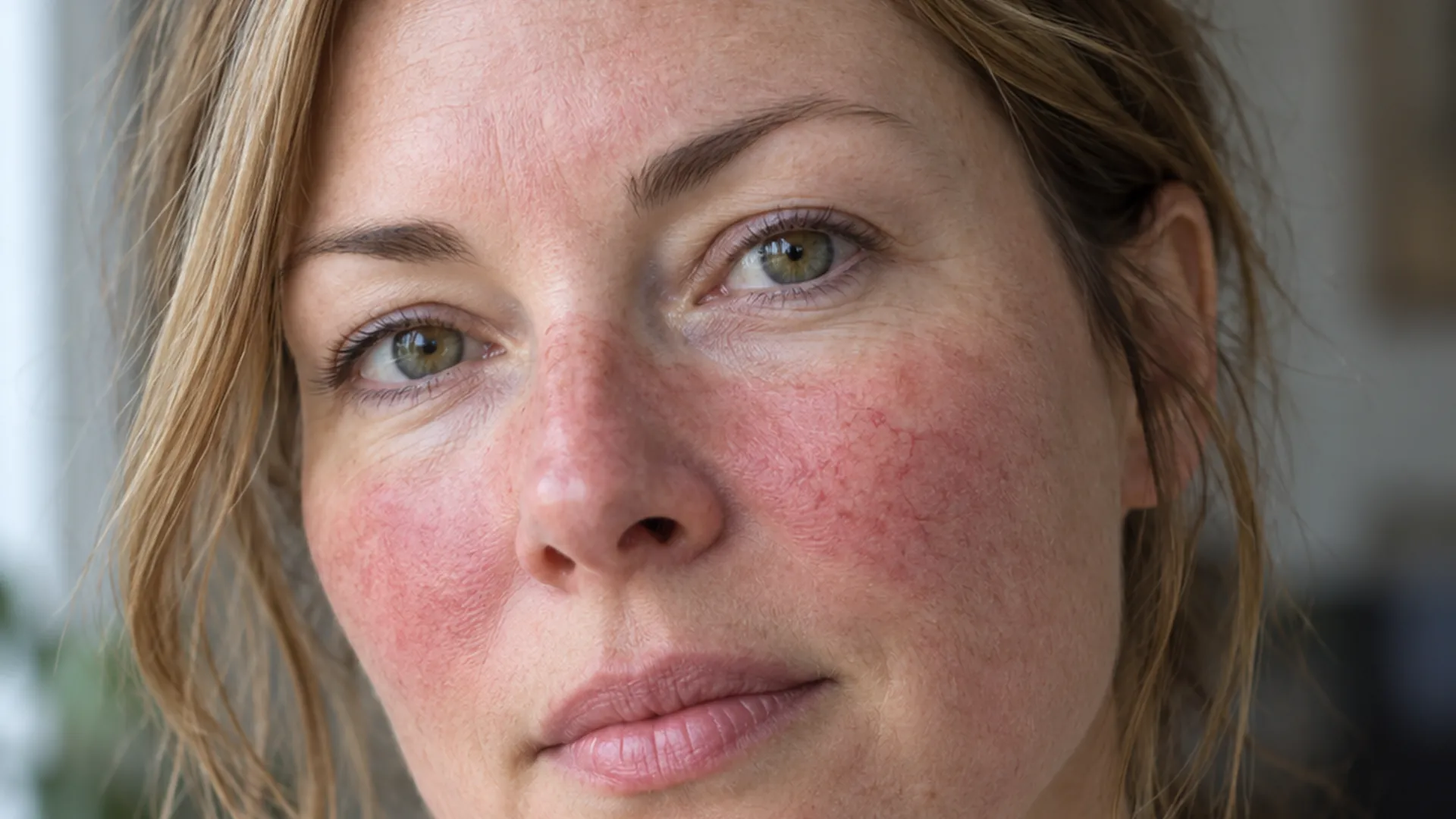
1. Five kinds of red that get treated as one
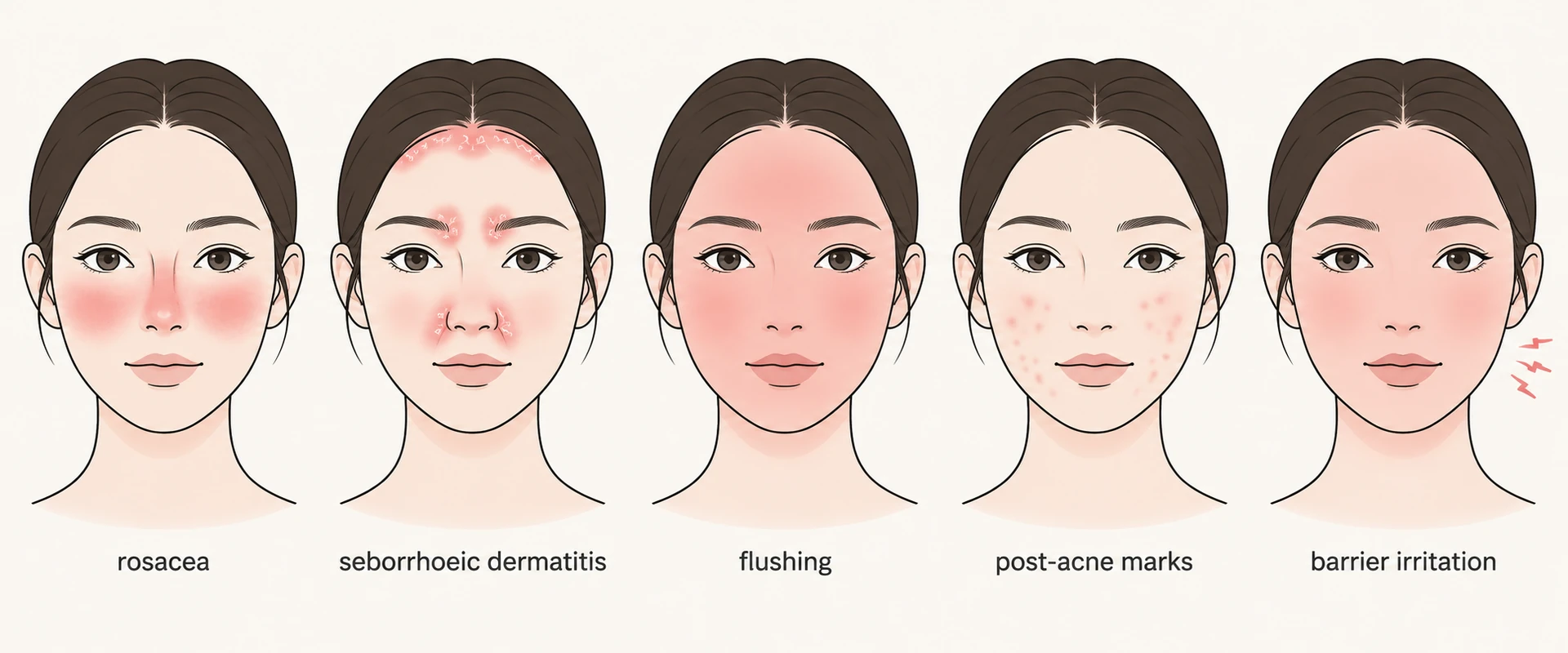
“Redness on the face” is a search term, not a diagnosis, and the reason so much money is wasted on it is that the five things it usually means respond to five different treatments. A rosacea laser does nothing for seborrhoeic dermatitis. An anti-fungal cream does nothing for rosacea. Neither touches the flush you get from a glass of wine. Sorting out which you have is most of the work.
| Cause | Where and what | Typical tells | Treatment family |
|---|---|---|---|
| Rosacea (erythematotelangiectatic) | Persistent redness of the central cheeks and nose, often with visible vessels; flushing episodes | Worse with heat, alcohol, spicy food, sun, stress; stinging with products | Vasoconstrictor topicals; pulsed dye laser or IPL; trigger control |
| Rosacea (papulopustular) | The same redness plus acne-like bumps, without blackheads | Bumps come and go in the red zones | Azelaic acid, ivermectin, low-dose doxycycline |
| Seborrhoeic dermatitis | Redness with fine greasy scale around the nose folds, eyebrows, hairline | Flakes; a T-zone pattern; often also dandruff | Antifungal and anti-inflammatory topicals |
| Flushing (including the alcohol flush) | Episodic whole-face redness that comes and goes within hours | Predictable triggers; skin looks normal between episodes | Trigger avoidance; medical review if new or severe |
| Post-inflammatory erythema | Flat pink or red marks exactly where acne spots were | Each mark has a history; fades over months | Time; vascular laser to speed it |
| Barrier irritation | Diffuse redness, tightness and stinging after products | Started with a new routine; improves when you stop | Stop, simplify, moisturise; then reintroduce |
Rosacea is the one to take seriously, because it is common and, as the East Asian review cited below describes it, progressive. A 2018 systematic review and meta-analysis pooled 32 studies covering 41 populations and more than 26 million people and put the prevalence at 5.46% of the general adult population (95% CI 4.91–6.04), affecting 5.41% of women and 3.90% of men, mostly between the ages of 45 and 60. The authors also found that questionnaires produced higher estimates than clinical examination — which is a polite way of saying that a lot of people who think they have rosacea have something else.
The something-else is usually seborrhoeic dermatitis. A Korean study photographed 34 patients with facial redness — 12 with erythematotelangiectatic rosacea, 12 with papulopustular rosacea and 10 with seborrhoeic dermatitis — and asked five dermatologists, blinded to the diagnosis, what each photograph showed. Every papulopustular case was recognised. But about 30% of the erythematotelangiectatic rosacea photographs were read as seborrhoeic dermatitis, and vice versa. Computer analysis of the colour data separated them: erythematotelangiectatic rosacea showed a large mean redness of the U-zone (the paper's term for the lower face outside the T-zone), seborrhoeic dermatitis a high ratio of T-zone to U-zone redness. If specialists looking at a photograph get it wrong nearly a third of the time, the person in the mirror is not going to do better, and the first treatment decision should be made in a clinic.
2. Working out which one you have
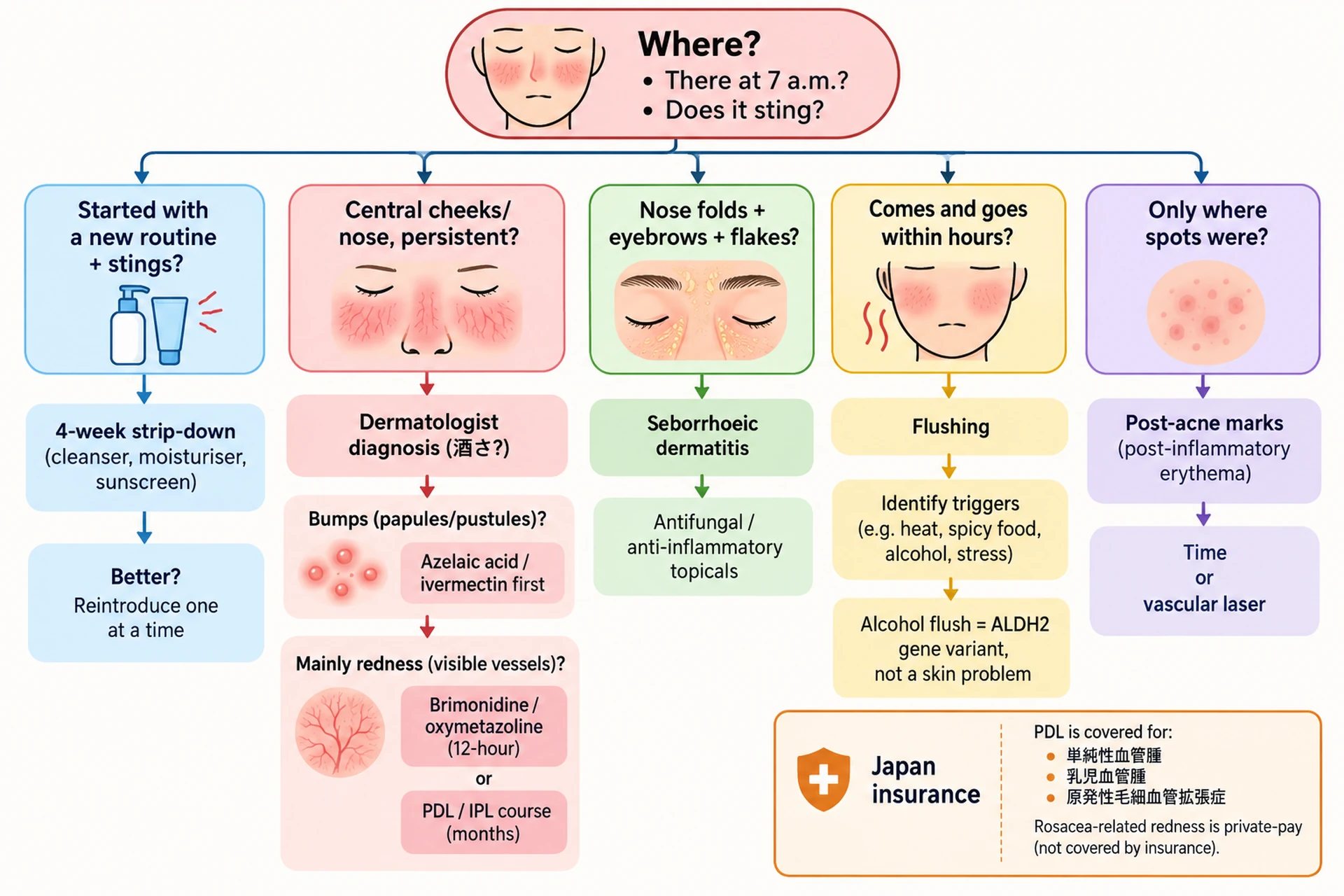
This is our own triage, not a diagnostic instrument, and it ends at a dermatologist's door rather than replacing one. Three questions do most of the sorting.
Where is it? Central cheeks and nose, often with the chin and forehead, points to rosacea. Redness that hugs the folds beside the nose, the inner eyebrows and the hairline, with fine flakes, points to seborrhoeic dermatitis. Marks that are where your spots were, and only there, are post-inflammatory erythema. Everywhere, evenly, with stinging, is a barrier problem or a flush.
Is it there at 7 a.m.? Rosacea and seborrhoeic dermatitis are there when you wake up. A flush is not; it arrives with heat, alcohol, exercise or emotion and leaves within hours. The alcohol flush deserves its own line, because in Japan you will encounter it constantly: the flushing response after drinking is predominantly due to an inherited deficiency of the enzyme ALDH2, and the variant allele has a high-frequency distribution in East Asian populations. It is not a skin condition and no cream treats it. It is also, per the same literature, a marker of substantially raised oesophageal cancer risk with alcohol, which is the one fact about facial redness worth passing on to a friend who drinks through it.
Does anything make it sting? Rosacea skin and barrier-damaged skin both sting with products that other people tolerate. Seborrhoeic dermatitis usually does not. If your redness began within weeks of a new routine — a strong acid, a retinoid, a new cleanser — stop everything but a bland moisturiser and sunscreen for four weeks before you spend money on a diagnosis.
3. What the evidence says, treatment by treatment
Rosacea has one of the best evidence maps in dermatology, because the same author group has been updating a systematic review of it for well over a decade. The 2019 update, published in the British Journal of Dermatology and organised by the phenotype you have rather than a subtype label, included 152 randomised trials and 20,944 participants, and graded the certainty of evidence for each intervention. Its conclusions are the spine of this article.
| For… | Intervention | Certainty |
|---|---|---|
| Persistent erythema (temporary reduction) | Topical brimonidine | High |
| Topical oxymetazoline | Moderate | |
| Erythema and mainly telangiectasia | Laser and intense pulsed light | Low to moderate |
| Papules and pustules | Topical azelaic acid; topical ivermectin | High |
| Doxycycline 40 mg modified-release; isotretinoin | Moderate to high | |
| Topical metronidazole; topical and oral minocycline (equal to doxycycline 40 mg MR) | Moderate | |
| Ocular rosacea | Oral omega-3 fatty acids | Moderate |
Two things stand out. The best-supported treatments for the redness itself are topicals that constrict blood vessels for a day, not anything that changes the skin. And the devices most clinics lead with — lasers and IPL — sit at low-to-moderate certainty, which does not mean they do not work; it means the trials are small and the comparisons few. The bumps, by contrast, have high-certainty treatments that are long-established.
4. The twelve-hour topicals: what they do and do not do
Brimonidine gel 0.5% is an α2-adrenergic agonist that constricts the small vessels in the skin. The two dose-finding studies are instructive. In the first, 122 subjects received a single application of one of three concentrations or vehicle; the gel reduced measured redness in a dose-dependent way across the three concentrations, and the 0.5% gel differed significantly from vehicle from 30 minutes to 12 hours after application. In the second, 269 subjects used the gel once or twice daily, or vehicle, for four weeks with four weeks of follow-up. Once-daily 0.5% had a statistically superior success rate — defined as a two-grade improvement on both the clinician's and the patient's scale over 12 hours — on days 1, 15 and 29 (all P < 0.001), and within that study no tachyphylaxis, rebound or worsening of vessels or bumps was observed.
Oxymetazoline cream 1.0% is an α1A agonist doing a similar job. In the second of its two pivotal trials, 445 patients (mean age 50.3, 78.7% women) applied it or vehicle once daily for 29 days. Significantly more oxymetazoline patients achieved the composite two-grade improvement on both scales at 3, 6, 9 and 12 hours post-dose on day 29 (P = 0.001); digital image analysis also favoured it (P < 0.001). Discontinuations for adverse events were 2.7% versus 0.5%, and in the 28 days after stopping, 2 patients (1.2%) in the oxymetazoline group and none on vehicle had rebound worsening compared with their baseline.
5. Pulsed dye laser versus IPL: what the meta-analyses found
If you want the redness reduced rather than hidden, the vascular devices are the route, and the choice at most clinics is between the pulsed dye laser (the V-beam family) and intense pulsed light. Two recent meta-analyses have compared them, and they agree more than the marketing suggests.
A 2022 systematic review with meta-analysis screened 423 records and analysed 12 that compared the pulsed dye laser with other light-based devices. Across erythema (RR 0.38, 95% CI −0.20 to 0.95), telangiectasia (RR 0.54), physician-assessed success (RR 1.23) and patient satisfaction (RR 1.15), the pulsed dye laser was not significantly different from the other devices. On pain it was as painful as devices overall, more painful than the Nd:YAG laser, and less painful than IPL (RR −1.18; 95% CI reported as −1.56–0.80 in the abstract). The authors' verdict: the pulsed dye laser has the most robust evidence base, the quality of evidence for any recommendation is low-to-moderate, and in practice its effectiveness is comparable to Nd:YAG or IPL.
A 2024 meta-analysis narrowed the question to IPL versus pulsed dye laser directly and found only four eligible studies with 141 participants in total. There was no significant difference in the proportion achieving more than 50% clearance; IPL had a small but significant advantage in the proportion achieving more than 75% clearance; the change in erythema index was similar; and the pulsed dye laser group reported significantly lower pain scores. The authors conclude that either is effective, IPL may edge ahead for substantial clearance, the pulsed dye laser is preferable for people who tolerate discomfort poorly, and the comparative literature is thin.
| Question | 2022 review (12 studies) | 2024 meta-analysis (4 studies, 141 pts) |
|---|---|---|
| Does one reduce erythema more? | No significant difference | No significant difference in erythema index |
| Does one clear more completely? | No significant difference in success or satisfaction | IPL higher for >75% clearance; no difference at >50% |
| Which hurts more? | IPL | IPL |
| How good is the evidence? | Low to moderate | Limited; larger trials needed |
The practical reading is that the device matters less than the operator and the course. Both need several sessions; both leave bruising or swelling for days with the pulsed dye laser at purpuric settings and less with IPL; and both are for the vessels and persistent redness, not for flushing episodes, which they do not prevent. For treatment-planning in Japan, see our laser treatment guide for how the device tiers are priced.
6. Doing this in Japan — prices, and the insurance line that matters
Japan's national health insurance can cover a vascular laser for specific diagnoses, and the line between covered and not covered is worth understanding before you assume anything. Per a Japanese dermatology clinic's own explanation of the rules, pulsed dye laser treatment is covered when a physician diagnoses port-wine stain (単純性血管腫), infantile haemangioma (乳児血管腫) or primary telangiectasia of unknown cause (原発性毛細血管拡張症); at the standard 30% patient share the laser fee runs from about ¥6,510 to ¥32,010 per session depending on the treated area (consultation and prescription fees are extra), with a minimum interval of once every three months. Redness due to rosacea is explicitly listed as private-pay. So the same machine, in the same clinic, is either an insured medical treatment or a ¥30,000 cosmetic one depending on the diagnosis written down — and the diagnosis has to be honest, because — as we understand it — the reimbursement rules are set nationally rather than by the clinic.
| Treatment | Price | What we checked |
|---|---|---|
| V-beam Prima, full face (chain, private-pay) | ¥31,800 per session; ¥134,000 for 5 | Shonan Beauty Clinic's laser price list, September 2026, as listed |
| V-beam Prima, cheeks only (chain) | ¥18,700 per session; ¥74,800 for 5 | Same list; nose or chin alone ¥8,800 per session |
| IPL (chain; Shonan “Photo RF”, no area specified on the list) | ¥9,980 per session (¥6,800 first-time price for new IPL patients); ¥44,000 for 5 | Shonan's laser price list, September 2026; its two higher IPL tiers, Photo Double and Photo Triple, list at ¥12,800 and ¥18,800 per session, or ¥7,800 and ¥10,800 as first-time prices |
| Pulsed dye laser, insured indications | About ¥6,510–32,010 per session at 30% patient share (laser fee only; consultation fees extra) | A Japanese dermatology clinic's published explanation of the coverage rules; once per three months |
| Consultation fee | ¥0–5,000 | Free at chains; charged at some independent clinics |
At roughly ¥157 to the dollar, a five-session full-face V-beam course at a chain is about $850 and a five-session IPL course about $280. Two cautions on the chain tier. IPL at a chain is sold as a general “photo-facial” and the settings are a protocol, not a rosacea plan; ask specifically whether the treatment is configured for vascular targets. And if you flush or sting easily, the consultation is where you find out whether the clinic recognises rosacea at all, or files you under sensitive skin — the East Asian diagnostic gap described in section 2 cuts both ways for a foreign patient.
For where to go, our English-speaking skin clinics in Tokyo list covers dermatology-led options, seeing a doctor in Japan explains how a consultation runs, and acne treatment in Tokyo covers the post-inflammatory-erythema end. For the daily side, Japanese sunscreen matters more for a red face than any other product, and Japanese skincare covers the bland, fragrance-free ranges that suit reactive skin.
7. What we would actually do, in order
This is our editorial sequence, built from the evidence above. It is not a protocol from any paper.
First, the four-week strip-down. Bland cleanser, bland moisturiser, mineral sunscreen, nothing else. A meaningful share of “redness” is barrier irritation from a routine, and it costs nothing to find out. If the redness settles, you have your answer; reintroduce products one at a time.
Second, a diagnosis from a dermatologist, not a device consultation. Section 1 exists because about 30% of erythema-type rosacea photographs were read as seborrhoeic dermatitis by specialists, and vice versa. A clinic whose business is lasers will see a laser case. Go to someone whose business is diagnosis, then take the diagnosis to the device clinic.
Third, if it is rosacea with bumps, treat the bumps first. Azelaic acid or ivermectin have high-certainty evidence. In our reading, clearing the inflammatory component tends to reduce the redness that accompanies it, and it changes what the laser has to do.
Fourth, decide what you want from the redness. If you want it gone for the day, brimonidine or oxymetazoline, with the twelve-hour caveat. If you want it reduced for months, a pulsed dye laser or IPL course, choosing by pain tolerance and by who is holding the handpiece rather than by brand. If you want both, they combine.
Fifth, triggers, permanently. Temperature swings, sun, exertion, emotional stress, hot drinks, spicy food and airborne pollen are among the triggers listed in the East Asian review; sunscreen is the only one you can apply rather than avoid. If your flush is the alcohol flush, the intervention is not dermatological.
If you are flying to Japan for this, a vascular laser course does not fit in a week and purpuric pulsed-dye settings can leave bruising for days, so plan a first session early in the trip and the rest at home or on a return visit, or accept a single session as a test. Our consultation guide covers what to expect in the room.
8. FAQ
Sources & Method
Every clinical claim here is sourced to a named, PubMed-indexed paper, and each PMID below was confirmed against the PubMed record by retrieving the abstract directly rather than quoting a secondary source; the figures in the text are taken from those abstracts as published. Japanese prices in section 6 are from the clinic's own published price page, accessed 26 September 2026; the insurance coverage rules are as explained on a Japanese dermatology clinic's public page on the same date and should be confirmed with the treating clinic, since coverage depends on the diagnosis. The yen-to-dollar conversion uses roughly ¥157 to the dollar as of late September 2026. The Five Causes table's “typical tells” and “treatment family” columns, the triage in section 2, the four-week strip-down, the treatment sequence in section 7, the trip-timing advice, the note on brimonidine and oxymetazoline availability in Japan, the statement that reimbursement rules are set nationally, and the statements about purpuric-setting bruising are our own editorial method and judgement, not findings from any single paper.
| Source | Used for |
|---|---|
| Incidence and prevalence of rosacea: a systematic review and meta-analysis (PMID 29478264) Gether et al., British Journal of Dermatology, 2018 · 32 studies, 41 populations, 26,519,836 individuals · accessed 26 Sep 2026 | The 5.46% (95% CI 4.91–6.04), 5.41% women, 3.90% men and 45–60 age figures, and the questionnaire-versus-examination note, in section 1 and the FAQ |
| Characteristics of subjective recognition and computer-aided image analysis of facial erythematous skin diseases (PMID 24354615) Choi et al., British Journal of Dermatology, 2014 · 34 photographs, five blinded dermatologists · accessed 26 Sep 2026 | The 12 / 12 / 10 case split, the approximately 30% misreading between erythematotelangiectatic rosacea and seborrhoeic dermatitis, and the colour-analysis characteristics in section 1 and the FAQ |
| The alcohol flushing response: an unrecognized risk factor for esophageal cancer from alcohol consumption (PMID 19320537) Brooks et al., PLoS Medicine, 2009 · accessed 26 Sep 2026 | The statement that the alcohol flushing response is predominantly due to ALDH2 deficiency and its link to oesophageal cancer risk, in section 2 and the FAQ |
| Origin and Spread of the ALDH2 Glu504Lys Allele (PMID 36939783) Zhang et al., Phenomics, 2021 · accessed 26 Sep 2026 | The statement that the ALDH2 variant allele has a high-frequency distribution in East Asian populations, in section 2 and the FAQ |
| Rosacea in East Asian populations: Clinical manifestations and pathophysiological perspectives for accurate diagnosis (PMID 39126257) Nobeyama, Journal of Dermatology, 2024 · review · accessed 26 Sep 2026 | The East Asian skin barrier, pollen-trigger and diagnostic-challenge points in section 2, the statement that rosacea is progressive in section 1, and the environmental trigger list used in section 7 |
| Interventions for rosacea based on the phenotype approach: an updated systematic review including GRADE assessments (PMID 30585305) van Zuuren et al., British Journal of Dermatology, 2019 · 152 studies, 20,944 participants · accessed 26 Sep 2026 | The entire certainty-of-evidence table in section 3, and the Direct Answer and FAQ summaries of it |
| Once-daily topical brimonidine tartrate gel 0.5% is a novel treatment for moderate to severe facial erythema of rosacea (PMID 22050040) Fowler et al., British Journal of Dermatology, 2012 · two randomised vehicle-controlled studies, 122 and 269 subjects · accessed 26 Sep 2026 | The 30-minute-to-12-hour effect, the day 1 / 15 / 29 results (P < 0.001), and the absence of tachyphylaxis or rebound within the study, in section 4 and the FAQ |
| Pivotal Trial of the Efficacy and Safety of Oxymetazoline Cream 1.0% for the Treatment of Persistent Facial Erythema Associated With Rosacea: Findings from the Second REVEAL Trial (PMID 29537447) Baumann et al., Journal of Drugs in Dermatology, 2018 · 445 patients, 29 days · accessed 26 Sep 2026 | The 445 / 50.3 years / 78.7% women figures, the P = 0.001 and P < 0.001 results, the 2.7% vs 0.5% discontinuations, and the 2 patients (1.2%) with rebound, in section 4 and the FAQ |
| Light-based therapies in the management of rosacea: a systematic review with meta-analysis (PMID 34089264) Husein-ElAhmed et al., International Journal of Dermatology, 2022 · 423 records screened, 12 analysed · accessed 26 Sep 2026 | The RR figures for erythema, telangiectasia, success and satisfaction, the pain comparisons including PDL vs IPL (RR −1.18), and the low-to-moderate quality verdict, in section 5 and the FAQ |
| Meta-Analysis of the Efficacy of Intense Pulsed Light and Pulsed-Dye Laser Therapy in the Management of Rosacea (PMID 39240125) Zhai et al., Journal of Cosmetic Dermatology, 2024 · 4 studies, 141 participants · accessed 26 Sep 2026 | The >50% and >75% clearance findings, the similar erythema-index change, and the lower pain scores for PDL, in section 5 and the FAQ |
| Source | Used for |
|---|---|
| Shonan Beauty Clinic — 医療レーザー外来の費用・料金 official price page · accessed 26 Sep 2026 | V-beam Prima ¥8,800 (nose or chin), ¥18,700 / ¥74,800 (cheeks), ¥31,800 / ¥134,000 (full face); Photo RF ¥9,980 per session / ¥6,800 first-time price / ¥44,000 for 5; Photo Double and Photo Triple ¥12,800 and ¥18,800 per session (first-time ¥7,800 and ¥10,800), in section 6 and the FAQ |
| 千里中央花ふさ皮ふ科 — Vビーム治療が保険適用になる条件 a Japanese dermatology clinic's public explanation of the rules · accessed 26 Sep 2026 | The three insured diagnoses, the explicit listing of rosacea-related redness as private-pay, the ¥6,510–32,010 range at 30% patient share, and the once-per-three-months interval, in section 6 and the FAQ |
| ClinicJapan editorial | The “typical tells” and “treatment family” table columns, the triage questions in section 2, the four-week strip-down, the treatment sequence in section 7, the trip-timing advice, the purpuric-setting bruising note, and the note on topical availability in Japan. These are our judgement, not trial findings |
Related Guides
About this guide: ClinicJapan is editorially independent. Where a clinic named on this site is an advertising partner, that relationship is disclosed on the page where it appears; no clinic named above is a partner, and nobody paid to be included. Prices change and vary by clinic; confirm before booking. Laser, light and prescription treatments are medical procedures requiring a qualified physician. Sudden, painful, swollen or one-sided facial redness, redness with fever, or redness with eye symptoms should be assessed by a doctor promptly rather than treated cosmetically. Informational only; not medical advice, and not a substitute for consultation with a physician.