1. Reading a Japanese sunscreen label
Two marks matter and both mean something different from what an American or European shopper expects.
| Mark | Covers | What to know |
|---|---|---|
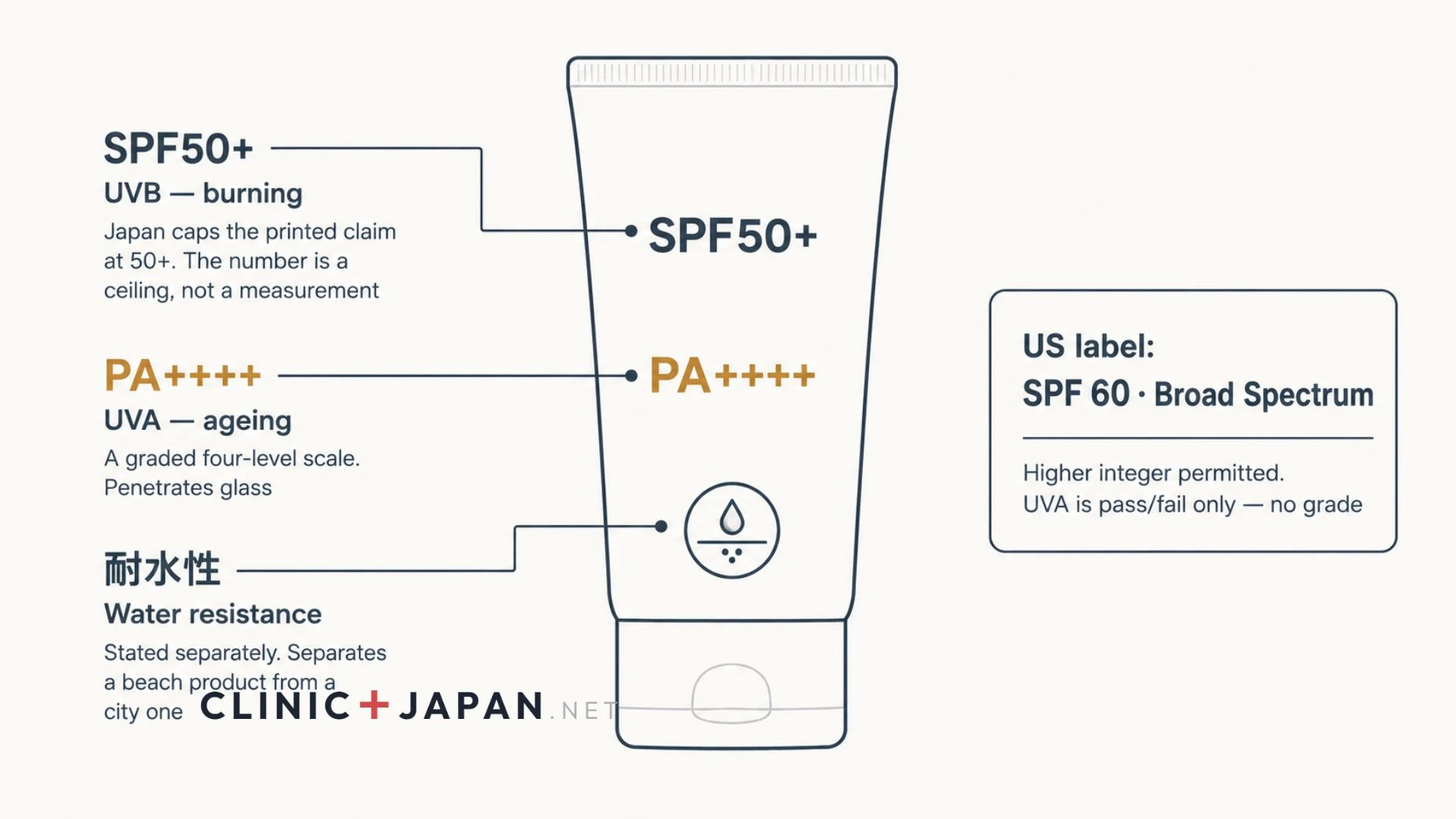
| SPF50+ | UVB — burning | Japan caps the printed claim at 50+. A product measuring far above that still prints "50+", so the number is a ceiling rather than a measurement |
| PA+ to PA++++ | UVA — ageing, and it penetrates glass | A four-level graded scale. The US has no graded equivalent, only a Broad Spectrum pass or fail |
| 耐水性 (water resistance) | Sweat and swimming | Stated separately when present. This is the property that separates a beach product from a city one |
2. Why the formulas differ from what you buy at home
Japanese sunscreens are regulated as cosmetics or quasi-drugs under Japan's own framework. US sunscreens are regulated as over-the-counter drugs under an FDA monograph, with a narrower list of approved UV filters.
That single difference explains most of why Japanese sunscreen feels different. Filters available to Japanese formulators but not approved for US sunscreens allow lighter, more cosmetically elegant textures at high protection levels — which is the actual reason the category developed the way it did, and why a bottle bought in Tokyo and a same-brand bottle bought in New York can contain different ingredients.
| Filter | Status |
|---|---|
| Bis-ethylhexyloxyphenol methoxyphenyl triazine (trade name Tinosorb S) | Widely used in Japan and Europe. Not on the US approved list for sunscreens |
| Diethylamino hydroxybenzoyl hexyl benzoate (trade name Uvinul A Plus) | A UVA filter used across Japanese and European formulas. Not on the US list |
| Avobenzone, octinoxate, zinc oxide and similar | Approved in both markets — the shared baseline that US sunscreens are built from |
The commonly repeated framing is that this reflects regulatory pace rather than a safety finding: these filters have long track records in Japan, Europe and Australia, and the US approval route for a new sunscreen active is slow because the product is classed as a drug there. That is a reasonable reading, but it is an argument about process rather than a verdict on any individual ingredient, and we would treat anyone claiming Japanese filters are simply "safer" with the same scepticism as anyone claiming the reverse.
3. The four brands worth knowing, by price
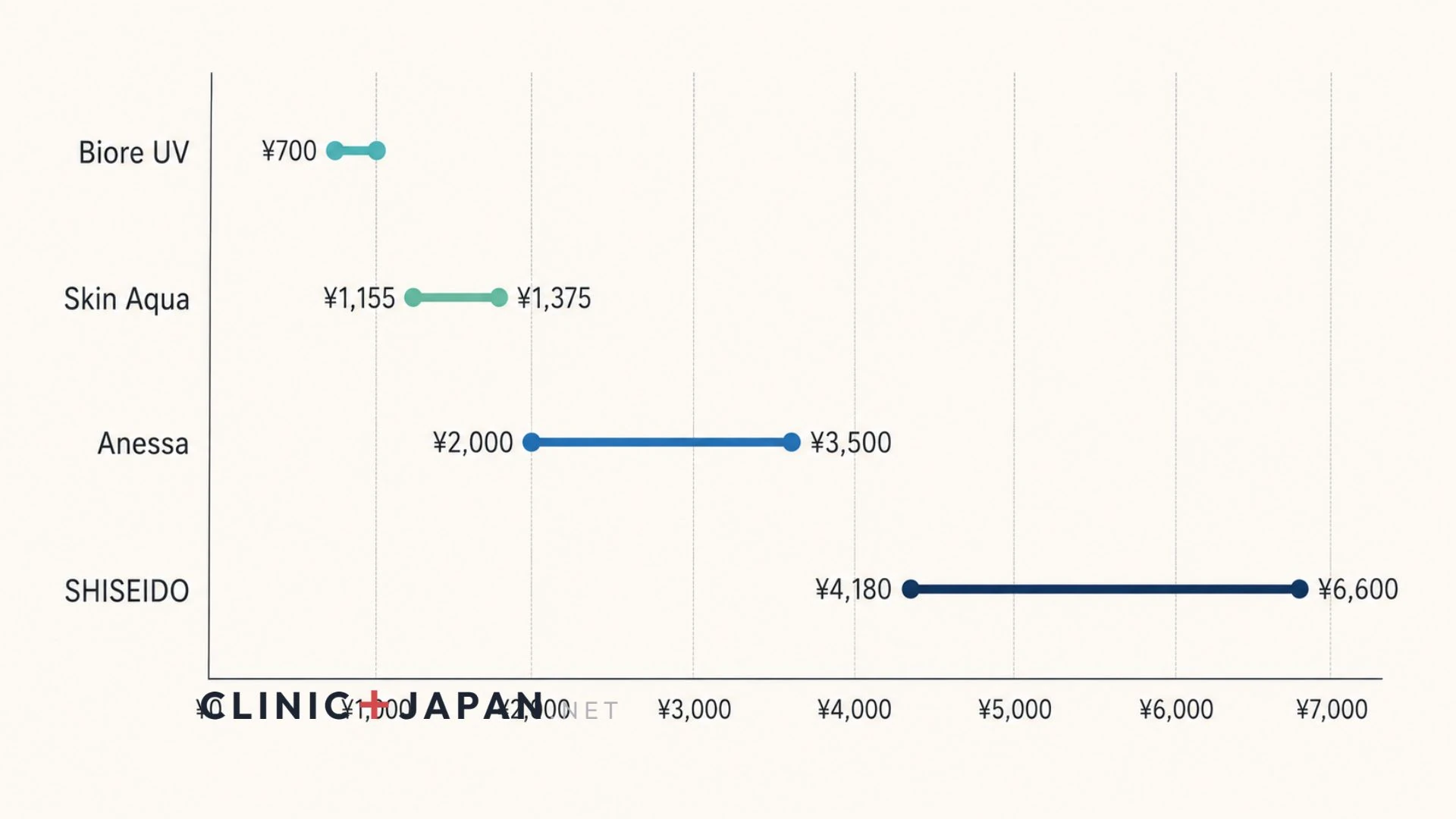
Japan's drugstore sunscreen aisle is one of the most competitive retail categories anywhere. Four names cover almost everything an English-speaking visitor will be looking for, and they sit at genuinely different points rather than being interchangeable.
| Brand | Price band | Buy it for | Full guide |
|---|---|---|---|
| Biore UV | From around ¥700 | The cheapest credible daily sunscreen. Watery, light textures | Biore UV guide |
| Skin Aqua | ¥1,155–1,375 list, often far below | Tone-up and colour correction. Doubles as a makeup base | Skin Aqua guide |
| Anessa | Roughly ¥2,000–3,500 | Water resistance. The one for beaches, sweat and long days outdoors | Anessa guide |
| SHISEIDO (house brand) | ¥4,180–6,600 | Department store counter. The clear stick format for reapplication | Shiseido guide |
4. Which one to buy, by what you are doing
The brand question is less useful than the situation question. Almost everyone needs one everyday product and, if they are outdoors, one water-resistant one.
| Your situation | What to buy |
|---|---|
| Daily city use, commuting, indoors | Biore UV or Skin Aqua. Cheap enough that you will apply enough of it, which matters more than the brand |
| Sightseeing, hours outdoors | Anything, plus a reapplication plan. A stick or powder for the midday top-up is worth more than upgrading the morning product |
| Beach, pool, heavy sweat | Anessa. Water resistance is a formulation property and the value brands do not have it in the same way |
| Under makeup | Skin Aqua's tone-up range doubles as a base. Reapplying a liquid over foundation does not work — switch to a stick or powder for top-ups |
| Sensitive or reactive skin | Look for ノンケミカル (mineral / non-chemical) versions. Most brands make one |
| Children | Dedicated children's versions exist in most lines and are formulated milder. Ask at the counter rather than guessing |
Reapplication, and what the brands claim about it
The standard guidance is to reapply roughly every two hours of sun exposure, and immediately after swimming, towelling or heavy sweating. That is the part almost nobody does, and it matters more than any choice between the four brands above.
Anessa markets a technology it describes as a protective film that strengthens on contact with sweat and water rather than breaking down. Whether you find that persuasive or not, it is a manufacturer claim about durability, not a licence to skip reapplication — the brand still recommends reapplying. Treat marketing about self-reinforcing films as a reason to trust a product through a sweaty afternoon, not as a reason to apply once and forget.
| Situation | Format that works |
|---|---|
| Bare skin | Anything. Reapply the same product you started with |
| Over makeup | A stick or a pressed powder. A liquid will move your base and you will stop doing it |
| Scalp and part line | A spray, which is the one place spray formats genuinely earn their place |
| Around the eyes | Stick formats give the most control. Avoid spraying near the eyes |
5. Buying and bringing it home
| Where | Notes |
|---|---|
| Drugstore chains | Matsumoto Kiyoshi, Welcia, Sundrug. Sunscreen is a summer loss-leader — discounts are the norm, not the exception |
| Don Quijote | Usually the lowest prices, multi-buys common, chaotic to navigate |
| Department stores | The SHISEIDO house line and other prestige brands. Not where the value is |
| Convenience stores | Travel sizes. Convenient, poor value per gram |
| Airport duty-free | Rarely stocks the value brands and rarely worth it when it does |
Tax-free shopping needs your passport and a minimum spend per store per day, so consolidate cosmetics into one shop rather than spreading purchases across a trip. For the wider drugstore picture see Japanese skincare and Japanese beauty products.
6. Japan's UV season is longer than visitors expect
Sun protection in Japan is not a July concern. UV levels are meaningful from roughly March through October, and the Japanese domestic habit of year-round daily sunscreen is not excessive caution — it is a large part of why this retail category is as developed as it is.
Visitors arriving in a Japanese spring routinely underestimate this because the temperature does not feel like sunburn weather. Two further factors that temperate-climate guides skip: summer humidity disturbs sunscreen faster than dry heat does, and reflected UV from concrete in dense city environments adds exposure a hat does not solve. Our guide to when to visit Japan covers what each month actually feels like on the ground.
| Concern | Realistic route |
|---|---|
| Preventing new pigmentation | Daily sunscreen, plus a brightening product if you want one — see Melano CC at ¥1,210 |
| Existing sun spots | A clinic question. Drugstore brightening products are approved in Japan to prevent, not remove |
| Treatment options in Japan | Pico laser and laser treatment, priced well below Western equivalents |
7. The short answer
If you want one recommendation: buy Biore UV or Skin Aqua for daily use because they are cheap enough that you will apply enough, and add Anessa only if you are going to be in water or sweating. Skip the SHISEIDO house brand unless you specifically want the clear stick for reapplication — it is the one Japanese beauty category where the domestic price is not the bargain, and the same company's Anessa costs roughly half.
Then apply more than you think you need, and reapply. That does more than any choice between the four names above.
8. FAQ
Sources & Method
This is a category overview rather than a product review. Price bands are carried over from our four brand guides, where the underlying manufacturer list prices and their check dates are documented; we did not re-survey prices for this page, and street prices in Japanese drugstores commonly run below list. Regulatory statements are from the FDA and the Japan Cosmetic Industry Association. The brand-by-situation recommendations, the tone-up warning and the closing verdict are our own editorial position, not manufacturer claims.
| Source | Used for |
|---|---|
| Sunscreen: How to Help Protect Your Skin from the Sun US Food and Drug Administration · primary · accessed 8 Aug 2026 | US regulation of sunscreen as an over-the-counter drug, the Broad Spectrum pass/fail designation, the narrower approved filter list, and the principle that application density governs real-world protection — sections 1 and 2 |
| Japan Cosmetic Industry Association JCIA · primary · accessed 8 Aug 2026 | The Japanese industry measurement standards behind the SPF50+ ceiling and the PA+ to PA++++ UVA scale in section 1 |
| Cosmetics and quasi-drugs policy pages Ministry of Health, Labour and Welfare (Japan) · primary · accessed 8 Aug 2026 | Japan's cosmetic and quasi-drug framework, and the basis for the statement in section 6 that Japanese brightening products are approved to prevent rather than remove pigmentation |
| Source | Used for |
|---|---|
| Price bands carried over from our brand guides ClinicJapan Research Team · Not re-surveyed for this page | Sections 3 and 7. Manufacturer list prices and their check dates are documented on the four linked brand guides. Japanese drugstores discount heavily and street prices run below list |
| Brand-by-situation recommendations ClinicJapan Research Team · Editorial judgement | Sections 4 and 7 in full. Our conclusion that a cheaper sunscreen applied generously beats an expensive one rationed follows from the known gap between tested and real-world application density, but the buying advice is ours |
| The tone-up cast warning ClinicJapan Research Team · Editorial assessment consistent with widely reported user experience, not a measured test | Section 4 and the FAQ. Manufacturers make no claim about performance across skin tones; the observation that paler-direction tinting can read ashy on deeper skin is our reading |
| Named UV filters ClinicJapan Research Team · Widely documented industry knowledge · not taken from the FDA page cited above | Section 2. Tinosorb S and Uvinul A Plus are trade names for filters used in Japanese and European sunscreens and not approved for US sunscreens. The FDA source above establishes that the US list is narrower; the specific filter names and the regulatory-pace framing are our own summary of widely reported industry context, and we deliberately stop short of calling either market's filters safer |
| Reapplication guidance and the Anessa durability claim ClinicJapan Research Team · General guidance plus a manufacturer marketing claim, reported as such | Section 4. The two-hour interval is standard sun-protection guidance. Anessa's sweat-activated film is the manufacturer's own marketing claim, which we report without endorsing and without treating as a reason to reapply less often |
| UV season and urban reflected UV ClinicJapan Research Team · Editorial framing, not sourced measurements | Section 6. We describe general patterns rather than citing UV index data for specific months or locations |
| No products ranked or scored Editorial note · Transparency item | Throughout. We take no commission from any brand or retailer named here and publish no ranking. Individual product detail lives on the four linked brand guides |
Related Guides
About this guide: This is an independent guide. We receive no commission from Kao, Rohto, Shiseido, any retailer, or any brand named or linked above, and nobody paid to be included or excluded. Prices, formulations and product lineups change constantly in this category — confirm before buying. Sunscreen selection for a diagnosed skin condition, photosensitivity, or for infants is a question for a doctor or pharmacist. Informational only; not medical advice.