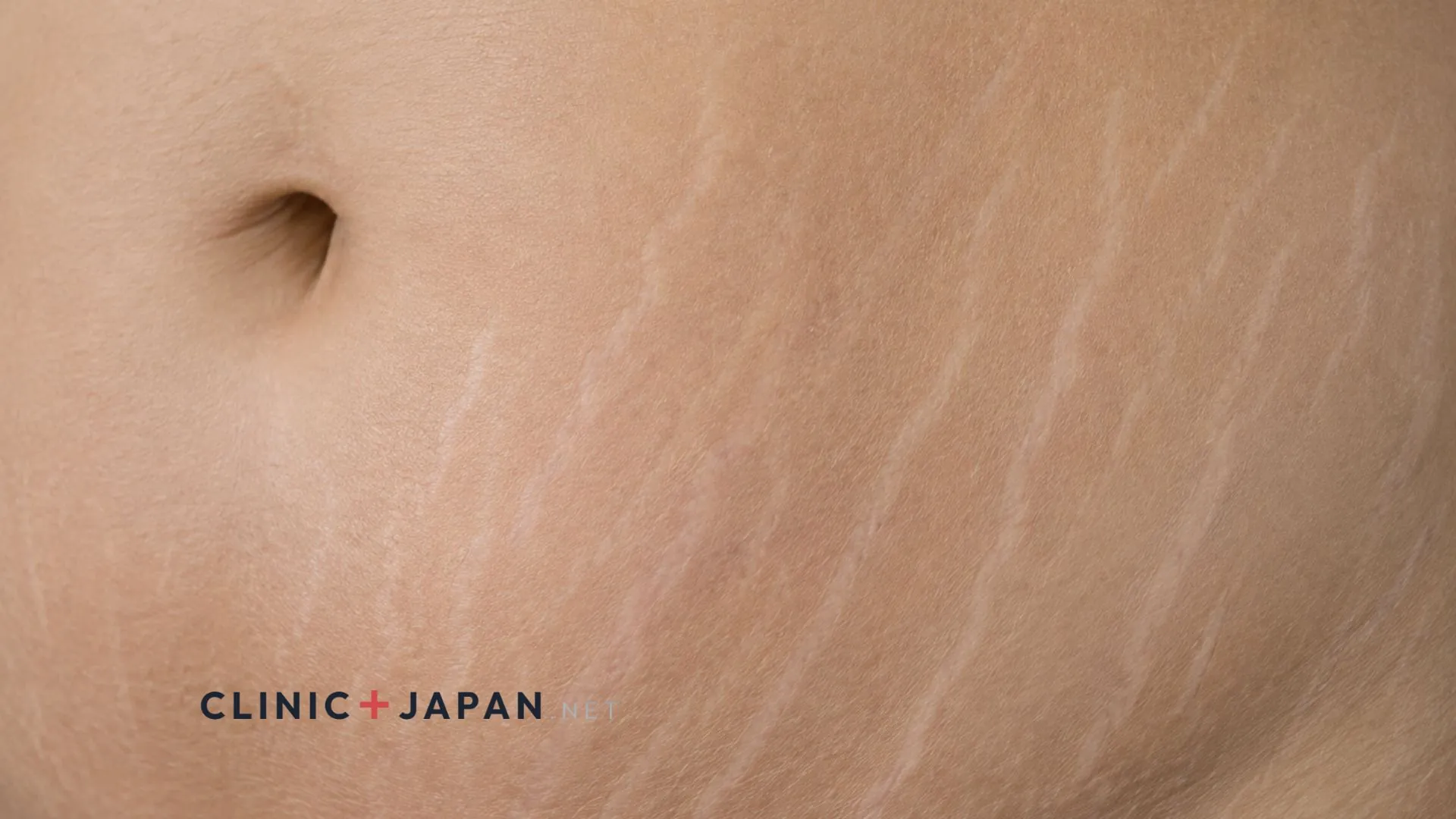
1. What a stretch mark actually is
The clinical name is striae distensae, and the definition matters more than it sounds: they are a form of dermal scarring. Not dryness, not a surface texture issue, not something sitting on top of the skin. When skin is stretched faster than the dermis can remodel, the collagen and elastic fibre network tears, and what you see afterwards is the repair.
They occur in pregnancy, puberty and rapid weight change, and also with a range of medical conditions and treatments — corticosteroid use is a well-documented one. The proposed mechanisms in the literature involve hormones, physical stretch and structural changes to the skin acting together, which is why no single cause explains everyone's.
2. The prevention question, and its uncomfortable answer
Striae gravidarum affect between 50% and 90% of pregnant women, and the market that has grown around preventing them is enormous. The evidence behind it is not.
A Cochrane review pooled six randomised and quasi-randomised trials covering 800 women, comparing topical preparations containing active ingredients against placebo, other actives, or no treatment. The result: no statistically significant difference in whether stretch marks developed — a risk ratio of 0.74 with a confidence interval running from 0.53 to 1.03, crossing 1. No significant difference in severity either. A sensitivity analysis excluding the weaker trials moved the number barely. The authors' conclusion is unambiguous: no high-quality evidence supports the use of any of the topical preparations for preventing stretch marks in pregnancy.
A separate comprehensive review in the British Journal of Dermatology, evaluating both prophylaxis and treatment across the literature, reached the same place from a different direction: topical therapeutic agents appear to lack efficacy in the prevention of striae distensae, and few high-level randomised controlled trials exist in this field at all.
3. Red versus white — the one variable you partly control
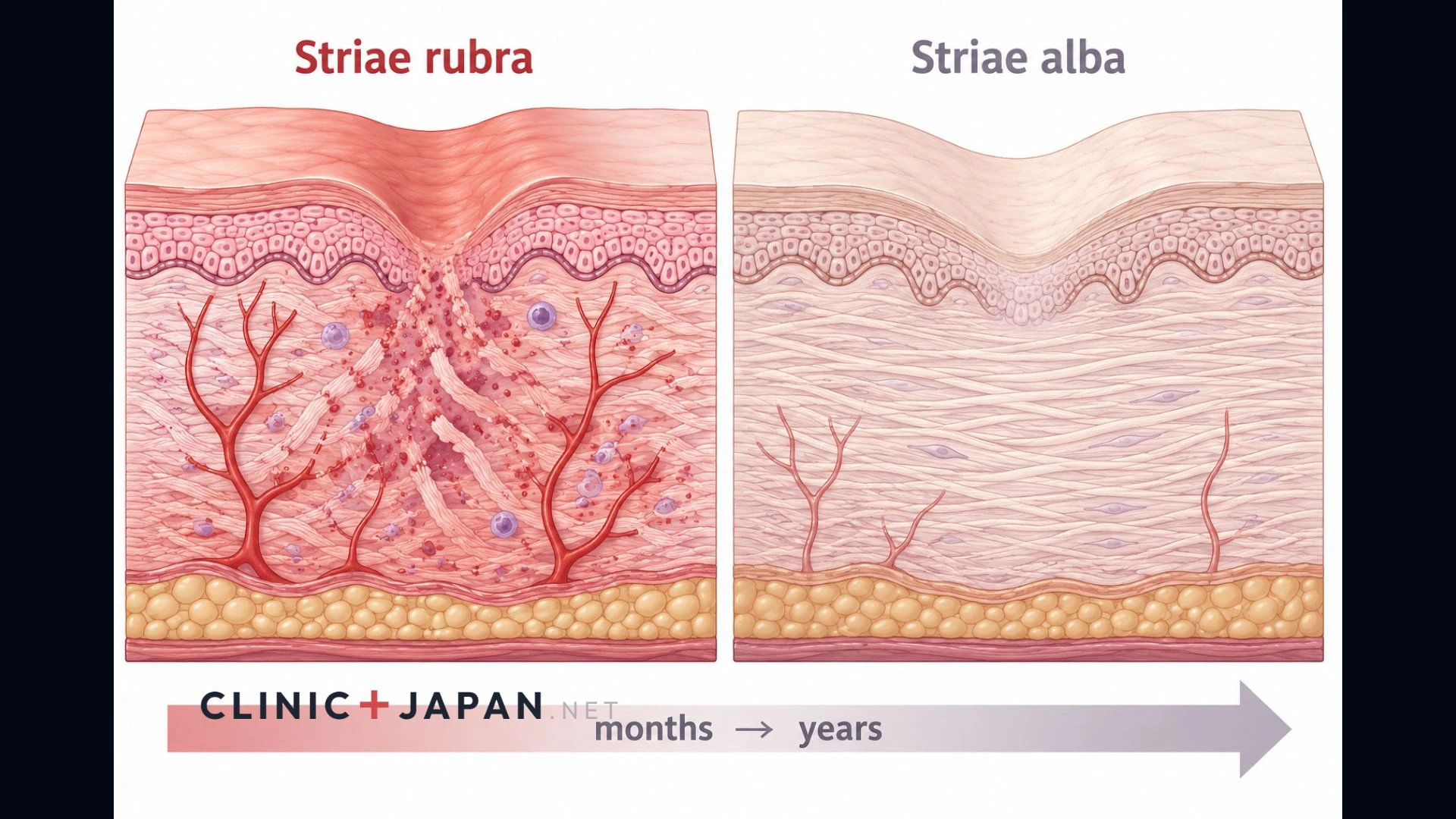
Stretch marks pass through stages. Early lesions are striae rubra: red or purple, inflamed, still vascular. Over months to years they mature into striae alba: pale, flat or slightly depressed, and permanent.
| Striae rubra (red) | Striae alba (white) | |
|---|---|---|
| What it looks like | Red to purple, sometimes slightly raised, occasionally itchy | Pale, sometimes lighter than the surrounding skin, often slightly sunken |
| What is happening | Active inflammation and vascularity in a recent dermal tear | A mature, settled scar with reduced pigment |
| Treatment response | Generally the more responsive stage — there is an active process to influence | Harder. Most of the published device work is done here because most people present here |
| Time window | Months, not years | Indefinite. They do not resolve on their own |
The practical implication: if yours are still red, the decision to seek treatment is more time-sensitive than the internet suggests. If they are already white, nothing is lost by taking your time to choose the right clinic — they are not going anywhere.
4. What actually moves the needle
The treatments with meaningful published evidence all do the same thing by different means: create controlled microscopic injury in the dermis so that the healing response lays down new collagen. The comparisons between them are more interesting than the individual results.
| Comparison | What was found | Practical read |
|---|---|---|
| Microneedling overall | A meta-analysis of 11 studies (six RCTs, five non-randomised) found a significant effect for the microneedle radiofrequency subgroup, and patient satisfaction significantly higher for microneedling than for either laser or non-laser comparators | The satisfaction gap is the striking part. Patients rated it above lasers even where clinical improvement was comparable |
| Microneedling vs lasers, clinically | Comparable effectiveness, with no significant difference between them in the pooled analysis | Device choice is less decisive than the marketing implies |
| Microneedle RF vs fractional CO2 | A separate meta-analysis found no significant difference on either professional assessment or patient self-assessment — but post-inflammatory hyperpigmentation was significantly less frequent with microneedle RF (odds ratio 0.24) | If your skin pigments readily, this is the single most useful number on the page |
| Pain and downtime | The same microneedling meta-analysis found significantly more pain than laser therapy. A randomised split-abdomen trial found the reverse for downtime — adverse events lasted longer after laser (4.03 days) than microneedling (3 days) | Trade one against the other according to what you can tolerate |
| Does anything change the tissue? | In that randomised trial, biopsies showed significantly increased collagen and elastic fibres after the third and fifth sessions with both modalities | The remodelling is real and measurable, not merely a lighting effect in before-and-after photos |
The most human finding in this literature comes from that same randomised study of 20 women with striae on the abdomen, treated over five monthly sessions. Dermatology Life Quality Index scores — a measure of how much a skin condition interferes with daily life — fell from an average of 8.4 before treatment to 3.17 after the third session and 2.64 after the fifth. Patient-reported improvement was similar for both modalities. That is a study measuring the thing people actually want, which is rarer than it should be.
5. Skin tone changes the calculation
Post-inflammatory hyperpigmentation — darkening at the treated site after the inflammation settles — is the complication that turns a cosmetic improvement into a cosmetic problem, and its risk rises with melanin content.
This is why the odds ratio of 0.24 for pigmentation with microneedle radiofrequency versus fractional CO2 is worth carrying into a consultation. Both approaches produced statistically indistinguishable improvement in the pooled analysis; one of them carried a meaningfully lower pigmentation risk. When two options work equally well and differ on side effects, the side effect profile is the whole decision.
The randomised trial with biopsy confirmation was conducted specifically in Fitzpatrick skin types III and IV and concluded that both non-ablative fractional laser and microneedling were safe in those phototypes. That is directly relevant to the majority of patients treated in Japanese clinics.
6. What this costs in Japan — and a 10x price spread
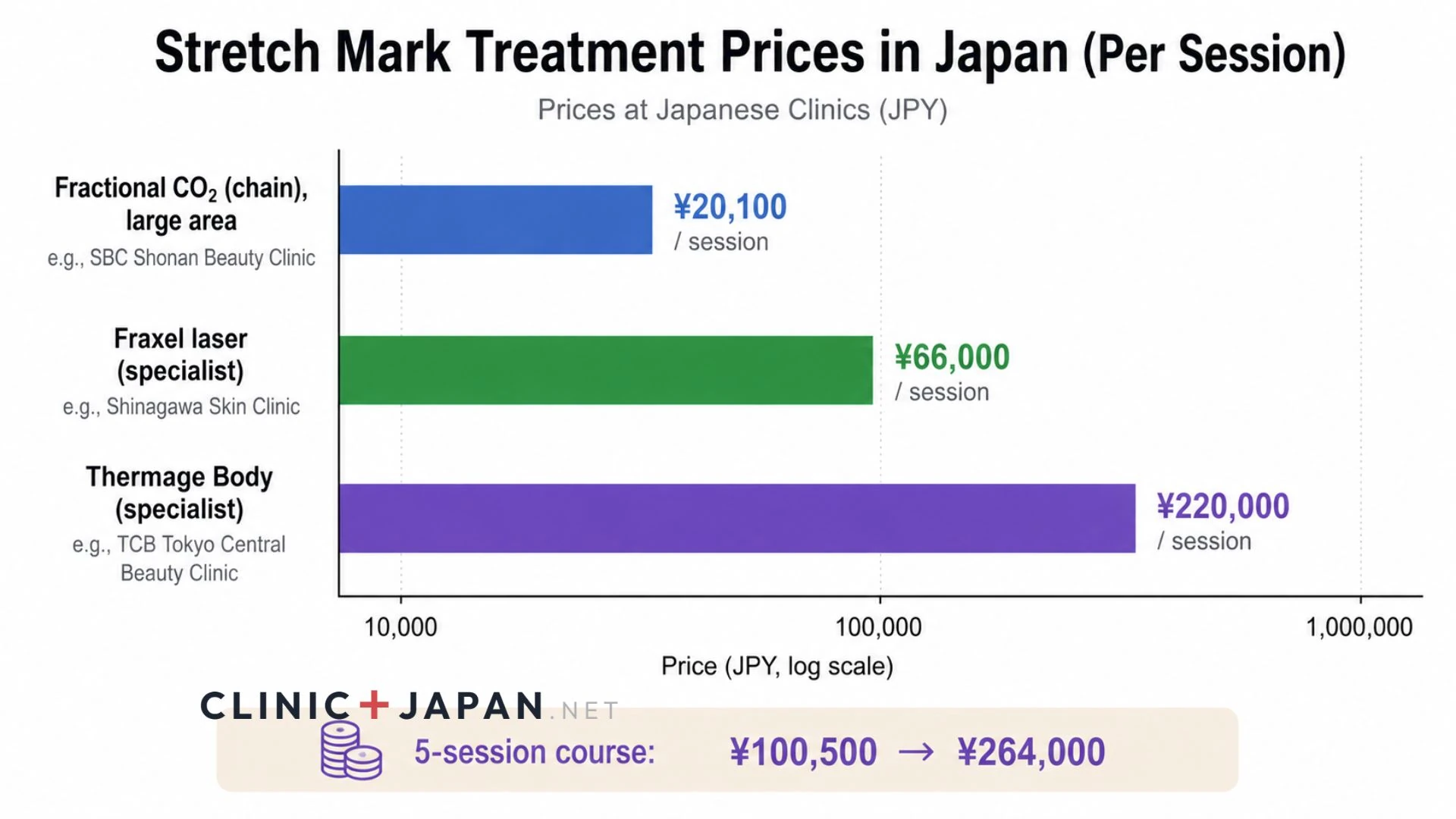
Stretch mark treatment in Japan is entirely jiyu shinryo, private-pay: no insurance coverage, published price lists, and a very wide spread depending on where you go. The spread is large enough to be worth understanding before you book.
| Clinic and treatment | Price per session (tax incl.) | Area covered |
|---|---|---|
| Shonan Beauty Clinic — fractional CO2, standard | ¥6,200 small / ¥10,600 medium / ¥20,100 large | The "large" category covers exactly the stretch mark areas: abdomen, hips, back, thighs, upper arms |
| Shonan Beauty Clinic — CO2 Skin Premium | ¥9,800 / ¥13,500 / ¥26,800 | Same areas, different post-treatment product |
| Shirono Clinic — Fraxel laser | ¥66,000 per session; ¥178,200 for three; ¥264,000 for five | Lower abdomen, hips, inner thigh or outer thigh |
| Shirono Clinic — Thermage Body | ¥220,000 per session (¥330,000 if physician-performed, upper arm) | Upper arm, lower abdomen, hips, inner thigh, around the knee |
One more thing worth noting, because it is on a Japanese clinic's own page rather than ours: asked directly whether stretch marks can be completely erased, Shirono Clinic's published answer is that complete removal is difficult, and that marks fade and become less noticeable over time after pregnancy. A clinic saying that on its own sales page is a reasonable benchmark for the honesty you should expect elsewhere.
For the device landscape and pricing generally, our guides to laser treatment in Japan, pico laser in Tokyo and skin treatment in Japan cover what each platform does. If you are travelling for this, medical tourism in Japan and English-speaking clinics are the practical starting points — and note that body treatments generally need a course, which makes them a poor fit for a single short trip.
7. Our position
The question "how do I get rid of stretch marks" has a disappointing answer and a useful one, and they are different questions.
Getting rid of them: you cannot. They are dermal scars, no modality in the literature clears them, and the reviews are consistent that high-quality evidence is scarce even for the improvements that are achievable. Any product or clinic promising removal is describing an outcome that does not appear in the published literature.
Making them substantially less noticeable: yes, and with better evidence than most cosmetic categories. Microneedling and fractional devices produce comparable clinical improvement, biopsies confirm new collagen and elastic fibre after a course, and the quality-of-life measurement in the randomised trial fell by roughly two-thirds. That is a real result.
So the sensible plan is: skip the prevention cream if you are buying it for prevention. Treat early if they are still red. If they are white, choose on side-effect profile rather than device name — microneedle radiofrequency if your skin pigments easily, laser if you would rather trade a day of downtime for less pain during the session. Budget for four to six sessions, not one. And measure success the way that trial did: not by whether you can still find the marks, but by whether you have stopped thinking about them.
8. FAQ
Sources & Method
Every clinical claim here is sourced to a named, PubMed-indexed paper, and each PMID below was confirmed against the PubMed record rather than taken from a secondary summary. Effect sizes, confidence intervals and odds ratios are reported exactly as the source study reports them. Japanese prices are taken directly from the clinics' own published Japanese-language price tables, fetched on 14 August 2026, and are tax-inclusive as those clinics state them — they are two specific clinics, not a market survey, and prices change without notice. The 'price the course, not the session' advice, the red-versus-white urgency framing and the device-choice recommendation in section 7 are our own editorial position rather than findings from any cited paper.
| Source | Used for |
|---|---|
| Topical preparations for preventing stretch marks in pregnancy (PMID 23152199) Brennan et al., Cochrane Database of Systematic Reviews, 2012 · Cochrane review, 6 trials / 800 women · accessed 14 Aug 2026 | All of section 2 — the 50% to 90% prevalence figure for striae gravidarum, the risk ratio of 0.74 (95% CI 0.53–1.03) for development of stretch marks, the absence of a significant difference in severity, the sensitivity analysis, and the authors' conclusion that no high-quality evidence supports any topical preparation for prevention |
| Striae distensae: a comprehensive review and evidence-based evaluation of prophylaxis and treatment (PMID 24125059) Al-Himdani et al., British Journal of Dermatology, 2014 · comprehensive systematic review · accessed 14 Aug 2026 | Section 1's description of striae as dermal scarring, the aetiological mechanisms (hormones, physical stretch, structural alteration) and the settings in which they occur; and section 2's finding that topical agents appear to lack efficacy in prevention and that few high-level RCTs exist |
| Microneedling Therapy for Striae Distensae: Systematic Review and Meta-Analysis (PMID 38509316) Sun et al., Aesthetic Plastic Surgery, 2024 · systematic review and meta-analysis, 11 studies · accessed 14 Aug 2026 | Section 4's microneedling rows — the 11 included studies (six RCTs, five non-randomised), the significant effect in the microneedle radiofrequency subgroup (SMD 0.57, 95% CI 0.20–0.94), comparable effectiveness against lasers with no significant difference, significantly higher patient satisfaction than laser and non-laser comparators, lower post-inflammatory hyperpigmentation, and significantly greater pain than laser therapy |
| Comparing fractional microneedle radiofrequency and fractional CO2 laser for striae distensae (PMID 39516426) Aktoz & Yilmaz, Lasers in Medical Science, 2024 · systematic review and meta-analysis · accessed 14 Aug 2026 | The head-to-head row in section 4 and all of section 5 — no significant difference on professional assessment (OR 1.27, 95% CI 0.49–3.31) or patient self-assessment (OR 0.72, 95% CI 0.13–3.90), and significantly less post-inflammatory hyperpigmentation with microneedle radiofrequency (OR 0.24, 95% CI 0.08–0.70) |
| Efficacy of Microneedling Versus Fractional Non-ablative Laser to Treat Striae Alba: A Randomized Study (PMID 30618025) Naspolini et al., American Journal of Clinical Dermatology, 2019 · randomised split-abdomen trial, 20 women · accessed 14 Aug 2026 | The downtime, biopsy and quality-of-life findings in sections 4 and 5 — five monthly sessions in Fitzpatrick types III and IV, no significant difference in patient-reported improvement between modalities, significantly increased collagen and elastic fibres on biopsy after the third and fifth sessions, Dermatology Life Quality Index falling from 8.4 to 3.17 to 2.64, pain scores of 5.23 for microneedling against 2.39 for laser, and adverse event duration of 4.03 days for laser against 3 days for microneedling |
| Advances in the Treatment of Striae Distensae (PMID 41560402) Wu & Wang, Journal of Cosmetic Dermatology, 2026 · systematic review · accessed 14 Aug 2026 | Section 4's framing of the current treatment landscape and the trend towards individualised combination strategies, including combination approaches for both striae rubra and alba |
| Source | Used for |
|---|---|
| Fractional CO2 laser price table Shonan Beauty Clinic (湘南美容クリニック) · clinic's own published prices, tax incl. · fetched 14 Aug 2026 | Section 6's ¥6,200 / ¥10,600 / ¥20,100 standard and ¥9,800 / ¥13,500 / ¥26,800 premium per-session prices, and the clinic's own definition of the 'large' area category as including the abdomen, hips, back, thighs and upper arms |
| Stretch marks and striae treatment page Shirono Clinic (シロノクリニック) · clinic's own published prices, tax incl. · fetched 14 Aug 2026 | Section 6's Fraxel prices (¥66,000 single session, ¥178,200 for three, ¥264,000 for five, for lower abdomen, hips, inner or outer thigh) and Thermage Body prices (¥220,000 per session, ¥330,000 physician-performed upper arm), plus the clinic's published FAQ answer that completely erasing stretch marks is difficult |
| Source | Used for |
|---|---|
| 'Price the course, not the session' ClinicJapan Research Team · Our conclusion from combining the trial protocols with the clinic price tables | Sections 4 and 6. The four-to-six session figure comes from the cited trials and reviews; the arithmetic applying it to the published Japanese prices, and the advice that follows, are ours |
| Red-versus-white urgency framing ClinicJapan Research Team · Editorial framing of the staging literature | Section 3. That striae rubra generally respond better is standard in the reviews; the practical instruction to act sooner while they are red is our framing and no trial has tested it as a strategy |
| Device choice by side-effect profile ClinicJapan Research Team · Editorial recommendation | Sections 5 and 7. The equivalence and pigmentation findings are from the cited meta-analyses; the recommendation to choose on side-effect profile rather than device name is our judgement, and it does not replace an assessment of your own skin by a doctor |
| Two clinics is not a market survey ClinicJapan Research Team · Transparency item | Section 6. The prices are quoted accurately from two clinics' own published tables, but they are two data points at opposite ends of the market and should not be read as the Japanese average |
Related Guides
About this guide: This is an independent guide. We receive no commission from any clinic, device manufacturer, brand or retailer named or linked above, and nobody paid to be included — the two clinics whose prices we quote were chosen because they publish transparent price tables, not because of any relationship. Prices are quoted from those clinics' own pages as of 14 August 2026 and change without notice. Laser, radiofrequency and microneedling are medical procedures requiring a qualified practitioner, and suitability depends on skin type and the stage of the striae. Sudden or widespread striae without an obvious cause such as pregnancy or weight change can occasionally signal an underlying medical condition and should be assessed by a doctor. Informational only; not medical advice, and not a substitute for consultation with a physician.