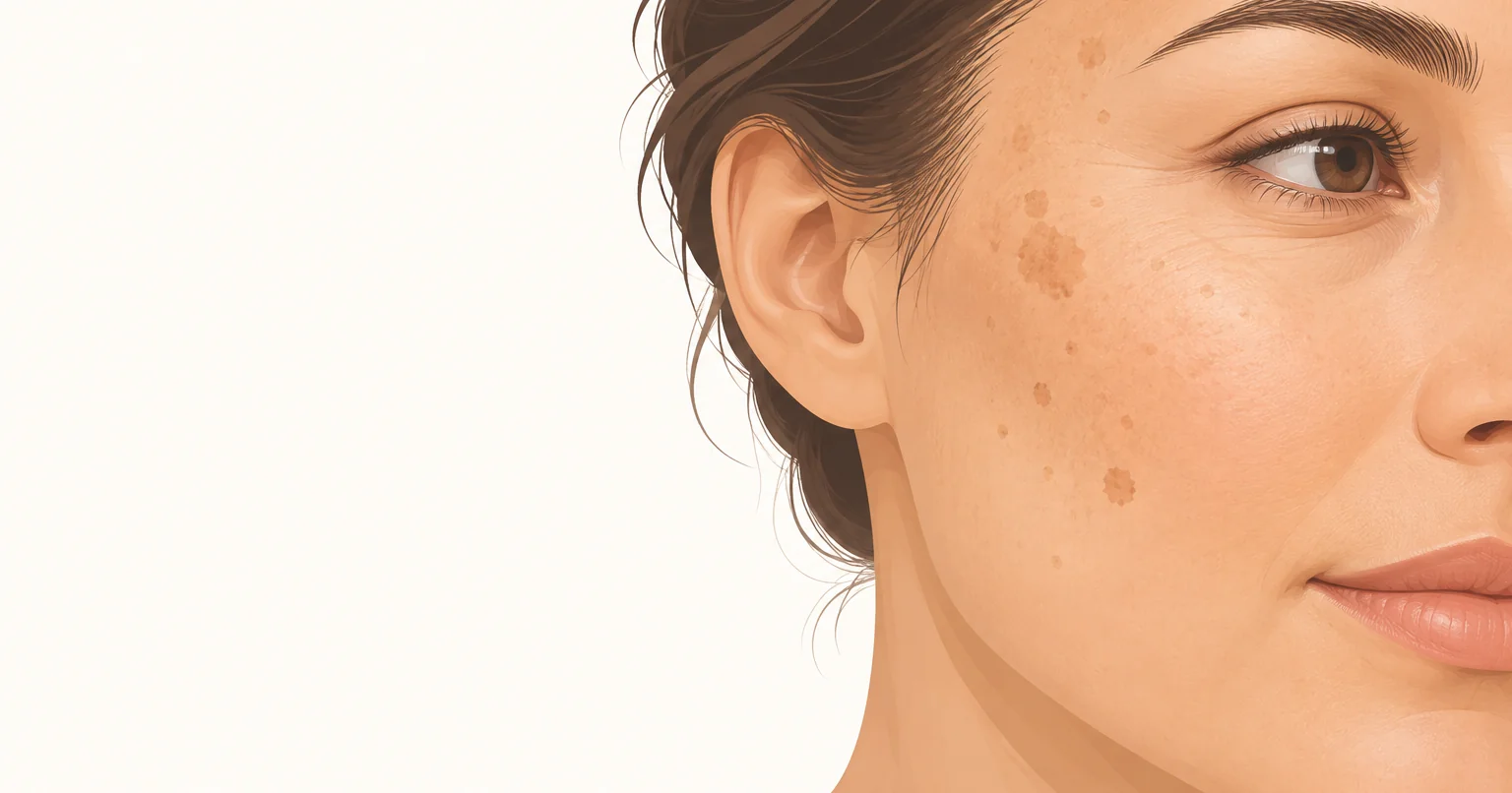
1. Which kind of dark spot do you have?
“Hyperpigmentation” just means skin that is darker than the skin around it. A 2023 review of pigment disorders groups the common causes by how deep the pigment sits: in the top layer of skin, deeper in the dermis, or both. Depth matters because it decides which treatment works. Surface pigment responds to lasers, light and creams. Deeper pigment needs different lasers and more sessions. And some types get darker if they are treated like the others.
| Type | What it looks like | What usually works |
|---|---|---|
| Sun spots solar lentigines; Japanese: 老人性色素斑 | Flat, round brown spots with clear edges on the face, hands and arms; appear from the 30s | Spot laser (Q-switched or picosecond), IPL |
| Freckles Japanese: そばかす | Small, scattered light-brown dots, often from childhood; darker in summer | IPL or laser; they return with sun |
| Post-inflammatory hyperpigmentation (PIH) | Brown or grey marks where acne, a rash, a burn or a procedure has been | Time, sunscreen, retinoids and other creams; gentle laser only |
| Melasma | Blurred, symmetrical patches on both cheeks, forehead or upper lip | A separate plan: see our melasma guide |
| Deeper grey-blue patches acquired dermal melanocytosis (ADM); Japanese: ADM, 後天性真皮メラノサイトーシス | Grey-brown or bluish spots on both cheekbones, often appearing in adulthood, common in East Asian skin | Q-switched or picosecond laser over several sessions |
Many faces have two or three of these at once, typically sun spots with some melasma or post-acne marks. That is the main reason to have a doctor look before any laser: a setting that clears a sun spot can darken melasma next to it.
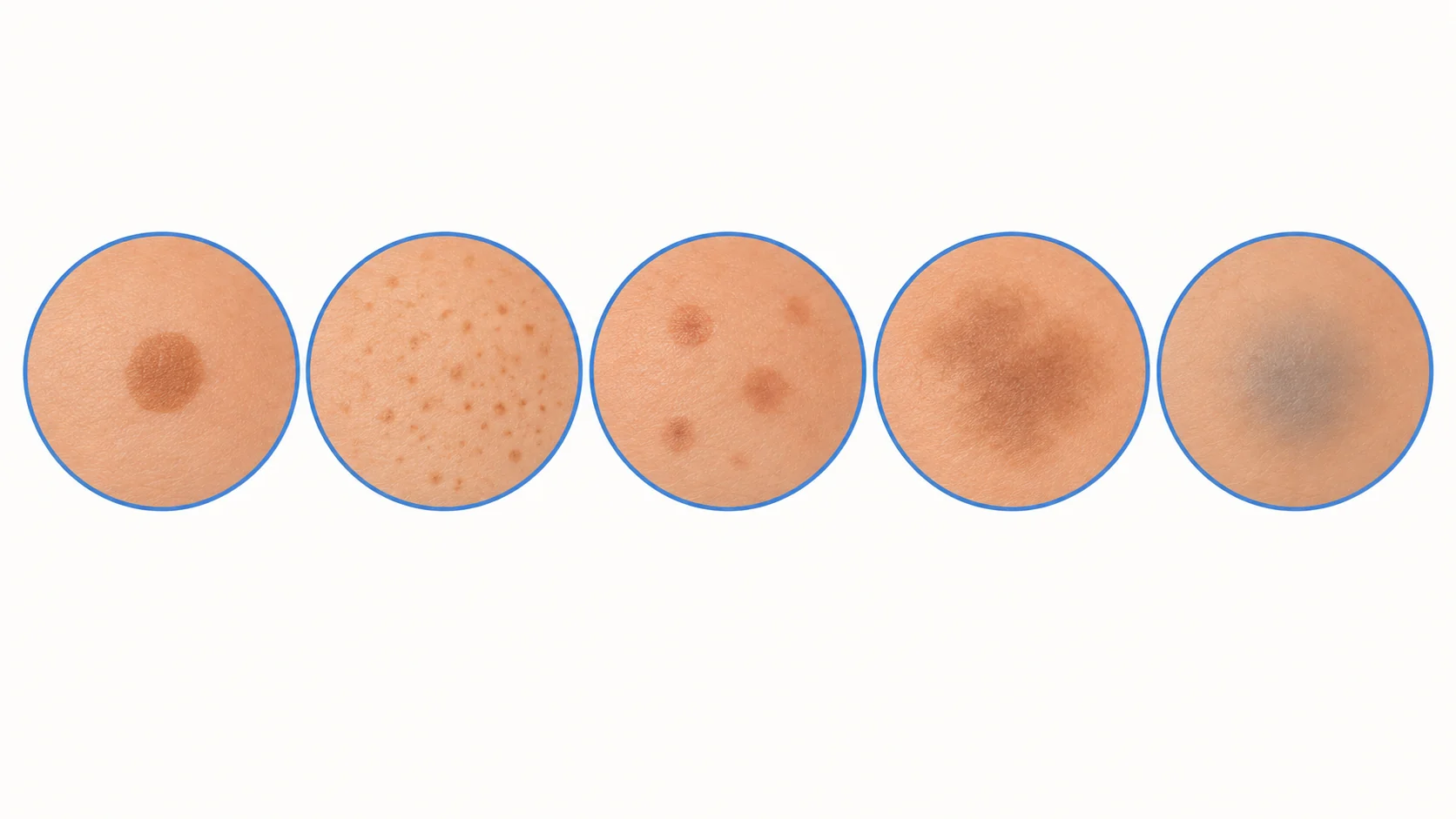
2. Sun spots and freckles: where lasers shine
Sun spots are the easiest type to treat. A 2025 systematic review of 41 clinical trials and 3,234 patients compared the options. Reported success rates were 67.9–93.0% for picosecond laser, 74.6–90% for IPL, 36.4–76.6% for Q-switched laser, 37–71.4% for freezing (cryotherapy), 27–57% for pulsed dye laser and 12–46% for trichloroacetic acid peels. The most commonly studied effective cream, mequinol 2% with tretinoin 0.01%, reached 52.6% to over 80%, particularly on the face. The authors concluded that lasers appear more effective than other options, with most side effects mild and temporary; pulsed dye laser and IPL were less often linked to post-inflammatory darkening, and cryotherapy to more severe side effects.
The main risk with a spot laser is temporary darkening of the treated spot, called post-inflammatory hyperpigmentation (PIH). In a survey of 516 Korean patients treated with a Q-switched 532 nm laser, PIH occurred in 20.3%. It was more common in people whose spots were reddish (erythematous), and in those with diffuse uneven pigmentation elsewhere on the face. Newer picosecond lasers may lower the risk: in a split-face trial of 20 patients, PIH occurred on 5% of the picosecond-treated sides versus 30% of the Q-switched sides, and the picosecond side cleared better. A 28-patient trial on the arms found similar clearance with both lasers, so the evidence is promising rather than settled.
3. Marks after acne or irritation (PIH)
Post-inflammatory hyperpigmentation is the brown or grey mark that stays after a spot, rash, burn or procedure has healed. It is more common in darker skin, and most cases studied were marks after acne. It usually fades on its own over months, but it can take a long time, and ongoing inflammation (active acne, rubbing, irritating products) keeps feeding it.
The evidence is sobering about how complete the results are. A 2024 systematic review of 41 studies and 877 patients found that complete clearance was achieved in 18.1% of patients with lasers and energy devices, 5.4% with creams and 2.4% with combinations. Partial improvement was common: 84.9% with combinations, 72.4% with creams and 61.2% with lasers. In 2.6% of laser-treated patients the marks got worse. A separate review of 47 studies of creams found the strongest evidence for retinoids (such as tretinoin and adapalene), hydroxy acids and broad-spectrum sunscreen of SPF 30 or more, which was recommended in almost every study. Niacinamide, thiamidol and some plant-derived products also had good-quality studies.
In practice: treat any active acne first (see our acne treatment guide), use sunscreen every day, add a retinoid or a hydroxy-acid product, and be patient. If the mark is a dent rather than a colour, it is a scar, not pigmentation; our acne scars guide covers that.
4. Uneven skin tone and the creams that help
For a generally uneven or dull tone rather than distinct spots, creams and sun protection do most of the work. Three ingredients are worth knowing:
- Niacinamide. In a Procter & Gamble–run study of 18 Japanese women, a 5% niacinamide moisturiser reduced hyperpigmentation compared with the same moisturiser without niacinamide after 4 weeks. It is gentle and widely available.
- Retinoids. Tretinoin (prescription) and adapalene speed up skin turnover and have the best evidence for post-acne marks. They can irritate at first, so start slowly.
- Hydroquinone. A strong lightener: clinics prescribe 4–5%, and lower strengths are sold in Japanese cosmetics. It often irritates at first. A systematic review of 126 cases of a rare blue-black skin darkening called exogenous ochronosis found they were most often reported with concentrations above 4% (35.7%) and long courses (median 5 years); only four involved use of 3 months or less. Use prescription strengths only under a doctor’s instructions and for the period they set.
Tranexamic acid, best known as a melasma treatment, is also being tried for other pigmentation. A 2024 review notes that it is still used off-label for pigment problems other than melasma, and the evidence there is thinner.
5. Melasma and deeper pigment
Melasma behaves differently from everything above: it is driven by sunlight, visible light and hormones, comes back, and can be worsened by aggressive lasers. If your patches are blurred and symmetrical, read our melasma guide before booking any laser.
Acquired dermal melanocytosis (ADM) is a deeper, grey-brown or bluish pigment on both cheeks, seen often in East Asian patients and frequently mistaken for melasma or sun spots. Because the pigment sits deep in the skin, creams alone do not reach it. A Japanese study at the University of Tokyo treated 19 patients by first using tretinoin and hydroquinone to clear the surface pigment for 4–6 weeks, then a Q-switched ruby laser for the deep pigment, repeated two or three times. All patients had good to excellent clearing, over an average of 8.3 months, with post-inflammatory darkening in 10.5%. The lesson for a visitor: ADM is a project of several months, not a single session.
6. What dark-spot treatment costs in Japan
Spot removal is one of the most common treatments in Japanese cosmetic dermatology, and the large chains publish fixed prices by spot size.
| Treatment | Clinic | Price |
|---|---|---|
| Spot laser, face, by size | Shonan Beauty Clinic | ≤2 mm ¥2,680 · ≤4 mm ¥4,200 · ≤6 mm ¥5,980 · ≤10 mm ¥8,100 (not for melasma) |
| TCB Tokyo Central | Pico spot removal: ≤1 mm ¥6,600 · ≤5 mm ¥14,300 · ≤10 mm ¥20,900 | |
| Spot laser, bundles | Shonan Beauty Clinic | Up to 3 spots ¥9,800 (¥7,800 first time) · up to 10 spots ¥24,800 |
| Pico laser, unlimited spots, full face | Shonan Beauty Clinic | ¥49,800 per session |
| IPL (Photo RF) | Shonan Beauty Clinic | ¥9,980 (¥6,800 first time) · 5 sessions ¥44,000 |
| Hydroquinone 4% cream, 5 g | TCB Tokyo Central | ¥7,150 |
| Tretinoin 0.1% cream, 5 g not approved in Japan; supplied at the doctor’s discretion, outside the drug-injury relief scheme | TCB Tokyo Central | ¥5,800 |
| Tranexamic acid capsules (oral) | Shinagawa Skin Clinic | ¥2,640 for 60 capsules |
Prices are from the clinics’ own price pages and are planning figures, not quotes; some menus are offered only at certain branches. Consultation fees, numbing cream and aftercare tape may be extra. ClinicJapan has no partnership with the clinics listed.
Three things to check before you pay. First, how the clinic counts: by millimetre, by spot, or as a bundle. Ten small spots priced individually can cost more than a bundle or an unlimited session. Second, whether a doctor examines the spots first: chains exclude melasma, moles and warts from these menus (some say they “may” exclude them), and a doctor should confirm which spots are suitable. Third, the device: ask whether it is a Q-switched or picosecond laser, and whether IPL would suit scattered spots better. More detail is in our pico laser guide and laser treatment guide.
7. Spot removal on a trip: the timeline
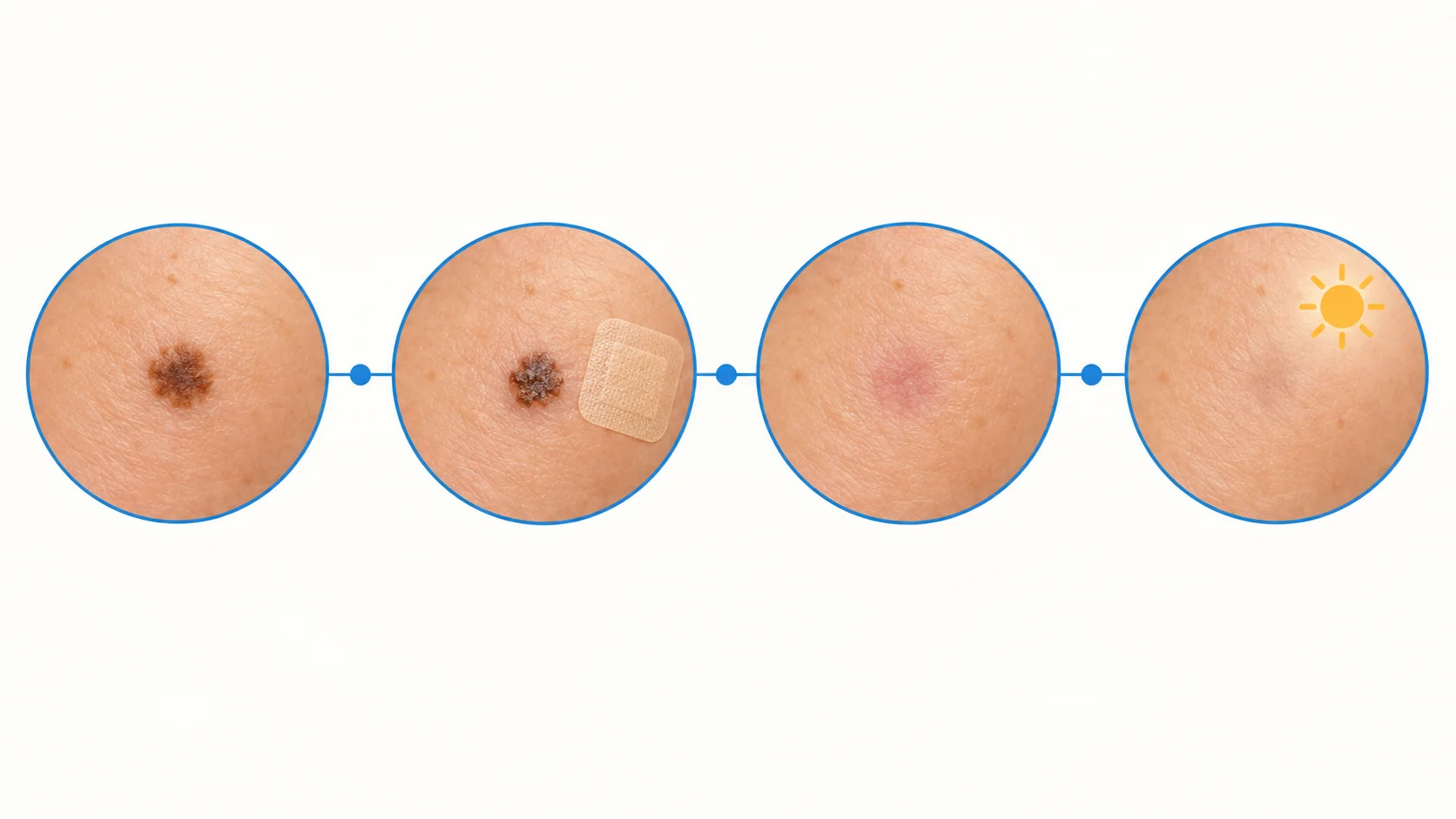
Shinagawa Skin Clinic describes the usual course after spot laser: the treated spot darkens or forms a thin crust within about 3–7 days, and protective tape stays on for around 10 days, until the crust comes off on its own. The clinic advises strict sunscreen for about 3 months afterwards.
- Book it early in the trip, ideally in the first two or three days. The crust needs about 10 days to come off, so on a shorter trip expect to fly home with tape on.
- Avoid a beach or ski holiday straight after. Fresh skin plus strong sun is the classic recipe for post-inflammatory darkening.
- Bring or buy a high-SPF sunscreen and use it daily for at least the next three months; see our Japanese sunscreen guide.
- Expect some spots to need a second session. If a treated spot darkens again after a few weeks, it may be PIH, which usually fades, rather than the spot returning. Ask the clinic how they handle follow-up for overseas patients.
- IPL fits short trips: little visible downtime beyond spots darkening and flaking for a few days, but a full course needs several visits.
Related concerns. Brown pigment under the eyes overlaps with dark circles. Marks after acne often come with acne scars and large pores, and redness that stays after spots heal is covered in facial redness and rosacea treatment. For texture rather than colour, see vampire facial (PRP microneedling), and for marks on the body, stretch marks.
8. What we would do
- Get the type diagnosed. Sun spots, freckles, post-acne marks, melasma and ADM need different plans, and many faces have more than one.
- Start daily sunscreen now. It is the one step that helps every type and protects the result of any treatment.
- Laser or IPL the distinct sun spots and freckles, early in the trip, after a doctor has excluded melasma.
- Treat post-acne marks gently: control the acne, then a retinoid or hydroxy acid, and give it months.
- Treat melasma and ADM as projects, with a doctor’s plan, not as add-ons to a spot-removal session.
9. FAQ
10. Sources & Method
Each clinical figure is sourced to a PubMed-indexed paper. Every PMID was found by searching PubMed, confirmed against the PubMed record, and the figures were taken from the published abstract. Japanese prices and aftercare times are from the clinics’ and manufacturer’s own pages, checked on 2 October 2026; prices change and campaign prices vary, so treat them as ranges, not quotes. The type table, the spot-laser-or-IPL box, the trip advice in section 7 and the plan in section 8 are our editorial judgement, based on the sources below, not findings from a single paper.
| Source | Used for |
|---|---|
| Disorders of hyperpigmentation. Part I. Pathogenesis and clinical features (PMID 35151757) Wang et al., J Am Acad Dermatol, 2023 · review · accessed 2 Oct 2026 | Grouping by pigment depth (section 1) |
| Treatment of Solar Lentigines: A Systematic Review of Clinical Trials (PMID 40145274) Mardani et al., J Cosmet Dermatol, 2025 · 41 trials, 3,234 patients · accessed 2 Oct 2026 | Success rates by treatment; side effects (section 2, FAQ) |
| PIH associated with treatment of solar lentigines using a Q-switched 532-nm Nd:YAG laser: multicenter survey (PMID 27786580) Kang et al., J Dermatolog Treat, 2017 · 516 patients · accessed 2 Oct 2026 | PIH 20.3%; risk factors (section 2, FAQ) |
| Split-face randomized comparison of 532 nm picosecond vs Q-switched Nd:YAG laser for solar lentigines (PMID 33911703) Kim et al., Ann Dermatol, 2020 · 20 patients · accessed 2 Oct 2026 | PIH 5% vs 30%; better clearance with picosecond (section 2, FAQ) |
| Q-switched 532-nm nanosecond vs 532-nm picosecond laser for solar lentigines in Asians (PMID 29948457) Vachiramon et al., Lasers Med Sci, 2018 · 28 completed · accessed 2 Oct 2026 | No difference in clearance on the arms (section 2) |
| Post-inflammatory hyperpigmentation: a systematic review of treatment outcomes (PMID 37843491) Kashetsky et al., J Eur Acad Dermatol Venereol, 2024 · 41 studies, 877 patients · accessed 2 Oct 2026 | Complete and partial response rates; 2.6% worsened with lasers (section 3, FAQ) |
| Topical treatment for postinflammatory hyperpigmentation: a systematic review (PMID 34525885) Tan et al., J Dermatolog Treat, 2022 · 47 studies, 1,853 subjects · accessed 2 Oct 2026 | Retinoids, hydroxy acids, sunscreen SPF 30+ (sections 3, 4, FAQ) |
| The effect of niacinamide on reducing cutaneous pigmentation (PMID 12100180) Hakozaki et al., Br J Dermatol, 2002 · Procter & Gamble-run, 18 subjects · accessed 2 Oct 2026 | 5% niacinamide in Japanese women, 4 weeks (section 4, FAQ) |
| Exogenous ochronosis associated with hydroquinone: a systematic review (PMID 34486734) Ishack & Lipner, Int J Dermatol, 2022 · 126 patients · accessed 2 Oct 2026 | Concentration above 4% in 35.7%; median 5 years; four cases at 3 months or less (section 4, FAQ) |
| Tranexamic acid for hyperpigmentation and telangiectatic disorders other than melasma (PMID 39350932) Chen et al., Clin Cosmet Investig Dermatol, 2024 · review · accessed 2 Oct 2026 | Off-label use beyond melasma (section 4) |
| Q-switched ruby laser with tretinoin and hydroquinone bleaching for acquired dermal melanocytosis (PMID 12974695) Momosawa et al., Dermatol Surg, 2003 · 19 patients · accessed 2 Oct 2026 | All good to excellent; mean 8.3 months; PIH 10.5% (section 5) |
| Source | Used for |
|---|---|
| Shonan Beauty Clinic — 医療レーザー外来の費用・料金 official price list, tax included · accessed 2 Oct 2026 | Spot laser by size, bundles, unlimited pico, IPL (section 6, FAQ) |
| TCB Tokyo Central Aesthetic Surgery — 料金表 official price list, tax included · accessed 2 Oct 2026 | Pico spot removal by size; hydroquinone 4% and tretinoin 0.1% (section 6, FAQ) |
| Shinagawa Skin Clinic — トラネキサム酸 official page · accessed 2 Oct 2026 | Tranexamic acid ¥2,640 for 60 capsules (section 6) |
| Shinagawa Skin Clinic — シミ取りレーザー治療特集 official page · accessed 2 Oct 2026 | Crust within 3–7 days; tape about 10 days; sunscreen for 3 months (section 7, FAQ) |
| Rohto — Melano CC manufacturer site · accessed 2 Oct 2026 | Quasi-drug prevention claim (section 4) |
| Rohto online shop — Melano CC manufacturer shop · as cited on our Melano CC page | Essence price ¥1,210 (section 4) |
Related Guides
About this guide: ClinicJapan is editorially independent. Where a clinic named on this site is an advertising partner, that relationship is disclosed on the page where it appears; no clinic named above is a partner, and nobody paid to be included. Prices change and vary by clinic; confirm before booking. Lasers, IPL and prescription creams are medical treatments; discuss your medical history with a doctor before starting them. Informational only; not medical advice, and not a substitute for consultation with a physician.