1. First: is it a scar, or a mark?
Many people searching for acne scar treatment have something else: flat red or brown marks left where spots have healed. These are changes in colour, not in the skin’s surface, and they usually fade over months on their own, faster with sun protection. Brown marks respond to the same approach as other pigment (see our pico laser guide), and red marks to vascular lasers or IPL (see facial redness). Neither needs the treatments below.
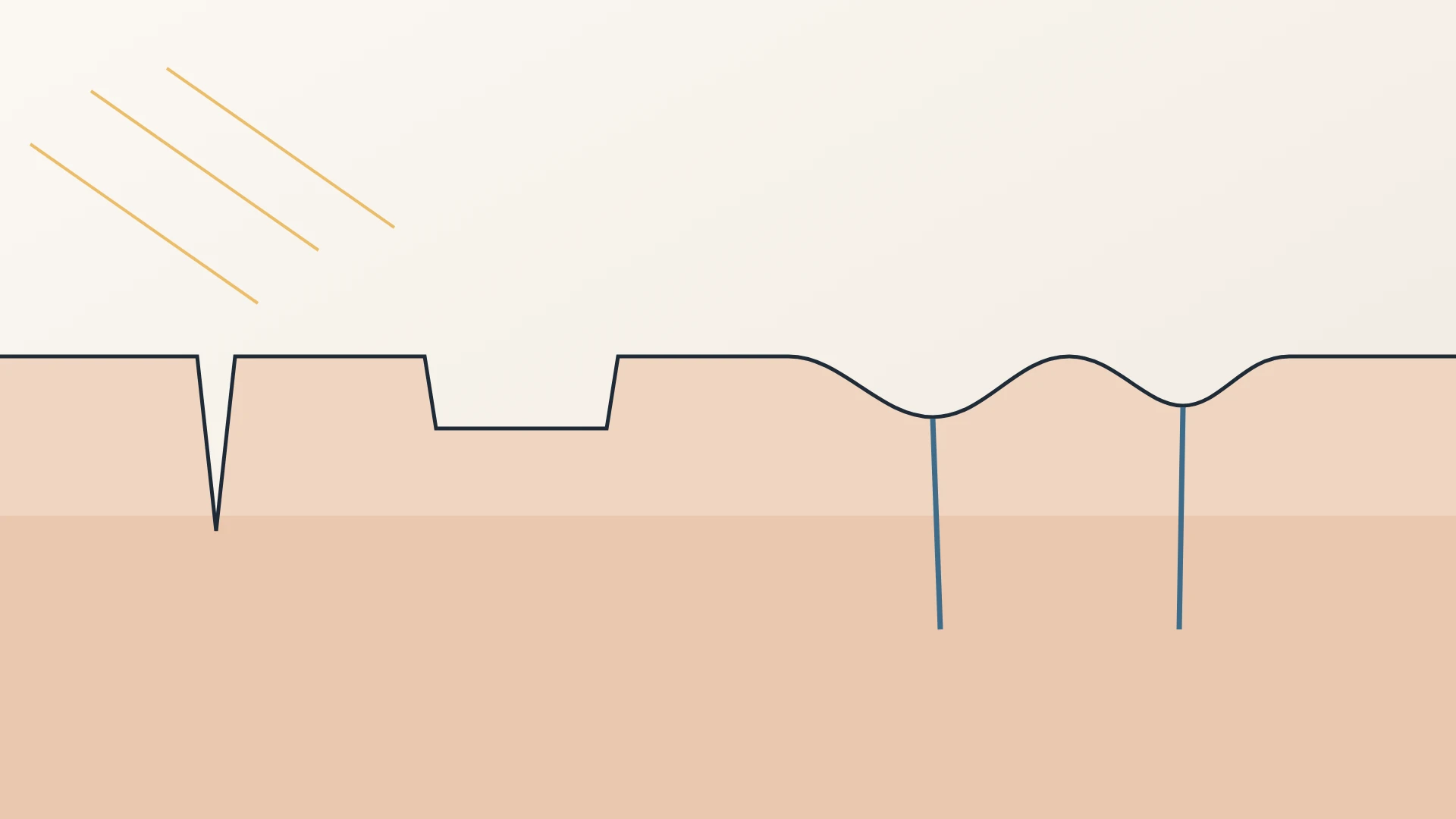
True acne scars change the texture of the skin. A 2010 review divides them into atrophic scars, which are sunken, and hypertrophic or keloid scars, which are raised. Raised scars are treated with silicone gel, steroid injections, cryotherapy or surgery, not with the resurfacing methods in this guide. The rest of this article is about sunken scars, which are far more common on the face.
2. The three types of sunken scar
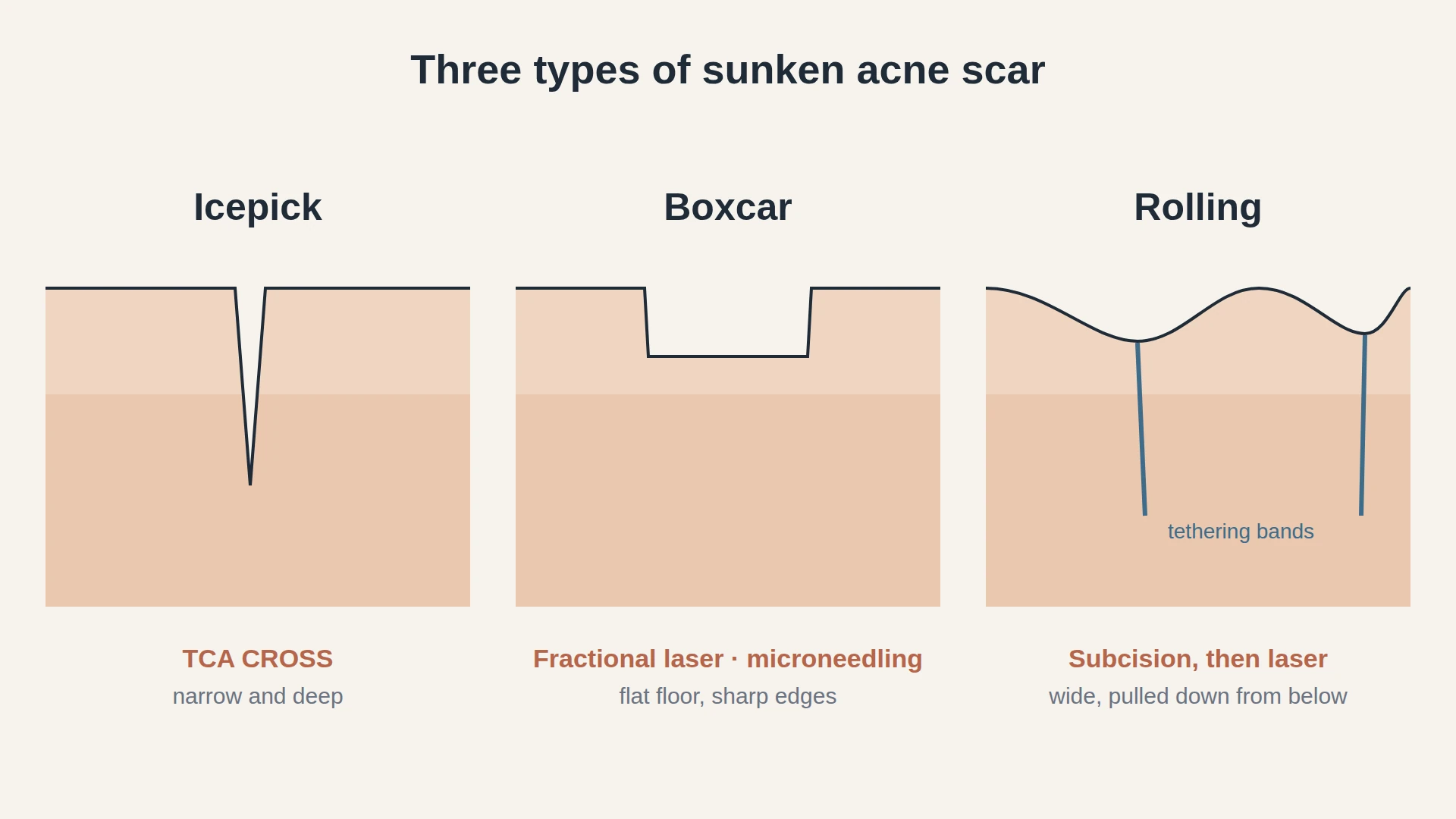
The classification most dermatologists still use comes from a 2001 paper in the Journal of the American Academy of Dermatology, which proposed three types — icepick, rolling and boxcar — and paired them with punch excision, punch elevation, subcision and laser resurfacing as the main tools.
| Type | What it looks like | Usually treated with | Weak option |
|---|---|---|---|
| Icepick | Narrow, deep holes, like a large open pore | TCA CROSS; punch excision | Laser alone rarely reaches the bottom |
| Boxcar | Round or oval dents with sharp edges | Fractional laser, microneedling, TCA CROSS for deeper ones | Filler alone |
| Rolling | Wide, soft undulations, worse in side light | Subcision, often followed by laser or microneedling | Surface treatments alone, because the scar is tethered underneath |
3. What the evidence can, and can’t, say
Before comparing machines, it is worth knowing how thin the evidence base is. The Cochrane review of acne scar treatments included 24 randomised trials with 789 participants. Its conclusion: the results “do not provide support for the first-line use of any intervention in the treatment of acne scars.” Fractional laser did better than older non-fractional non-ablative laser on patients’ own ratings (risk ratio 4.00), but the evidence was rated very low quality, and fractional laser performed about the same as fractional radiofrequency. Only filler compared with placebo reached moderate-quality evidence.
That does not mean the treatments don’t work; experienced dermatologists see clear improvement in practice. A 2022 consensus of 24 experts from 12 countries considers energy-based devices a first-line treatment for many scar types. It does mean that no treatment reliably erases scars, that improvement is usually partial, and that the choice between similar options should rest on your skin type and downtime, not on marketing.
4. Fractional laser: effective, with a pigment trade-off
Fractional lasers make a grid of microscopic wounds that trigger new collagen while leaving the skin between them intact. Ablative versions (CO2 and Er:YAG) remove tissue; non-ablative versions heat it without breaking the surface.
- CO2 vs Er:YAG: a 2024 meta-analysis of 8 studies (418 patients) found CO2 more effective (odds ratio 1.81) with a shorter overall downtime, but longer redness. It noted CO2 may carry a higher risk of pigmentation afterwards, although the difference was not statistically significant.
- CO2 vs other lasers: an earlier meta-analysis of 8 studies found no significant difference between fractional CO2 and non-CO2 lasers on observer or patient ratings.
- CO2 vs radiofrequency microneedling: a 2026 meta-analysis of 8 randomised trials (249 patients) found CO2 improved scars more and patients were more satisfied, but it was more painful, caused about 1.7 days more redness, and carried a 4.44 times higher risk of post-inflammatory hyperpigmentation. The authors concluded that radiofrequency microneedling has the more favourable safety profile.
Post-inflammatory hyperpigmentation — dark marks after treatment — is the main risk for East Asian, South Asian, Latin and Black skin. A 2017 review found only level 2 evidence for non-ablative fractional laser for acne scars in skin types IV–VI, and very few high-quality studies in types V and VI. If your skin tans easily, ask the clinic what settings and pre-treatment they use to reduce this risk.
5. Microneedling and radiofrequency microneedling
Microneedling (Dermapen is the best-known brand in Japan) makes tiny punctures with fine needles. Radiofrequency (RF) microneedling, such as Potenza, adds heat through the needle tips.
- A 2022 meta-analysis of 12 randomised trials (414 participants) found microneedling improved scars on its own, and that no form of microneedling caused post-inflammatory hyperpigmentation.
- A 2024 network meta-analysis of 24 randomised trials (1,546 participants) found combinations were clearly better than microneedling alone, with microneedling plus chemical peels performing best.
- A 2017 meta-analysis of six randomised trials, all in Asian patients, found fractional RF improved scars about as much as fractional laser, with less hyperpigmentation and shorter redness.
For a traveller with medium-to-dark skin, this is often the more practical choice: less redness, less pigment risk, and makeup soon after. The trade-off is that you may need more sessions to reach what a CO2 laser does.
6. Subcision and TCA CROSS: the targeted tools
Subcision releases the fibrous bands that pull rolling scars down, using a needle or blunt cannula under the skin. A 2023 review of 16 trials found needle and cannula subcision comparably effective, with the cannula causing fewer side effects, and that adding filler or platelet gel can stop scars from sinking back. A 2024 split-face trial found that adding ten suction sessions after subcision looked better to patients at one month (37% vs 24%), but the difference in rated improvement had gone by four months and blinded dermatologists saw none.
TCA CROSS (chemical reconstruction of skin scars) places a tiny drop of strong trichloroacetic acid into the bottom of each icepick or narrow boxcar scar, so it heals from the base up. The original 2002 series, in 65 patients with skin types IV–V, reported a good response in 82% with 65% TCA and 94% with 100% TCA, without significant complications. A 2011 study of 30 patients with darker skin using four sessions two weeks apart rated improvement as excellent in 73.3% and good in 20%, with darkening in 2 patients. A 2024 nonrandomised split-face trial found 50% TCA as effective as 80% with fewer severe complications.
7. PRP and skincare: add-ons with limits
Platelet-rich plasma (PRP), made from your own blood, is often offered as an add-on. A 2019 meta-analysis of 7 studies found PRP added to fractional laser or microneedling improved results (odds ratio 8.19), though the studies varied widely. A systematic review the same year found the support stronger alongside fractional ablative laser than with microneedling.
Skincare mainly prevents new scars. In a six-month split-face trial of 67 people with active acne, adapalene 0.3% plus benzoyl peroxide reduced atrophic scar counts by 15.5% while the side treated with the inactive base gel increased by 14.4% (the trial was funded by the manufacturer). For older, established scars, the evidence is limited to one small uncontrolled study. Retinoids are worth using, but they won’t fill a scar.
8. What acne scar treatment costs in Japan
Prices from the clinics’ own published pages, checked on 1 October 2026. First-visit prices apply once; consultation fees and numbing cream may be extra. Confirm the total before treatment.
| Treatment | Clinic | Price per session |
|---|---|---|
| Fractional CO2, full face | Shinagawa Biyo Geka | ¥4,320 first visit, then ¥10,190 (Standard); ¥11,880 / ¥19,110 (Premium) |
| Fractional CO2 (by area size) | Shonan Beauty Clinic | ¥6,200 small / ¥10,600 medium / ¥20,100 large |
| Dermapen 4, face | Shonan Beauty Clinic / TCB / Shinagawa Skin Clinic | ¥11,000 / ¥19,800 / ¥19,800 |
| Potenza (RF microneedling), full face | TCB | ¥85,000 |
| Subcision | Shonan Beauty Clinic / TCB | From ¥9,800 per 1 cm²; ¥115,000 for 5×5 cm (SBC); ¥150,000 for one full cheek (TCB) |
| TCA CROSS | Noda Dermatology, Ikebukuro / Hanafusa Dermatology, Osaka | ¥22,000 for up to 20 scars / ¥11,000 for up to 10 scars, ¥55,000 full face |
Two things stand out. Fractional laser and Dermapen are far cheaper in Japan than in most Western cities, which makes a course realistic. TCA CROSS is offered mainly by dermatology clinics rather than the big cosmetic chains, so ask for it specifically. For clinics with English support, see English-speaking skin clinics in Tokyo.
9. Planning treatment around a trip
Acne scar treatment is a course, not a single visit. Clinics typically space fractional laser and microneedling three to four weeks apart; Shinagawa, for example, suggests fractional CO2 once a month for four sessions, with makeup possible the next day, redness for about a day and rough skin for four days to a week. Here is how we would use a trip:
- Short trip (under two weeks): one consultation and one session early in the stay. If you have rolling scars, subcision is the single session most likely to make a visible difference; for icepick scars, a first TCA CROSS session, knowing it usually takes several sessions about four weeks apart. Expect bruising or small scabs for several days, so don’t book it before a wedding or photoshoot.
- Longer stay (a month or more): two sessions three to four weeks apart, for example subcision or TCA CROSS first, then fractional laser or RF microneedling.
- Regular visitor: a full course across several trips, with the same clinic keeping your records.
- Before any treatment: tell the clinic if you tend to form keloids, get cold sores, have melasma, are tanned, or have taken isotretinoin recently; these can change or rule out laser, TCA and needling.
- In all cases: strict sun protection for several weeks afterwards to reduce the risk of dark marks. That is where your Japanese sunscreen earns its place.
If you want help finding an English-speaking clinic that offers the right combination for your scar type, tell us your dates and area → We reply within 24 hours with options and real prices. The service is free.
10. FAQ
11. Sources & Method
Each clinical claim is sourced to a PubMed-indexed paper. Every PMID was found by searching PubMed, confirmed against the PubMed record, and the figures were taken from the published abstract. Japanese prices are from the clinics’ own pages, checked on 1 October 2026; some pages do not state whether tax is included, and first-visit offers vary. Treat them as ranges, not quotes. The scar-versus-mark distinction and stretch test, the “weak option” column of the scar-type table, the “why combinations win” box, the skin-type advice, the trip plans in section 9 and the bruising and scab expectations are our editorial judgement based on the sources below and general dermatology practice, not findings from a single paper.
| Source | Used for |
|---|---|
| Acne scarring: a classification system and review of treatment options (PMID 11423843) Jacob et al., J Am Acad Dermatol, 2001 · accessed 1 Oct 2026 | Icepick, rolling and boxcar classification and treatment pairing (section 2) |
| Acne scars: pathogenesis, classification and treatment (PMID 20981308) Fabbrocini et al., Dermatol Res Pract, 2010 · accessed 1 Oct 2026 | Atrophic vs hypertrophic scars and their treatment (section 1) |
| Interventions for acne scars (PMID 27038134) Abdel Hay et al., Cochrane Database Syst Rev, 2016 · 24 RCTs, 789 participants · accessed 1 Oct 2026 | No first-line support; RR 4.00; filler moderate-quality (section 3, FAQ) |
| Energy-based devices for the treatment of Acne Scars: 2022 International consensus recommendations (PMID 34719045) Salameh et al., Lasers Surg Med, 2022 · accessed 1 Oct 2026 | Devices as first-line in expert consensus (section 3) |
| CO2 fractional laser versus Er:YAG fractional laser for atrophic acne scar: meta-analysis (PMID 38733085) Liu et al., J Cosmet Dermatol, 2024 · 8 studies, 418 patients · accessed 1 Oct 2026 | OR 1.81, downtime and redness, pigmentation (section 4) |
| The efficacy of fractional CO2 laser in acne scar treatment: A meta-analysis (PMID 33190373) Zhang et al., Dermatol Ther, 2021 · accessed 1 Oct 2026 | No significant difference vs non-CO2 lasers (section 4) |
| Fractional CO2 Laser Versus Micro Needling Radiofrequency for Post Acne Scarring: A Meta-Analysis of RCTs (PMID 41821146) Argobi et al., J Cosmet Dermatol, 2026 · 8 RCTs, 249 patients · accessed 1 Oct 2026 | Efficacy, pain, 1.72 days more redness, PIH RR 4.44 (section 4, FAQ) |
| Nonablative Fractional Laser Resurfacing in Skin of Color: Evidence-based Review (PMID 28979657) Kaushik & Alexis, J Clin Aesthet Dermatol, 2017 · accessed 1 Oct 2026 | Level 2 evidence in skin types IV–VI (section 4) |
| Microneedling Monotherapy for Acne Scar: Systematic Review and Meta-Analysis of RCTs (PMID 35426044) Shen et al., Aesthetic Plast Surg, 2022 · 12 RCTs, 414 participants · accessed 1 Oct 2026 | Improvement; no PIH with any microneedling (section 5, FAQ) |
| Microneedling and its combination with other treatments for acne scars: network meta-analysis (PMID 39110247) Li et al., Arch Dermatol Res, 2024 · 24 RCTs, 1,546 participants · accessed 1 Oct 2026 | Combinations better; microneedling plus peels best (section 5, FAQ) |
| Fractional radiofrequency for atrophic acne scar in Asians: meta-analysis (PMID 28388236) Dai et al., J Cosmet Laser Ther, 2017 · 6 RCTs · accessed 1 Oct 2026 | Similar improvement to fractional laser; less PIH and redness (section 5, FAQ) |
| Subcision in acne scarring: A review of clinical trials (PMID 36315903) Ahramiyanpour et al., J Cosmet Dermatol, 2023 · 16 trials · accessed 1 Oct 2026 | Needle vs cannula; fillers to prevent re-depression (section 6) |
| Subcision with and without suction for acne scars: split-faced, rater-blinded RCT (PMID 38847979) Shi et al., Arch Dermatol Res, 2024 · accessed 1 Oct 2026 | 37% vs 24% at one month, no difference at four months (section 6) |
| Focal treatment of acne scars with trichloroacetic acid: CROSS method (PMID 12460296) Lee et al., Dermatol Surg, 2002 · 65 patients · accessed 1 Oct 2026 | 82% and 94% good response (section 6, FAQ) |
| CROSS technique with 100% TCA for ice pick acne scars in darker skin types (PMID 21332915) Khunger et al., J Cosmet Dermatol, 2011 · 30 patients · accessed 1 Oct 2026 | 73.3% excellent, 20% good, darkening in 2 (section 6) |
| 80% vs 50% trichloroacetic acid for atrophic acne scars (PMID 38722745) Dac Thuy et al., Dermatol Surg, 2024 · accessed 1 Oct 2026 | 50% as effective with fewer severe complications (section 6) |
| Meta-analysis of platelet-rich plasma as assisted therapy for atrophic acne scars (PMID 31506783) Hsieh et al., Aesthetic Plast Surg, 2019 · 7 studies · accessed 1 Oct 2026 | OR 8.19 as an add-on (section 7) |
| Platelet-rich plasma and its utility in the treatment of acne scars: A systematic review (PMID 30742878) Hesseler & Shyam, J Am Acad Dermatol, 2019 · accessed 1 Oct 2026 | Stronger support with fractional ablative laser (section 7) |
| Adapalene 0.3%/benzoyl peroxide 2.5% gel and atrophic acne scars: 6-month RCT (PMID 29549588) Dréno et al., Am J Clin Dermatol, 2018 · 67 participants, manufacturer-funded · accessed 1 Oct 2026 | −15.5% vs +14.4% scar count (section 7, FAQ) |
| Adapalene 0.3% Gel Shows Efficacy for the Treatment of Atrophic Acne Scars (PMID 29549598) Loss et al., Dermatol Ther (Heidelb), 2018 · open-label, no control · accessed 1 Oct 2026 | Limited evidence for established scars (section 7) |
| Source | Used for |
|---|---|
| Shinagawa Biyo Geka — フラクショナルCO2レーザー official page, tax included · accessed 1 Oct 2026 | Fractional CO2 prices, monthly four-session schedule, makeup next day (sections 8, 9) |
| Shinagawa Skin Clinic — ニキビ跡 official page, tax included · accessed 1 Oct 2026 | Dermapen 4 full-face price; fractional CO2 redness and rough-skin duration (sections 8, 9) |
| Shonan Beauty Clinic — 美容皮膚科 料金表 official price list · accessed 1 Oct 2026 | Fractional CO2, Dermapen 4 and subcision prices (section 8) |
| TCB Tokyo Central Aesthetic Surgery — ニキビ・ニキビ跡 料金 official price list, tax included · accessed 1 Oct 2026 | Dermapen 4, Potenza and subcision prices (section 8) |
| Noda Dermatology (のだ皮膚科) — TCAクロス official page, tax included · accessed 1 Oct 2026 | TCA CROSS price (section 8) |
| Senri-Chuo Hanafusa Dermatology — TCAクロス official page, tax included · accessed 1 Oct 2026 | TCA CROSS price tiers (section 8) |
Related Guides
About this guide: ClinicJapan is editorially independent. Where a clinic named on this site is an advertising partner, that relationship is disclosed on the page where it appears; no clinic named above is a partner, and nobody paid to be included. Prices change and vary by clinic; confirm before booking. Lasers, microneedling, subcision and TCA CROSS are medical procedures requiring a qualified physician, and results vary with skin type and scar type. Informational only; not medical advice, and not a substitute for consultation with a physician.