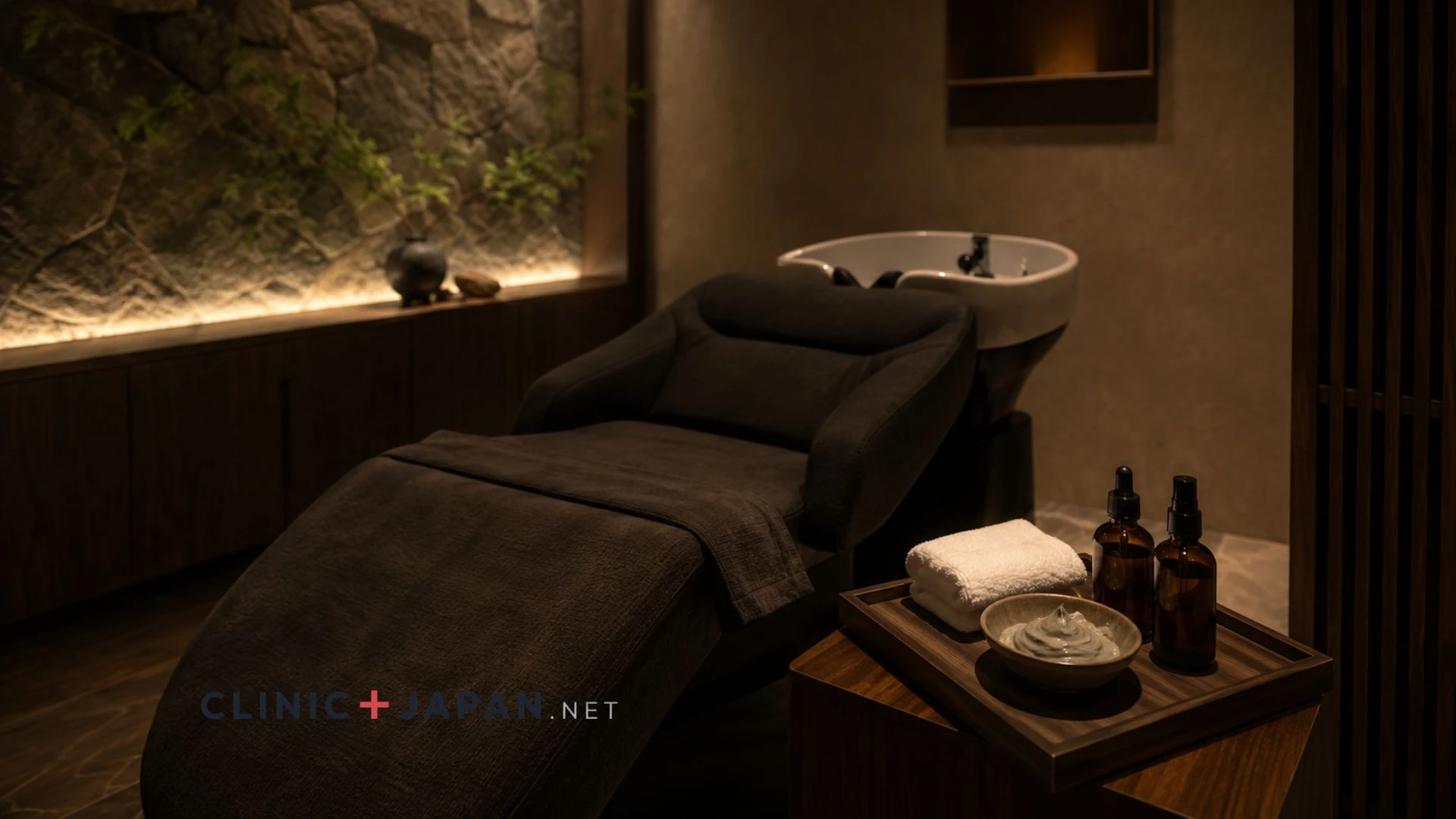
1. What a head spa actually is
A Japanese head spa treats the scalp the way an aesthetician treats facial skin: diagnose first, cleanse thoroughly, stimulate circulation, then apply targeted product. The practice emerged from Japanese hair salons in the early 2000s and is now widely offered across Japanese salons, from neighbourhood shops to dedicated specialist chains. It is not a haircut with a longer shampoo. The hair is largely incidental; the scalp is the client.
What the treatment is not is medical. A head spa is a relaxation and scalp-hygiene service delivered by a stylist or therapist, not a physician. That distinction matters enormously if you are dealing with actual hair loss, and we come back to it in section 6.
2. Wet vs dry — the split that decides your price
Almost every confusing price you will see online resolves once you know which of these two you are looking at.
| Dry head spa | Wet head spa | |
|---|---|---|
| Water used | None | Yes — shampoo basin |
| Focus | Massage, acupressure, tension release | Cleansing, exfoliation, serums, conditioning |
| Typical length | 30–60 min | 60–120 min |
| Sold for | Eye strain, stiff shoulders, sleep | Scalp buildup, hair quality, deep relaxation |
| Local price (60 min) | ¥5,000–10,000 | ¥6,000–14,000 |
| Hair gets wet? | No — go straight back to work | Yes — includes drying and styling |
Dry head spa specialists cluster around office districts and commuter stations because the appeal is a lunch-break reset with no wet hair afterwards. Wet head spas are the salon-based version and the one most foreign visitors picture when they see the treatment on social media — steam, warm cream, the shampoo chair.
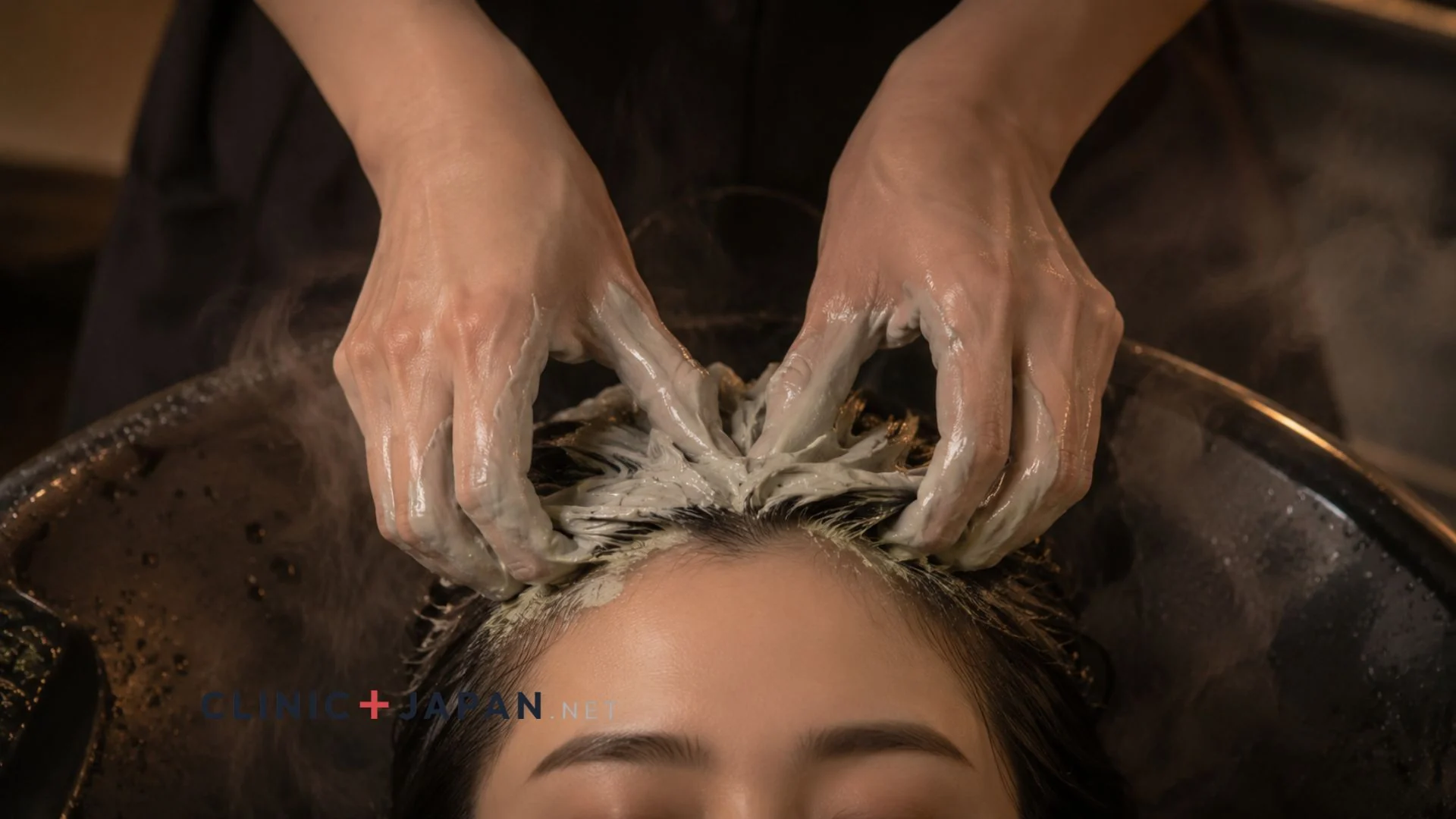
3. What happens in a session
Sequence varies by salon, but a full wet course follows a recognisable arc. Roughly:
| Stage | Minutes | What happens |
|---|---|---|
| Scalp diagnosis | 5–10 | Microscope camera on the scalp; oil level, pore condition, follicle density reviewed on a monitor |
| Pre-massage | 10 | Dry acupressure along the hairline, temples, occipital ridge |
| Cleanse / exfoliation | 15 | Clay or carbonated cleanser to lift sebum and product buildup |
| Main massage | 30–40 | The core of the treatment — slow, repetitive, silent |
| Serum + steam | 10 | Scalp essence under a steamer or warm towel |
| Rinse, dry, style | 10–15 | Blow-dry included at wet salons |
4. What the research actually shows
Head spa marketing leans heavily on hair growth claims. The honest position is narrower than that, and the narrower version is still interesting.
The most-cited piece of evidence is a 2016 study in Eplasty by Koyama and colleagues (PMID 26904154). Nine healthy Japanese men received four minutes of standardised scalp massage daily for 24 weeks. Average hair thickness rose from 0.085 mm to 0.092 mm. The proposed mechanism was mechanobiological — stretching forces transmitted to dermal papilla cells altered gene expression in those cells.
What the treatment does reliably deliver is easier to defend: removal of sebum and product buildup that shampoo at home leaves behind, and a genuine parasympathetic wind-down. The stress-relief effect is the honest headline product, and it is the reason the category has grown into a global wellness segment rather than staying a niche salon add-on.
5. Real prices in Japan (two-tier)
This is where most English-language guides mislead by omission. They quote the tourist-facing tier and present it as "the price of a head spa in Japan."
| Tier | Duration | Price | What you get |
|---|---|---|---|
| Neighbourhood dry spa | 50–60 min | ¥5,000–10,000 | Semi-private, Japanese-only booking, no frills |
| Hair salon wet spa | 60–90 min | ¥6,000–14,300 | Add-on to a salon menu; strong technique, shared floor |
| Specialist domestic salon | 70–90 min | ¥12,100–14,300 | Dedicated head spa brand, scalp diagnosis included |
| English-facing tourist spa | 90 min | ¥22,000–24,750 | Private room, English booking and consultation |
| Premium tourist course | 120–210 min | ¥30,000–57,750 | Extended course, hair repair or facial add-ons |
The technique gap between tiers is far smaller than the price gap. What you are actually buying at the top tier is English throughout, a fully private room, guaranteed availability for a same-week booking, and a service designed around someone who has never done this before. For a lot of visitors that is worth ¥15,000. It should be a decision, not a default.
6. Head spa vs medical scalp treatment
If your reason for searching is thinning hair rather than stress, the head spa is the wrong aisle. A salon therapist cannot diagnose androgenetic alopecia, cannot prescribe, and cannot assess whether your shedding is hormonal, nutritional, or a symptom of something else.
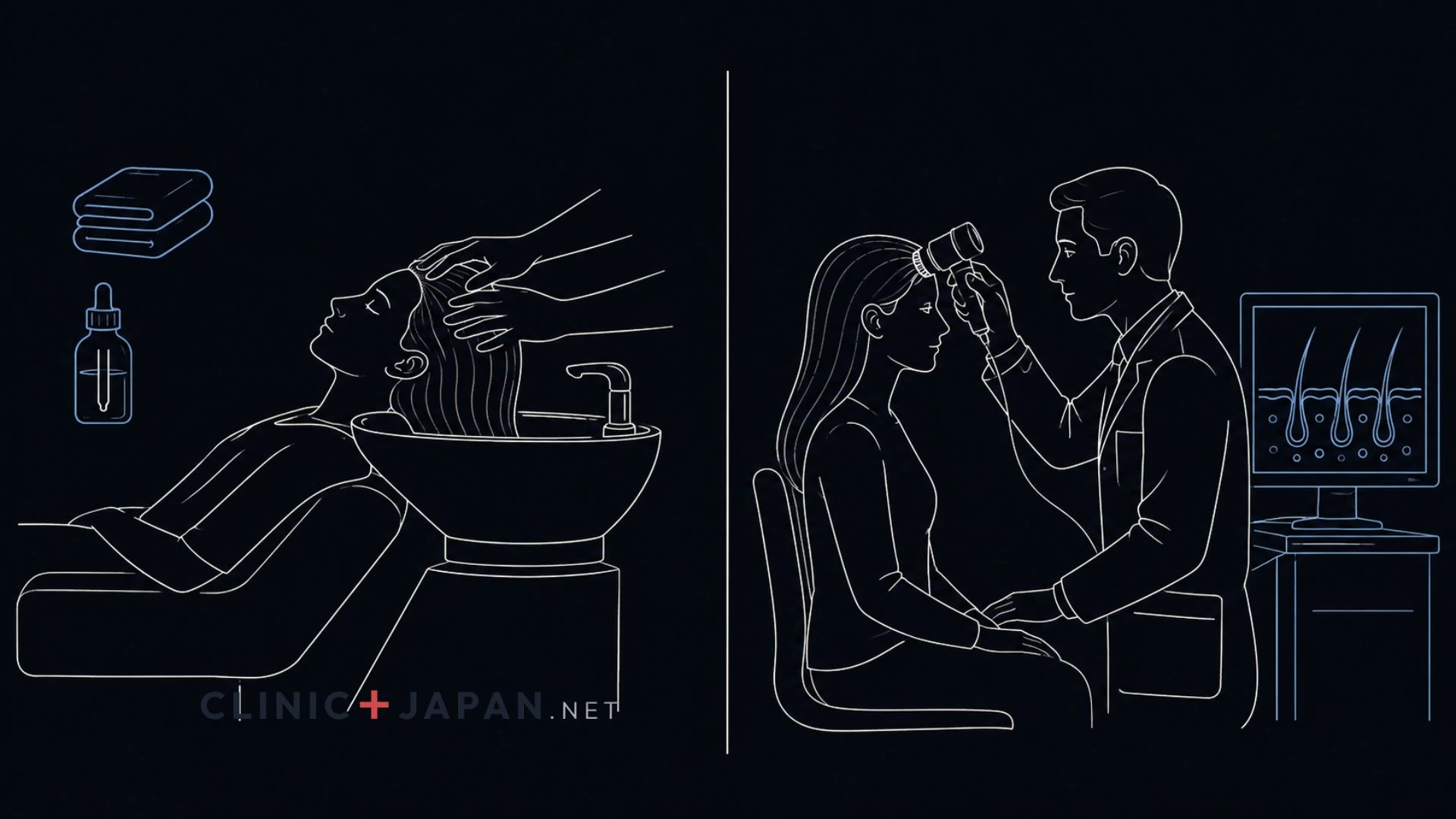
| Your situation | Head spa | Clinic |
|---|---|---|
| Stress, tension, poor sleep | ✓ Yes | — |
| Itchy or flaky scalp, product buildup | ✓ Yes | If persistent |
| Dull, brittle hair after travel | ✓ Yes | — |
| Receding hairline, visible thinning | ✗ Not a treatment | ✓ Dermatology |
| Sudden or patchy shedding | ✗ See a doctor | ✓ Urgent |
| Considering a transplant | — | ✓ Surgical consult |
The two are complementary rather than competing. Many clients under medical treatment for hair loss also use head spas for scalp hygiene and stress — just with the roles kept straight. If the thinning is the actual concern, start at our hair transplant guide for Japan, and read Japanese hair treatments for the at-home care layer.
7. Who it's for — and who should skip it
Good fit: anyone arriving in Japan jet-lagged, anyone with a scalp that feels heavy after long-haul travel, anyone who finds massage genuinely restorative, and anyone curious about a category Japan defined. It slots neatly into a first or last afternoon — see our Tokyo beauty weekend itinerary for how it fits alongside other treatments.
Skip or postpone if: you have an active scalp infection, open sores, or a recently treated scalp condition; you have had recent scalp surgery or a transplant; or you have uncontrolled high blood pressure, in which case check with a doctor first. Salons will usually ask, but not always, and not always in English.
8. FAQ
Sources & Method
Price figures below are taken from operators' own published menus and from Hot Pepper Beauty listings, read directly in August 2026 rather than reproduced from secondary summaries. Ranges are what the named operators actually charge, not national averages. Clinical statements are limited to what the single cited peer-reviewed study supports; where the popular literature makes broader claims, we have not repeated them. Salon menus change without notice — confirm current pricing with the operator before booking.
| Source | Used for |
|---|---|
| Standardized Scalp Massage Results in Increased Hair Thickness by Inducing Stretching Forces to Dermal Papilla Cells in the Subcutaneous Tissue Koyama T, Kobayashi K, Hama T, Murakami K. Eplasty. 2016 · PMID 26904154 / PMC4740347 · verified against PubMed Central, accessed 7 Aug 2026 | Hair thickness 0.085→0.092 mm after 24 weeks of daily 4-minute scalp massage (n=9); mechanobiological mechanism; the limits we state on that finding |
| Source | Used for |
|---|---|
| ヘッドスパ・ヘッドマッサージ 東京都 サロン一覧 Hot Pepper Beauty (Recruit) · accessed 7 Aug 2026 | Station-adjacent dry and wet head spa pricing, ¥7,500–9,590 for 50–70 minutes |
| ドライヘッドスパの料金相場は? Salon Naru · accessed 7 Aug 2026 | Dry head spa market rate of ¥5,000–10,000 per 60 minutes, and what drives the spread |
| ヘッドスパの料金相場【各サロン比較】 料金相場.jp · accessed 7 Aug 2026 | Chain-level entry pricing (Head Mania, AUBE HAIR, 悟空のきもち) used to sanity-check the lower band |
| メニュー・料金 The Head Spa Tokyo · accessed 7 Aug 2026 | Domestic specialist salon tier: 70-minute and 90-minute course pricing |
| Source | Used for |
|---|---|
| Premium Head Spa menu (90–210 min) HEAD SPA Kuu Omotesando · accessed 7 Aug 2026 | Premium course pricing ¥24,750 / ¥33,000 / ¥57,750, tax included |
| Head Spa Tokyo — Complete Guide for Tourists (English-Friendly) BALNEA TOKYO · accessed 7 Aug 2026 | English-facing 90-minute and 120-minute course pricing, and what the premium includes |
| The Ultimate Guide to Japanese Head Spas in Japan Japan Travel · accessed 7 Aug 2026 | Tourist-facing price bands; wet vs dry distinction; the point that most of a session is wordless |
| Source | Used for |
|---|---|
| The Japanese Head Spa And The $5 Trillion Wellness Opportunity Forbes (Kate Hardcastle), 23 Mar 2026 · accessed 7 Aug 2026 | Why the category went global, and its positioning between beauty, wellness and preventative care |
| Source | Used for |
|---|---|
| Two-tier price analysis and booking guidance ClinicJapan Research Team · Our own synthesis, not a cited source | The comparison between domestic and English-facing tiers, the decision rule in section 5, and the head spa vs clinic table in section 6 |
| Claim we could not source and therefore removed Editorial note · Transparency item | A widely repeated figure that ~95% of Japanese salons offer head spa traces only to a vendor blog citing an unnamed industry observatory. We could not verify it against a primary source and have not used a number |
Related Guides
About this guide: This is an independent guide. We are not affiliated with any salon named or linked above, receive no commission on bookings, and were not paid to include or exclude any operator. Prices are as published by each operator in August 2026 and include tax where the operator states so. A head spa is a relaxation and scalp-hygiene service, not a medical treatment — nothing here is medical advice, and hair loss should be assessed by a physician.