1. The short verdict
Most guides answer this question with "spring or autumn" and stop. That is correct and nearly useless, because it ignores the two things that actually ruin trips: Japan's domestic holiday calendar, and the gap between what a month looks like in photographs and what it feels like at street level.
| Month | Weather | Crowds | Cost | Verdict |
|---|---|---|---|---|
| January | Cold, dry, clear | Low after Jan 4 | Low | Best value. Empty temples in Kyoto |
| February | Cold, driest | Low | Low | Hokkaido snow. Cedar pollen begins |
| March | Cool, variable | Rising sharply late | Rising | Early March calm; late March chaos |
| April | Mild, pleasant | Peak | Peak | Sakura. Book six months out |
| May | Warm, low humidity | Low after Golden Week | Moderate | Best overall month |
| June | Rainy season | Low | Low | Underrated. Hydrangeas, few tourists |
| July | Hot, humid | Moderate | Moderate | Festivals, but 33°C and sticky |
| August | Hottest, typhoons | High mid-month | High | Avoid. Obon shuts things down |
| September | Hot early, typhoon risk | Moderate | Moderate | Gambling on weather |
| October | Mild, clear, dry | Rising | Rising | Second-best month |
| November | Cool, crisp | High mid-month | High | Autumn foliage peak |
| December | Cold, dry | Low until Dec 27 | Low then spike | Great until the New Year rush |
2. Cherry blossom season, honestly
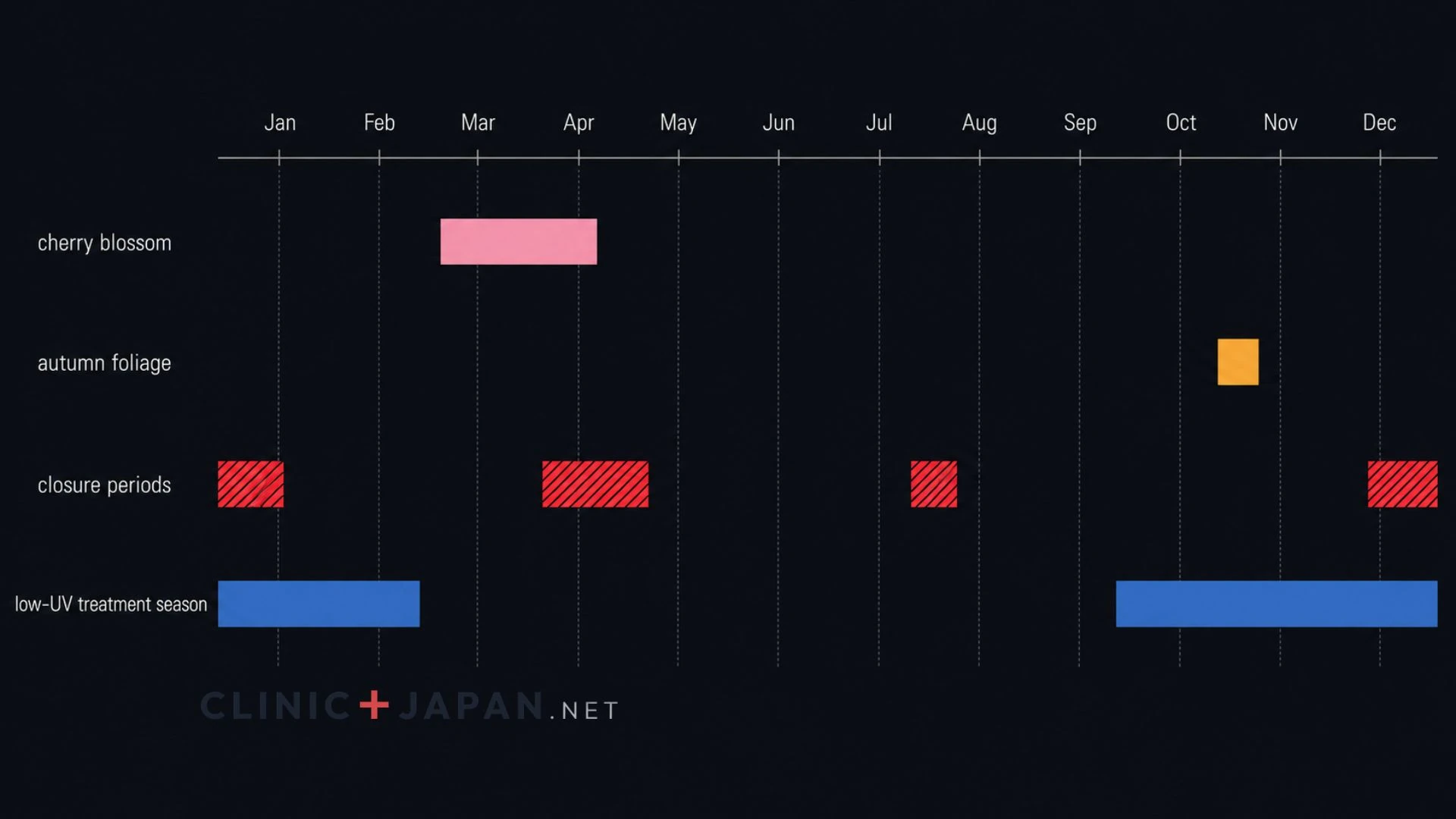
Sakura is why most first-time visitors pick their dates, so it deserves precision. Peak bloom in Tokyo, Kyoto and Osaka lands in the window from roughly the last days of March through the first week of April. Individual trees hold blossoms for seven to ten days from opening to petal fall; actual peak bloom — mankai, when the tree is fully open — lasts only three to seven days, and a single day of rain and wind can end it.
That narrow window is the whole problem. You are booking flights six months ahead against a three-to-seven-day target that shifts with the winter's temperature. Bloom forecasts from Japanese meteorological services are published from February and refine weekly, but by then most people have already committed.
If your dates are fixed and you miss the central-Japan window, the bloom front moves north. Sendai and Aomori run roughly two to three weeks behind Tokyo; Hokkaido blooms around the end of April into early May. Late bloomers exist in Kyoto too — yaezakura and the Omuro-zakura at Ninna-ji hold on after the main season ends.
3. The three weeks to avoid outright
Japan's domestic holiday calendar matters more to your trip than the weather does. During these three periods the entire country travels at once, and foreign visitors get the worst of it: full trains, doubled hotel rates, and — the part nobody warns you about — closed businesses.
| Period | Approximate dates | What actually happens |
|---|---|---|
| Golden Week | Apr 29 – May 6 | Four national holidays in a row. Shinkansen and domestic flights book out months ahead; resort towns fill completely |
| Obon | Mid-August (around Aug 13–16) | Families return to home towns. Heaviest domestic travel of the year, in the year's worst heat |
| New Year | Dec 29 – Jan 3 | Most of the country closes. Restaurants, clinics and many shops shut for several days |
4. What each season actually feels like
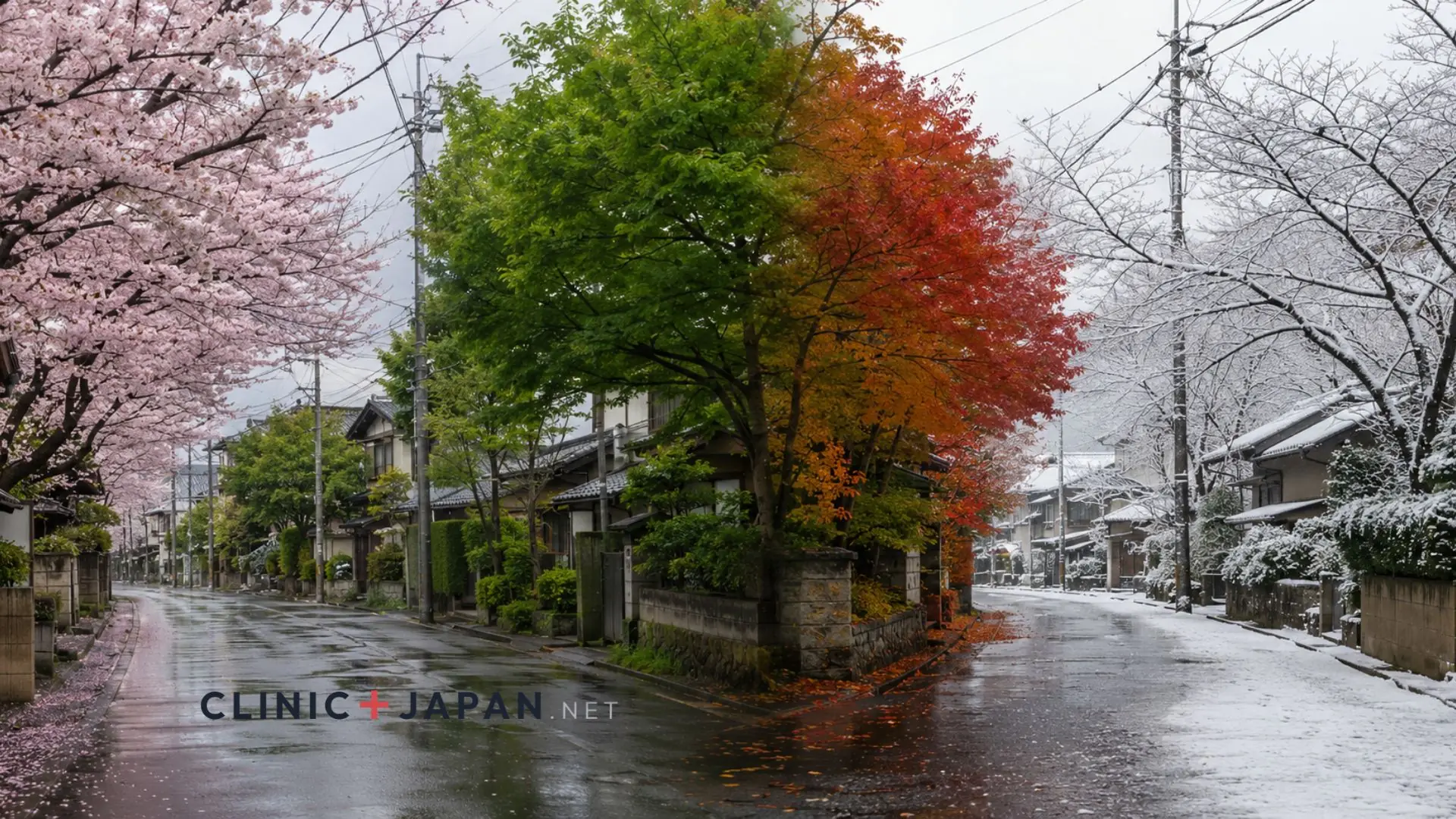
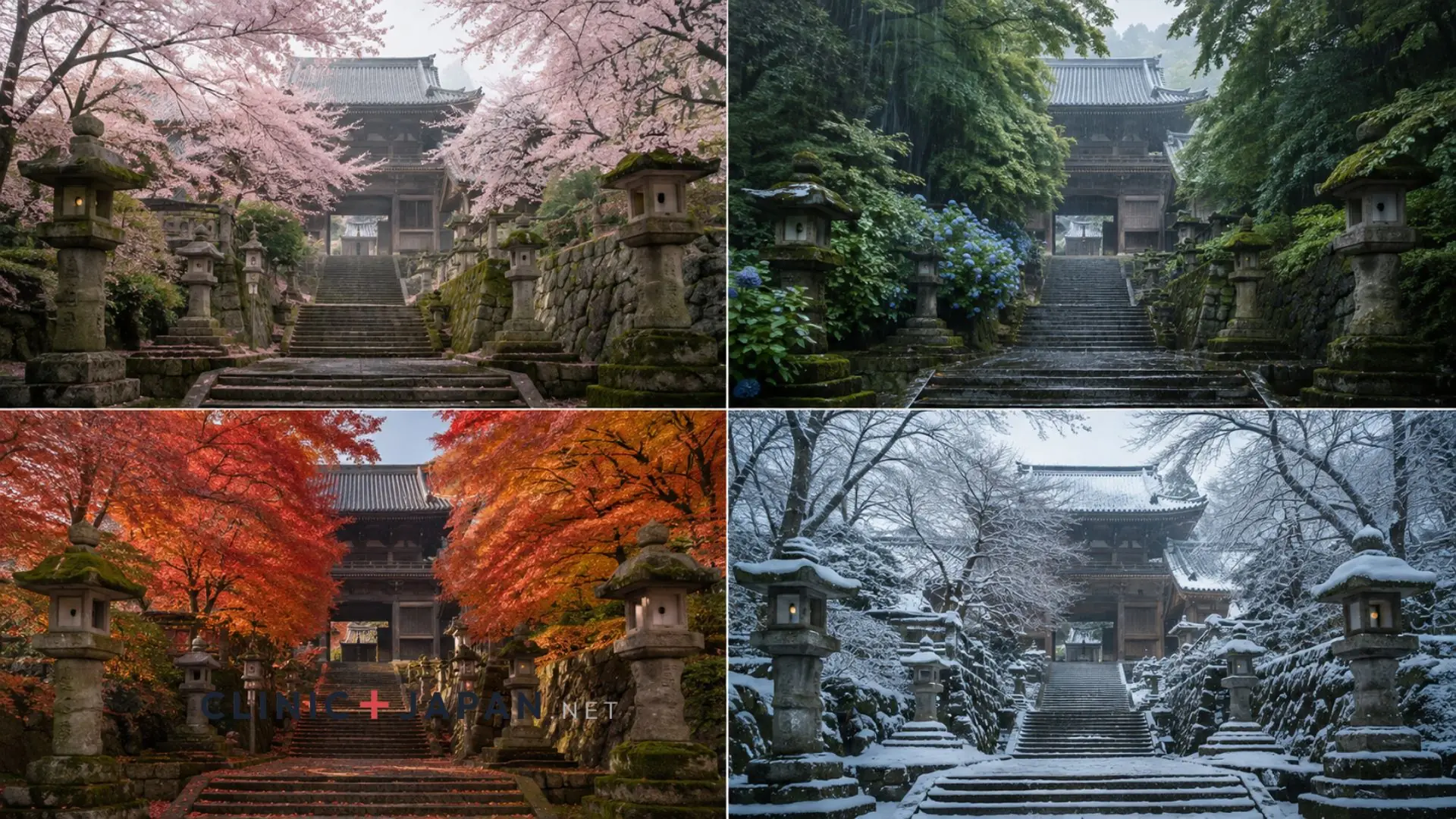
Spring (March–May). The postcard season, and it earns it. Mild days, low humidity, everything in bloom. The catch is that April is the single most expensive and crowded month of the year, and Golden Week sits at the end of it. May is the quiet reward — the same pleasant weather with a fraction of the pressure.
Rainy season (mid-June to mid-July).Tsuyu is a genuine deterrent for some travellers and a genuine opportunity for others. It rains, but not continuously — expect grey days with heavy bursts rather than all-day downpours. Hotel rates drop, temples empty out, and hydrangea season is at its best. If you are indoors-oriented, this is the cheapest good month of the year.
Summer (July–August). Tokyo in August averages around 32°C with humidity that pushes the felt temperature closer to 38°C, and Kyoto — sitting in a basin — is worse. Outdoor sightseeing is only comfortable before about 10am. Typhoon season overlaps from roughly August into September, which can mean cancelled flights and closed train lines at short notice. Summer festivals and fireworks are the compensation, and they are considerable, but go in knowing what you are buying.
Autumn (September–November). September is a weather gamble because of typhoons. October and early November are excellent: clear, dry, mild. Foliage peaks in Kyoto around mid-November and draws crowds comparable to sakura season, so the sweet spot is early-to-mid October if you want the weather without the density, or mid-November if the maples are the point.
Winter (December–February). Underrated in central Japan. Tokyo and Kyoto get cold and very dry with a high proportion of clear days, and January in Kyoto is genuinely one of the best-value travel experiences available anywhere — cold, but the temples are close to empty. Hokkaido in February is a separate trip entirely, built around snow.
5. The season nobody plans around: your skin
This is where most travel guides stop being useful and where we can add something. If any part of your trip involves a dermatology visit, a laser or peel appointment, or even a serious skincare shopping haul, the calendar looks different.
| Season | Skin conditions | Treatment suitability |
|---|---|---|
| Oct – Feb | Cold, very dry indoor air | ✓ Best window. Low UV means pigment and resurfacing treatments carry the least post-treatment risk |
| Feb – Apr | Cedar pollen season | Pollen-related irritation and redness are common; sensitive skin may react badly |
| Jun – Jul | Humid, rainy | ◯ Workable, but humidity aggravates congestion and breakouts |
| Jul – Sep | Peak UV and heat | ✗ Worst window for anything light-based. Strict sun avoidance afterwards is impractical on a sightseeing trip |
The rule Japanese clinics work to is simple, and we state it here as our own editorial synthesis of standard aftercare guidance rather than as a study finding: pigment and laser work belongs to the cool months. Post-treatment skin is photosensitive, and a summer itinerary of outdoor temples and walking tours is the opposite of what aftercare requires. If a treatment is a real reason for the trip rather than an afterthought, autumn and winter are the seasons to book — see the laser treatment guide and medical tourism planning guide for how to structure that.
6. How long, and how it changes your month
Trip length interacts with season more than people expect. A five-day trip in a crowded month is mostly queueing; the same five days in May or October covers noticeably more ground. If your dates are locked to a peak period, shorten the itinerary and go deeper in one city rather than attempting Tokyo–Kyoto–Osaka.
If you are building the trip around treatments or salon appointments rather than sightseeing, the arithmetic changes again: procedures with downtime need buffer days at the end, not the start, and follow-up appointments need to land before your departure. Our Tokyo beauty weekend itinerary shows how a short, treatment-led trip actually sequences, and Japan trip costs covers what each season does to your budget.
7. FAQ
Sources & Method
Bloom timing and crowd figures below trace to Japanese meteorological forecasting and official arrival statistics; where we read them through a secondary outlet rather than the primary release, the table says so. Cherry blossom dates move by up to two weeks year to year — every date in this guide is a planning range, not a fixture, and the current season's forecast supersedes it. Holiday closure patterns reflect standard Japanese business practice, not any single operator's schedule.
| Source | Used for |
|---|---|
| さくら開花予想 (cherry blossom forecast) Japan Meteorological Corporation (日本気象株式会社) · accessed 7 Aug 2026 | The forecast source we point readers to. Note that JMA stopped issuing bloom forecasts in 2010; private forecasters now publish them from February |
| Japan Cherry Blossom Forecast 2026: Dates by City Trip To Japan · secondary reporting of forecast data · accessed 7 Aug 2026 | Central-Japan peak window; the north-bound bloom front through Sendai, Aomori and Hokkaido |
| Is Japan Crowded in 2026? Crowd Calendar BluePlanet / SelfGuideJapan · secondary · accessed 7 Aug 2026 | 7–10 day blossom life and 3–7 day peak; sakura-season arrival pressure; the book-by-December booking lead time |
| Source | Used for |
|---|---|
| Best Time to Visit Japan 2026 — Month-by-Month Verdict BluePlanet / SelfGuideJapan · secondary · accessed 7 Aug 2026 | Golden Week, Obon and New Year date ranges; the May and October–November verdict |
| Best Time to Visit Japan: Season-by-Season Guide Travel Japan Together · secondary · accessed 7 Aug 2026 | Tokyo August heat and felt temperature; the pre-peak 70–80% bloom timing argument; hana-fubuki as the post-peak window |
| Visitor arrivals statistics Japan National Tourism Organization (JNTO) · primary · accessed 7 Aug 2026 | Where readers can check current inbound volume rather than relying on our snapshot |
| Source | Used for |
|---|---|
| 花粉症環境保健マニュアル (2014年1月改訂版) Ministry of the Environment, Japan (環境省) · primary · accessed 7 Aug 2026 | Cedar (sugi) pollen season and symptom profile behind the February–April caution |
| Source | Used for |
|---|---|
| Treatment-season table and holiday closure warning ClinicJapan Research Team · Our own synthesis, not a cited source | The October–February low-UV treatment window, the July–September caution for light-based treatments, and the point that clinics and specialist salons close during all three holiday periods. These follow standard aftercare practice and Japanese business custom; they are not findings from a specific study, and individual clinics set their own schedules |
Related Guides
About this guide: This is an independent guide. We receive no commission from any hotel, tour operator, airline or clinic, and no operator paid to be included. Weather, crowd and bloom figures are a snapshot taken in August 2026 and will drift — check the current season's forecast and each business's own calendar before fixing dates. Informational only; not medical advice.