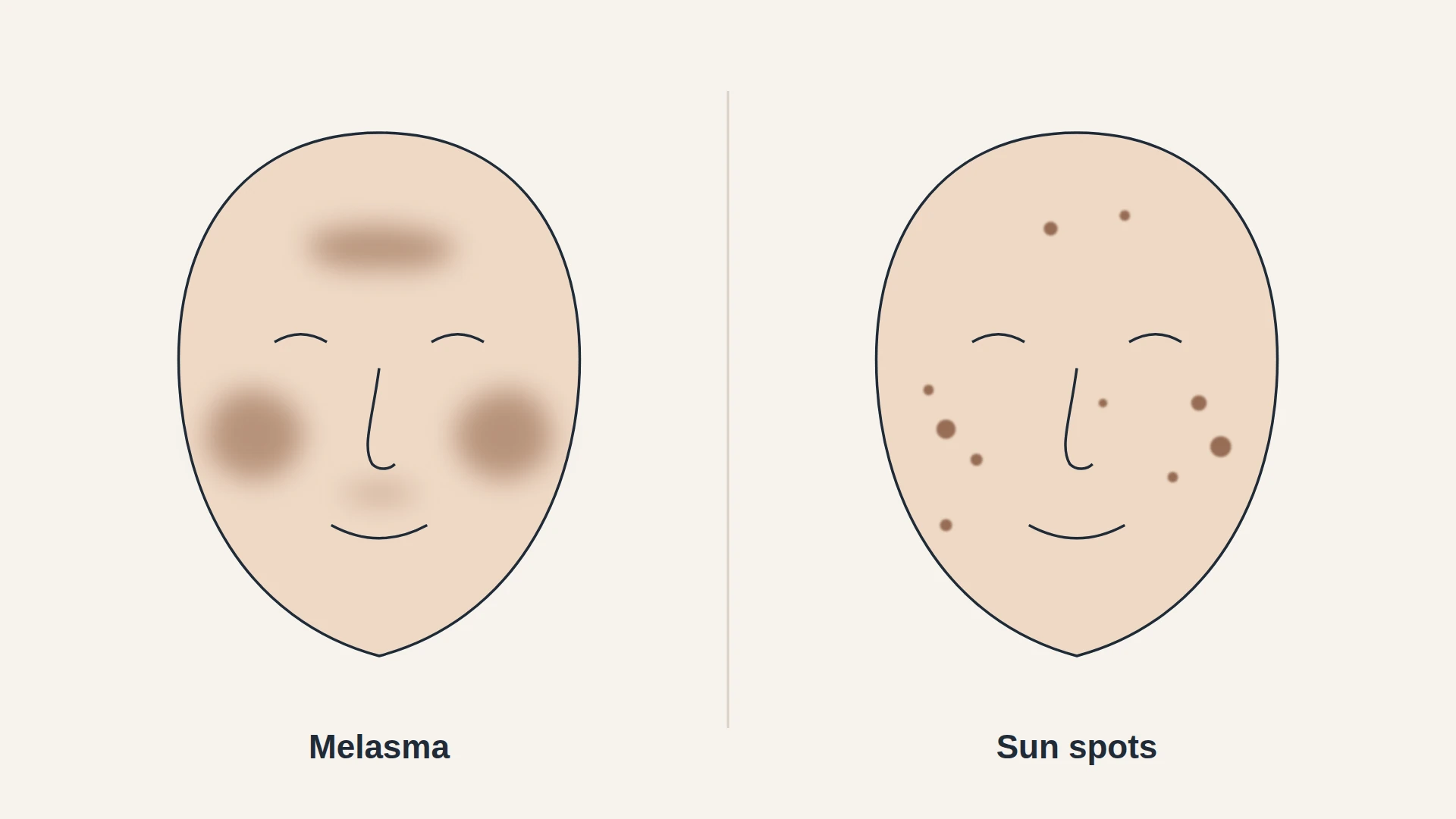
1. Is it melasma, or ordinary sun spots?
This matters more than any product choice, because the two respond to opposite treatments. A 2014 clinical review describes melasma as a chronic, acquired darkening that appears symmetrically on sun-exposed skin, mostly the face. It mainly affects women, particularly during the reproductive years, and people with more pigmented skin (Fitzpatrick types III–V). The same review lists sun exposure, pregnancy, sex hormones, skin inflammation, cosmetics, steroids and photosensitising drugs as triggers, and notes that over 40% of patients have an affected relative.
Sun spots (solar lentigines and freckles) look different: they are separate, rounder spots with clearer edges, scattered where the sun hit hardest. They usually respond well to a laser or IPL. Melasma is a blurred, patchy shadow, often across both cheeks, the forehead or the upper lip, and the same laser can darken it. Many people have both at once, which is why a doctor’s diagnosis should come before any laser.
| Feature | Melasma | Sun spots / freckles |
|---|---|---|
| Shape | Blurred, blotchy patches | Separate spots with clearer edges |
| Pattern | Symmetrical: both cheeks, forehead, upper lip | Scattered where sun exposure was highest |
| Triggers | Sun and visible light, pregnancy, hormones, inflammation | Cumulative UV exposure |
| Laser or IPL | Risky: can darken or leave pale blotches | Usually works well |
| First-line approach | Sun protection + cream ± oral tranexamic acid | IPL or pico laser |
2. Why melasma keeps coming back
Melasma is not a stain that can be removed once. A 2022 review of how it develops describes several overlapping causes — sun exposure, sex hormones and pregnancy, and skin inflammation, including from contact dermatitis and aesthetic procedures — acting on skin that is genetically prone to it. That last point is the important one for anyone planning a treatment trip: an aggressive procedure is itself a trigger.
In practice this means three things. The treatment that clears it has to be kept up, or replaced with a maintenance routine, or it returns. Summer, a beach holiday or a new contraceptive pill can undo months of progress. And anything that irritates the skin — harsh peels, scrubs, high-energy lasers — can make it worse, even if it looks better for a few weeks.
3. Sunscreen: UV protection is not enough
Most sunscreens block ultraviolet light only. Melasma also reacts to visible light, the part of sunlight (and bright indoor light) that we can see. A 2014 double-blind trial gave 68 melasma patients 4% hydroquinone plus either an ordinary SPF 50+ UV sunscreen or one that also contained iron oxides, the pigments that give tinted sunscreens their colour and block visible light. After eight weeks, the 61 who finished showed 15%, 28% and 4% greater improvement in the visible-light group on the MASI score, colour measurement and melanin measurement respectively. A 2022 review of self-applied treatments agreed that the evidence favours UV-plus-visible-light sunscreen alongside hydroquinone.
For shopping in Japan, that means a tinted sunscreen rather than a clear one. Look for 酸化鉄 (iron oxide) in the ingredient list. Our guides to Japanese sunscreen, Biore and Anessa cover the best clear formulas; with melasma, wear a tinted product over or instead of them, and reapply.
4. Creams: still the backbone
A 2020 evidence review of 113 studies and 6,897 participants concluded that hydroquinone on its own and triple-combination cream (hydroquinone with a retinoid and a mild steroid) are the most effective and best-studied melasma treatments. The Cochrane review of 20 randomised trials found triple-combination cream beat hydroquinone alone (risk ratio 1.58), while warning that the quality of the studies was generally poor.
A trial in East and South-East Asian patients shows both sides of that result. After eight weeks, 64.2% of those on triple-combination cream were rated clear or mild, against 39.4% on 4% hydroquinone. But treatment-related side effects, mostly mild irritation, occurred in 48.8% vs 13.7%. Irritation matters in melasma because inflammation can darken it, so creams are usually introduced gradually and used under a doctor’s guidance.
In Japan, hydroquinone is sold both in cosmetics and as clinic-dispensed creams. Clinic versions are stronger and come with instructions; the clinics we checked warn about pigment loss and white patches with misuse. Topical tranexamic acid exists too, but the trials behind it are small.
5. Oral tranexamic acid: the pill that changed melasma treatment
Tranexamic acid is an old drug used to reduce bleeding. It also reduces pigment production, and it is now the most-studied tablet for melasma.
- Randomised trial (2018): 44 patients with moderate-to-severe melasma took 250 mg twice daily or placebo for three months, with sunscreen. Severity fell by 49% vs 18%. Three months after stopping, it was 26% below baseline in the tranexamic acid group and 19% in the placebo group — so part of the benefit faded. No serious side effects were recorded.
- 561 Asian patients (2016): in a retrospective study at Singapore’s National Skin Centre, 89.7% improved, usually within two months, and the relapse rate was 27.2%. Side effects occurred in 7.1%. One patient developed a deep-vein thrombosis and was later found to have an inherited clotting disorder; the authors recommend screening for personal and family clotting risk before starting.
- Meta-analyses: 11 studies with 667 participants showed tranexamic acid reduced severity scores both alone and added to other treatments, with minor side effects such as lighter periods, mild stomach upset and skin irritation. A 2024 meta-analysis of 22 randomised trials found the oral form reduced severity the most, ahead of injections and creams. A 2023 network meta-analysis put the best dose at 250 mg three times a day for 12 weeks, which is 750 mg a day.
In Japan, oral tranexamic acid for melasma is sold without a prescription. Daiichi Sankyo’s Transino products are Class 1 OTC drugs, which only a pharmacist may sell, with written information. The current Transino EX contains 750 mg of tranexamic acid a day (two tablets, twice daily, after meals), matching the dose above. Its label says not to take it for more than two months in a row; the manufacturer advises a two-month break after two months of use. It must not be taken by people on dialysis or combined with other medicines containing tranexamic acid, which includes some Japanese cold and sore-throat remedies. People with blood clots or clotting risk, those taking the contraceptive pill or hormone replacement therapy, those with kidney disease, those who are pregnant or breastfeeding, and those aged 55 or over are told to consult a doctor or pharmacist first. It is for ages 15 and over.
6. Lasers: an add-on, not a cure
Low-power “laser toning” with a Q-switched Nd:YAG laser, and newer picosecond (pico) toning, are sold heavily in Japan for melasma. The evidence is mixed.
- A 2022 meta-analysis of 22 studies and 694 patients found low-fluence Q-switched Nd:YAG reduced severity (MASI change −2.76), while picosecond laser showed no significant change. It flagged the risk of both darkening and lightening in darker skin.
- A 2022 systematic review of 42 papers on laser toning reported that mottled pale patches occasionally develop and persist, possibly linked to accumulated laser energy; that even toning, used aggressively, can cause darkening; and that a few studies reported considerable recurrence three months after treatment, with little long-term follow-up.
- A 2023 meta-analysis of six randomised trials found the 1064 nm pico laser reduced severity, but the 755 nm pico laser was no better than creams and caused darkening.
- The 113-study review summed it up: peels and light-based treatments are equal or inferior to creams, with a higher risk of side effects.
Laser toning is usually sold as a course of five to ten sessions a few weeks apart. For a traveller, one or two sessions on a trip will not do much for melasma on their own; if you have ordinary sun spots as well, those are what a laser treats well.
7. What melasma treatment costs in Japan
Prices from the clinics’ own published pages, checked on 1 October 2026. First-visit prices are discounted and apply once; a consultation fee may be added. Confirm the total before treatment.
| Treatment | Where | Price |
|---|---|---|
| Transino EX (OTC tranexamic acid, 1 month) | Pharmacies with a pharmacist on duty | ¥3,960 suggested retail (120 tablets) |
| Tranexamic acid (clinic, self-pay) | Shinagawa Skin Clinic | ¥2,640 for 60 capsules; ¥3,520 for 90 |
| Oral set for spots and melasma (30 days) | Shonan Beauty Clinic | ¥5,500 |
| Hydroquinone cream (4%, 5 g) | TCB | ¥7,150 per tube |
| Hydroquinone cosmetic (clinic’s own brand) | Shonan Beauty Clinic | ¥6,930 per tube |
| Laser toning (full face) | Shinagawa Skin Clinic / Shonan Beauty Clinic | ¥5,190 first visit, then ¥8,320 / ¥8,750 per session |
| Pico toning (full face) | Shinagawa Skin Clinic / Shonan Beauty Clinic | ¥6,500 first visit, then ¥9,500 / ¥7,800 first visit, then ¥9,800 |
Treatment in Japan is not only cheaper than in most Western cities; the combination of oral tranexamic acid, tinted sunscreens and hydroquinone creams is also easy to put together in a single visit. For clinics with English support, see our English-speaking skin clinics in Tokyo, and our laser treatment guide for how the different lasers compare.
8. What we would do on a trip to Japan
- See a dermatologist first. Confirm it is melasma, sun spots or a mix. That decides everything else.
- Start the cheap, well-supported parts. A tinted sunscreen, reapplied, every day. A hydroquinone cream at night if the doctor agrees.
- Ask about oral tranexamic acid if you have no clotting risk. Get the prescription and instructions in English, and a supply that covers the course.
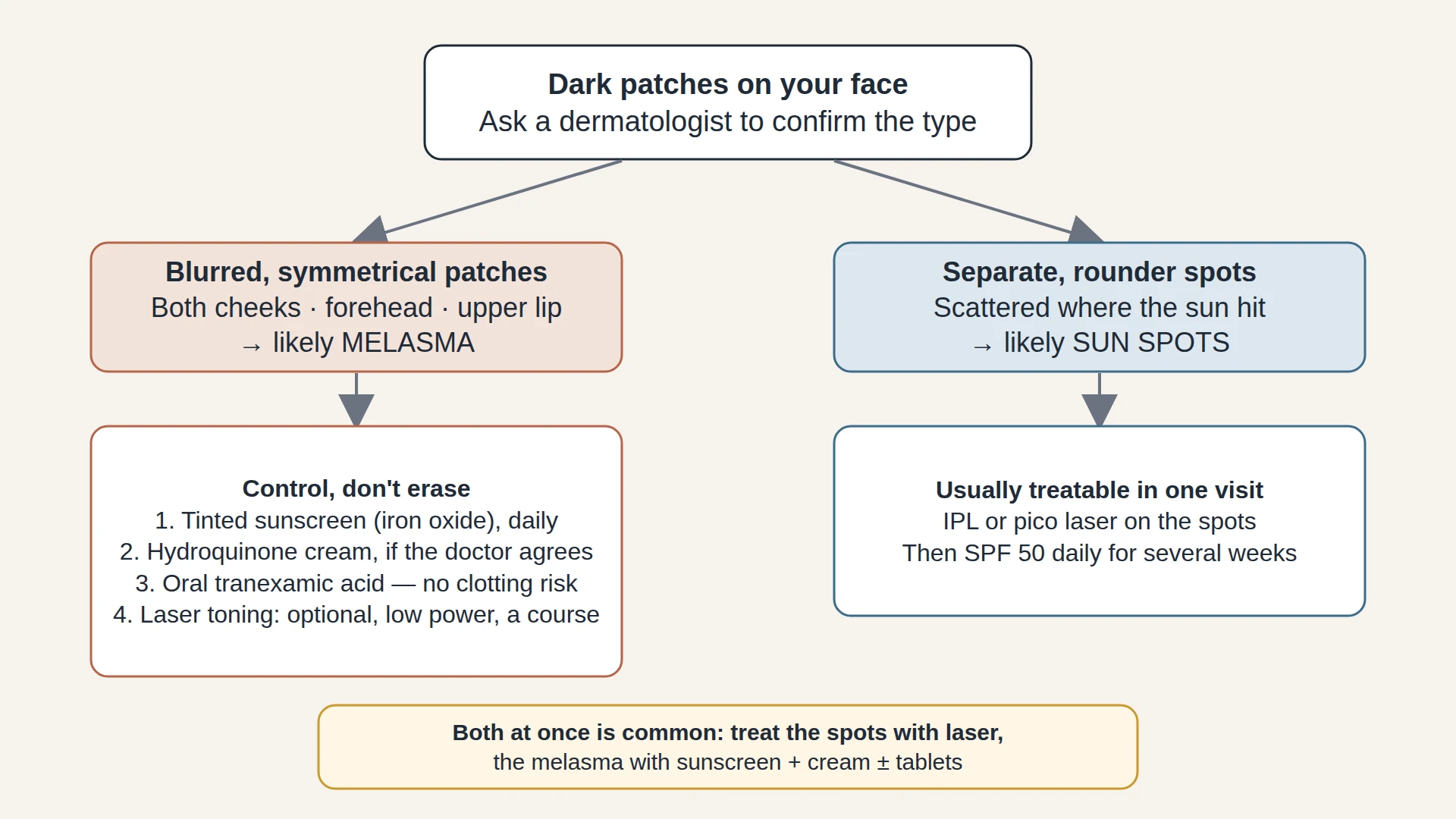
- Treat sun spots with laser, not melasma. If you have both, a careful laser on the separate spots can make a visible difference in one visit. For the melasma itself, low-power toning is optional and needs a course, not a single session.
- Plan for maintenance. Expect summer flares. Keep the sunscreen habit for good.
If you want help finding an English-speaking dermatologist for a melasma consultation during your trip, tell us your dates and area → We reply within 24 hours with options and real prices. The service is free.
9. FAQ
10. Sources & Method
Each clinical claim is sourced to a PubMed-indexed paper. Every PMID was found by searching PubMed, confirmed against the PubMed record, and the figures were taken from the published abstract. Japanese prices are from the clinics’ and manufacturer’s own pages, checked on 1 October 2026; the Transino EX retail price is the manufacturer’s suggested price as reported by the trade newspaper Yakuji Nippo. Prices change and first-visit offers vary; treat them as ranges, not quotes. The melasma-vs-sun-spots table, the “honest goal” box, the shopping advice on tinted sunscreen, the safety box on tranexamic acid and the plan in section 8 are our editorial judgement, based on the sources below, not findings from a single paper.
| Source | Used for |
|---|---|
| Melasma: a clinical and epidemiological review (PMID 25184917) Handel et al., An Bras Dermatol, 2014 · accessed 1 Oct 2026 | Definition, who is affected, triggers, family history (section 1) |
| Update on Melasma-Part I: Pathogenesis (PMID 35904706) Espósito et al., Dermatol Ther (Heidelb), 2022 · accessed 1 Oct 2026 | Causes including inflammation from aesthetic procedures (section 2) |
| Melasma Treatment: An Evidence-Based Review (PMID 31802394) McKesey et al., Am J Clin Dermatol, 2020 · 113 studies, 6,897 participants · accessed 1 Oct 2026 | Creams as most effective; lasers and peels equal or inferior with more side effects (sections 4, 6) |
| Interventions for melasma (PMID 20614435) Rajaratnam et al., Cochrane Database Syst Rev, 2010 · 20 RCTs · accessed 1 Oct 2026 | Triple cream vs hydroquinone, RR 1.58; study quality (section 4) |
| Fixed triple combination vs hydroquinone 4% in Asian patients with melasma: RCT (PMID 18616780) Chan et al., Br J Dermatol, 2008 · accessed 1 Oct 2026 | 64.2% vs 39.4% clear or mild; side effects 48.8% vs 13.7% (section 4) |
| Self-applied topical interventions for melasma: systematic review and meta-analysis (PMID 35290681) Pennitz et al., Br J Dermatol, 2022 · 36 RCTs · accessed 1 Oct 2026 | UV plus visible-light sunscreen improves efficacy (section 3) |
| Near-visible light and UV photoprotection in the treatment of melasma: double-blind randomized trial (PMID 24313385) Castanedo-Cazares et al., Photodermatol Photoimmunol Photomed, 2014 · accessed 1 Oct 2026 | 15%, 28% and 4% greater improvement with visible-light sunscreen (section 3, FAQ) |
| Randomized, placebo-controlled, double-blind study of oral tranexamic acid in moderate-to-severe melasma (PMID 28987494) Del Rosario et al., J Am Acad Dermatol, 2018 · accessed 1 Oct 2026 | 49% vs 18%; 26% vs 19% three months after stopping (section 5, FAQ) |
| Oral tranexamic acid in the treatment of melasma: a retrospective analysis (PMID 27206758) Lee et al., J Am Acad Dermatol, 2016 · 561 patients · accessed 1 Oct 2026 | 89.7% improved, 27.2% relapse, 7.1% side effects, DVT case and screening advice (section 5, FAQ) |
| Efficacy and Safety of Tranexamic Acid in Melasma: A Meta-analysis and Systematic Review (PMID 28374042) Kim et al., Acta Derm Venereol, 2017 · 11 studies, 667 participants · accessed 1 Oct 2026 | Effect alone and as add-on; minor side effects (section 5) |
| Tranexamic acid for melasma: meta-analysis of randomized controlled trials (PMID 38843906) Calacattawi et al., J Dermatolog Treat, 2024 · 22 RCTs, 1,280 patients · accessed 1 Oct 2026 | Oral form reduced severity most (section 5) |
| The optimal dose of oral tranexamic acid in melasma: network meta-analysis (PMID 36332095) Wang et al., Indian J Dermatol Venereol Leprol, 2023 · 6 RCTs, 599 patients · accessed 1 Oct 2026 | 250 mg three times daily for 12 weeks (section 5) |
| Laser therapy in the treatment of melasma: systematic review and meta-analysis (PMID 35122202) Lai et al., Lasers Med Sci, 2022 · 22 studies, 694 patients · accessed 1 Oct 2026 | Q-switched Nd:YAG −2.72; picosecond no significant change (section 6) |
| The Low-Fluence Q-Switched Nd:YAG Laser Treatment for Melasma: A Systematic Review (PMID 35888655) Lee et al., Medicina (Kaunas), 2022 · 42 articles · accessed 1 Oct 2026 | Mottled hypopigmentation, darkening, recurrence (section 6, FAQ) |
| Efficacy and safety of picosecond laser for melasma: systematic review and meta-analysis (PMID 36897459) Feng et al., Lasers Med Sci, 2023 · 6 RCTs · accessed 1 Oct 2026 | 1064 nm vs 755 nm results (section 6) |
| Source | Used for |
|---|---|
| Daiichi Sankyo Healthcare — トランシーノEX official product page · accessed 1 Oct 2026 | Class 1 OTC status (section 5) |
| Transino EX package insert (JAPIC data via KEGG) accessed 1 Oct 2026 | Indication, dose, 750 mg daily, two-month limit, dialysis and combination warnings, consult-a-doctor list (section 5, FAQ) |
| Daiichi Sankyo Healthcare — Transino EX FAQ accessed 1 Oct 2026 | Two-month break after two months (section 5) |
| Daiichi Sankyo Healthcare — OTC drug classes accessed 1 Oct 2026 | Class 1: sold only by a pharmacist, with written information (section 5) |
| Yakuji Nippo — Transino EX launch March 2024 · accessed 1 Oct 2026 | Suggested retail price ¥3,960 for 120 tablets (section 7) |
| Shinagawa Skin Clinic — トラネキサム酸 · レーザートーニング · ピコトーニング official pages, tax included · accessed 1 Oct 2026 | Tranexamic acid, laser toning and pico toning prices (section 7) |
| Shonan Beauty Clinic — 美容皮膚科 料金表 official price list · accessed 1 Oct 2026 | Laser toning, pico toning, 30-day oral set, hydroquinone cosmetic (section 7) |
| TCB Tokyo Central Aesthetic Surgery — 料金表 official price list, tax included · accessed 1 Oct 2026 | Hydroquinone 4% cream (section 7) |
Related Guides
About this guide: ClinicJapan is editorially independent. Where a clinic named on this site is an advertising partner, that relationship is disclosed on the page where it appears; no clinic named above is a partner, and nobody paid to be included. Prices change and vary by clinic; confirm before booking. Oral tranexamic acid, prescription creams and lasers are medical treatments; discuss your medical history with a doctor before starting them. Informational only; not medical advice, and not a substitute for consultation with a physician.