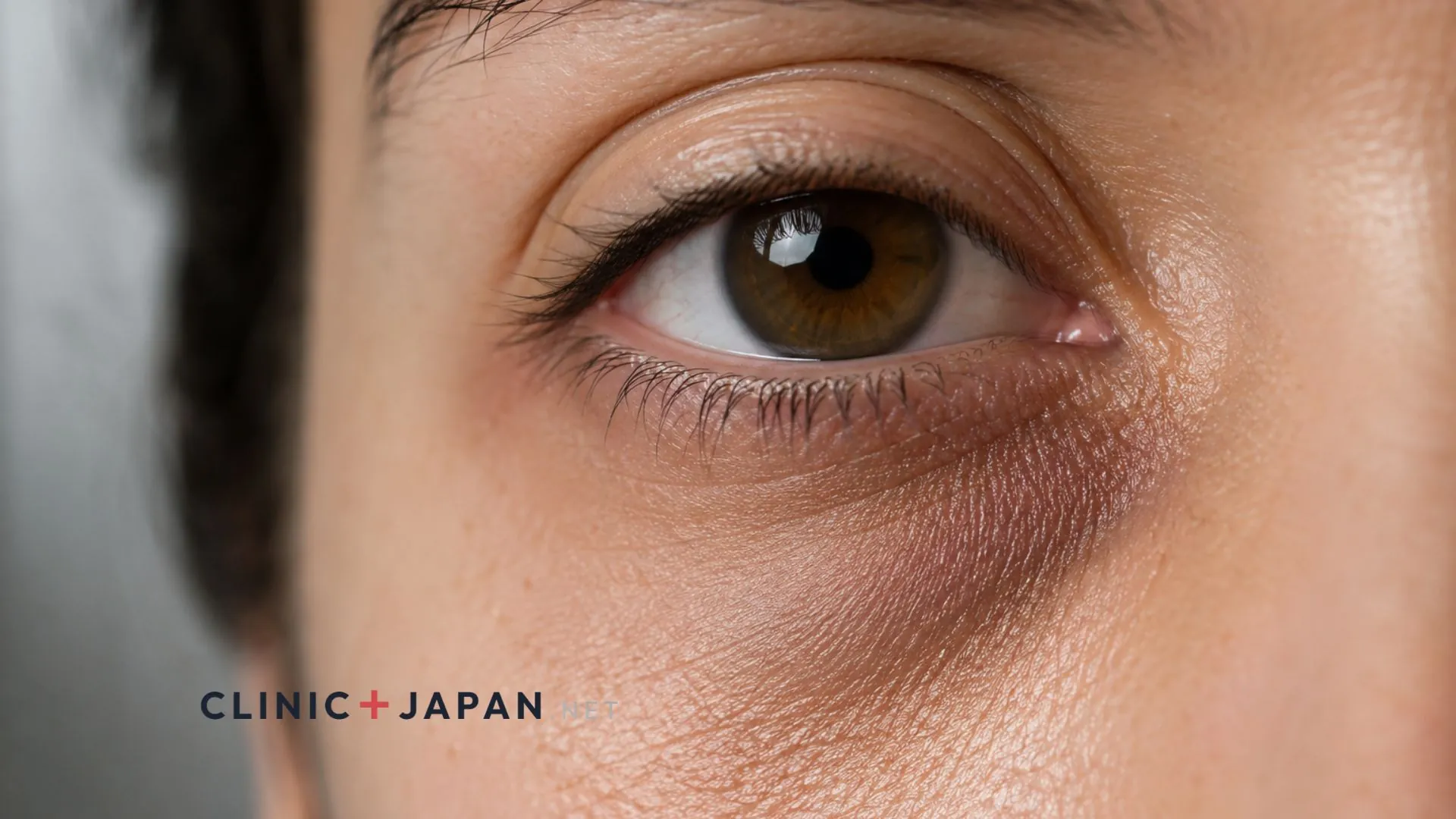
1. Four different problems wearing the same name
"Dark circles" is a description of what you see, not a diagnosis of what is there. Dermatology splits the appearance into four categories, and they respond to almost nothing in common.
| Type | What you are looking at | The tell |
|---|---|---|
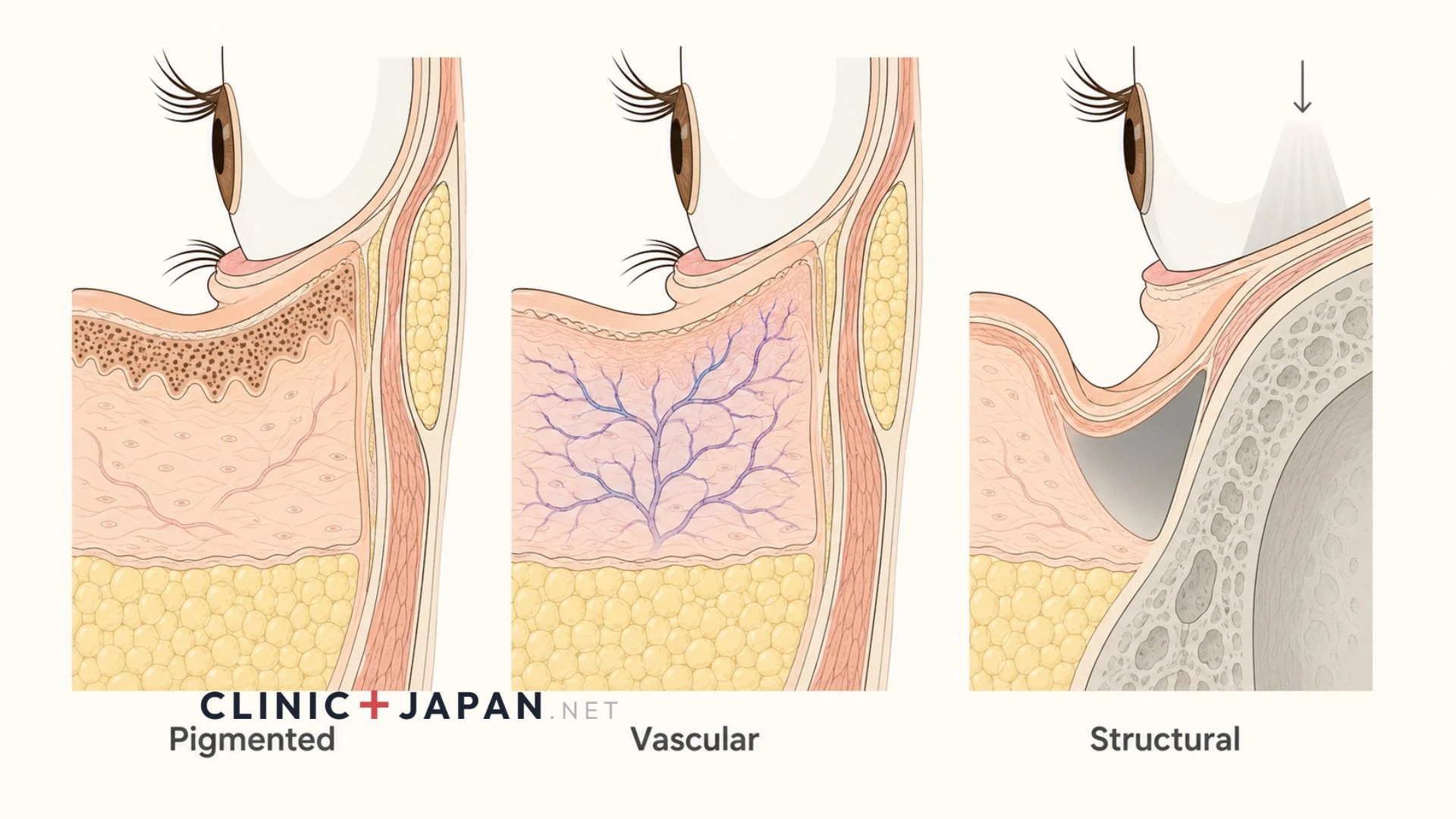
| Pigmented | Melanin in the skin itself — genetic, post-inflammatory, or sun-driven | Brown. Stays brown when you stretch the skin flat |
| Vascular | Blood vessels showing through thin lower-lid skin, plus congestion and puffiness | Blue to purple. Worse when tired, worse lying down, sometimes worse with allergy |
| Structural | A shadow. The eye socket has hollowed or the lid has bagged, and the darkness is cast, not deposited | Changes with the light. Nearly disappears under flat overhead lighting, deepens in a bathroom downlight |
| Mixed | Two or three of the above at once | Almost everybody |
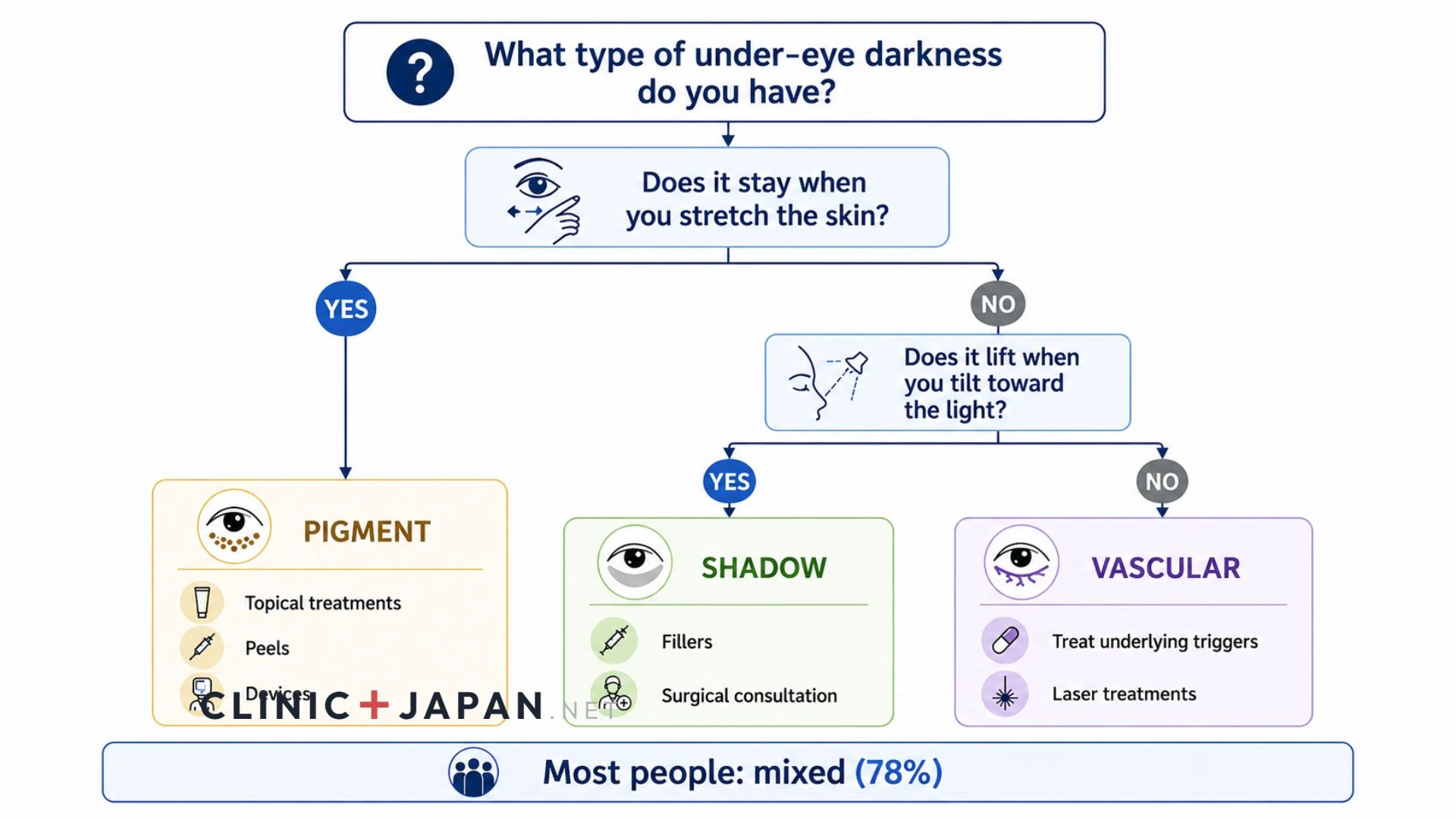
Do the mirror test before you spend anything. Sit in front of a window. Pull the lower lid skin gently sideways: if the darkness stays, it is pigment. Tilt your face up towards the light: if the darkness lifts, it is shadow. Press gently on the puffiness: if the colour blanches and refills, there is a vascular component. Most people will get two answers, not one.
2. The sleep question, answered properly
Everyone will tell you to sleep more. It is the most common piece of advice about dark circles and the least examined, so it is worth looking at what happens when someone actually measures it.
A Karolinska Institutet team randomised 181 people to one night of total sleep deprivation or a normal night in bed, photographed them the next day, and analysed the images objectively — including a digital measure of periorbital darkness. Neither sleep deprivation nor the participants' own sleepiness produced a measurable difference in periorbital darkness, skin colour, eye openness or mouth curvature. A separate panel rating the photographs also found no difference between the groups.
But the same study found something that explains why the folk belief survives. When raters judged people as fatigued, the features that predicted those judgements included periorbital darkness, less open eyes and downturned mouth corners. So dark circles do read as tiredness to other people — they simply are not caused by a bad night in any way that showed up over one night in 181 people.
3. What creams can and cannot do
Topicals have one real target: the pigmented component. A systematic review of periorbital hyperpigmentation covering 39 studies concluded that topical creams and chemical peels are useful for pigment-based cases, that soft-tissue fillers and fat grafting are the most effective option where volume loss is the cause, and that surgery is the answer where the driver is excess skin laxity. Its own closing caveat matters as much as its findings: high-quality evidence in this area is scarce and the recommendations should be read selectively.
The agents that appear across the literature are the same ones used for melasma — hydroquinone, kojic acid, azelaic acid, topical retinoic acid — and the honest framing is that they are being borrowed from a better-studied condition rather than proven on this one.
| If it is… | What has support | What will disappoint you |
|---|---|---|
| Pigmented | Depigmenting topicals, chemical peels, sun protection — the eyelid is skin and photoprotection is not optional | Filler. Adding volume under a brown patch leaves you with a smoother brown patch |
| Vascular | Treating the aggravator first: allergic rhinitis, atopic dermatitis, rubbing. Lasers give modest help | Brightening creams. There is no pigment to lighten |
| Structural | Filler or fat for hollowing; blepharoplasty where skin excess or fat herniation is the cause | Every cream ever sold. A shadow is a geometry problem |
| Mixed — 78% of people | Sequencing. Usually pigment and aggravators first, structure second, and a reassessment in between | Buying one product and judging the whole condition by it |
4. Lasers and energy devices: real, modest, oversold
A systematic review of laser therapy for periorbital hyperpigmentation pooled ten clinical trials and reported that around 45% of patients had a good response and 36% an excellent one, with satisfaction reported by roughly three-quarters of participants. At four to six months of follow-up the picture held reasonably well, with around 26% good and 43% excellent responses recorded.
Read carefully, that is an honest endorsement of a modest treatment. The reviews that assess lasers against the other options describe them as mildly to moderately beneficial across both vascular and pigmented types — useful, not transformative, and the follow-up windows in this literature are months rather than years.
Two cautions that apply particularly to the readers of this site. First, melanin-rich skin carries a real post-inflammatory hyperpigmentation risk with aggressive settings, which is why conservative, multi-session protocols dominate Japanese practice. Second, a device aimed at a shadow will not move it. If your problem is structural, no amount of energy delivered into the skin changes where the bone and fat sit.
5. Filler: the highest-satisfaction option and the highest-stakes one
For the structural type — the tear trough hollow that casts a shadow — hyaluronic acid filler is the intervention with the strongest numbers. A meta-analysis of 31 reports covering 2,556 patients found a pooled satisfaction rate of 91%. It also quantified what people actually experience afterwards, which most clinic pages do not.
| Outcome | Pooled rate | What it means in practice |
|---|---|---|
| Satisfaction | 91.0% | The highest of any option here, for the right indication |
| Swelling / oedema | 19.2% | Roughly one in five. Do not book this the week of an event |
| Bruising / ecchymosis | 18.4% | Similar. Cannula technique reduces but does not eliminate it |
| Redness | 7.1% | Usually short-lived |
| Lumps / contour irregularity | 5.3% | The most common reason people return for dissolving |
| Blue discolouration (Tyndall) | 0.9% | Filler placed too superficially reads as a new blue shadow — the irony of the procedure |
6. Doing this in Japan — what it costs and how it differs
Under-eye work in Japan is jiyu shinryo, private-pay: no insurance, published price lists, and a consultation the doctor is paid for by time rather than by procedure code. That structure tends to produce longer consultations than a Western cosmetic clinic visit, which matters more for this condition than for most, because the entire job of the first visit is working out which of the four types you have.
| Treatment | Typical range per session | Notes |
|---|---|---|
| Under-eye HA filler | ¥50,000–120,000 | Budget chains start near ¥15,000 with basic HA; premium clinics using Belotero or Restylane sit at the top of the range |
| Hyaluronidase (dissolving) | ¥20,000–40,000 | Budget for this before you inject, not after. It is the correction path for lumps and Tyndall |
| Pico toning, full face | ¥15,000–40,000 | Pigmented component. Usually a course of 5–10 |
| IPL photofacial | ¥10,000–40,000 | Mild pigment and redness together |
| Consultation fee | ¥0–5,000 | Frequently waived if you treat the same day — which is also the pressure point. You are allowed to leave and think |
Our full breakdowns sit on under-eye filler in Japan, filler cost by area and laser treatment pricing. For the pigment side specifically, pico laser in Tokyo covers the device tiers, and skin treatment in Japan is the general entry point.
7. What we would actually do, in order
The mistake that costs people the most money is buying the treatment before identifying the type. Here is the sequence we would follow, and where we would stop.
| Step | Do this | Stop here if… |
|---|---|---|
| 1. Identify | Stretch test, light-angle test, and an honest look at family photographs. Pigment that has been there since childhood is usually constitutional | The darkness disappears when you tilt your face up — that is shadow, and steps 2 and 3 will do nothing |
| 2. Remove the aggravators | Treat allergic or atopic disease, stop rubbing, use sunscreen on the lower lid, sleep for the sake of sleeping | You get a meaningful improvement in six to eight weeks. Many mild cases end here |
| 3. Address pigment | Depigmenting topicals or a conservative peel; add device work if that plateaus | You are satisfied. Pigment work is slow — judge it at three months, not three weeks |
| 4. Address structure | Filler for hollowing, or a surgical opinion where there is fat herniation or skin excess | Always — this is the step that needs a doctor's assessment, not an internet one |
| 5. Accept the residue | Concealer, and the knowledge that thin lower-lid skin over blood vessels is anatomy | You have done steps 1–4 and something remains. That is normal, not failure |
Our position: the realistic outcome for most people is a meaningful reduction, not elimination. The literature is candid about this — the evidence base is thin, the studies are small, and no modality clears the condition. Anyone promising to get rid of your dark circles is describing a marketing outcome rather than a clinical one. Getting the type right is worth more than getting the product right, and it is the one step you cannot buy.
8. FAQ
Sources & Method
Every clinical claim here is sourced to a named, PubMed-indexed paper, and each PMID below was confirmed against the PubMed record rather than quoted from a secondary source. Where a figure is a pooled rate from a meta-analysis, we state the number of studies and patients it came from. Japanese prices are the ranges verified for our own Japan pricing guides in March 2026 and cross-checked against published clinic price lists; treat them as ranges, not quotes, and confirm with the clinic. Yen-to-dollar conversion, where relevant, uses roughly ¥157 to the dollar as of August 2026. The four-step mirror test, the treatment sequence in section 7 and the trip-timing advice are our own editorial method, not findings from any paper.
| Source | Used for |
|---|---|
| Clinical analysis and classification of dark eye circle (PMID 23879616) Huang et al., International Journal of Dermatology, 2014 · classification study, 65 patients · accessed 14 Aug 2026 | The four-type classification in section 1 and the 5% pigmented / 14% vascular / 3% structural / 78% mixed distribution, assessed by Wood's lamp and ultrasonography |
| Treatments of Periorbital Hyperpigmentation: A Systematic Review (PMID 32740208) Michelle et al., Dermatologic Surgery, 2021 · systematic review, 39 studies · accessed 14 Aug 2026 | Section 3's statement that fillers and fat grafting are most effective for volume-loss cases, blepharoplasty for skin laxity, topicals and peels for pigment, and lasers mildly to moderately beneficial for both vascular and pigmented types — plus the review's own caveat about scarce high-quality evidence, quoted in section 7 |
| Periorbital Hyperpigmentation: A Comprehensive Review (PMID 26962392) Sarkar et al., Journal of Clinical and Aesthetic Dermatology, 2016 · narrative review · accessed 14 Aug 2026 | The aetiology list in section 1 and the FAQ (genetics, post-inflammatory pigmentation from atopic and allergic contact dermatitis, periorbital oedema, excess vascularity, laxity and tear trough), and the named depigmenting agents in section 3 |
| The effect of sleep deprivation on objective and subjective measures of facial appearance (PMID 31006920) Holding et al., Journal of Sleep Research, 2019 · randomised, 181 participants · accessed 14 Aug 2026 | All of section 2 — the null result for periorbital darkness after one night of total sleep deprivation, and the separate finding that periorbital darkness, eye openness and mouth curvature predict fatigue ratings by others |
| Effects of laser therapy on periorbital hyperpigmentation: a systematic review (PMID 33474663) Roohaninasab et al., Lasers in Medical Science, 2021 · systematic review, 10 trials · accessed 14 Aug 2026 | Section 4's response figures — 45.3% good and 35.9% excellent immediately, 26.27% good and 43.35% excellent at four to six months, and 76.4% patient satisfaction |
| The Efficacy and Safety of Hyaluronic Acid Injection in Tear Trough Deformity (PMID 37684413) Liu et al., Aesthetic Plastic Surgery, 2024 · systematic review and meta-analysis, 31 reports / 2,556 patients · accessed 14 Aug 2026 | The entire outcomes table in section 5 — 91.0% pooled satisfaction, 19.2% swelling, 18.4% bruising, 7.1% redness, 5.3% contour irregularity and 0.9% Tyndall discolouration |
| Ocular Complications Post-Cosmetic Periocular Hyaluronic Acid Injections: A Systematic Review (PMID 35091771) Mortada et al., Aesthetic Plastic Surgery, 2022 · systematic review, 34 articles · accessed 14 Aug 2026 | The vascular occlusion warning in section 5 — vision loss as the most common reported complication, near-immediate onset, and no improvement in about 45% of published reports |
| Source | Used for |
|---|---|
| Under-Eye Filler Japan ClinicJapan · our own price research, verified March 2026 | The ¥50,000–120,000 under-eye filler range, the ¥15,000 budget-chain entry point and the ¥20,000–40,000 hyaluronidase figure in section 6 |
| Laser Treatment Japan ClinicJapan · our own price research, verified March 2026 | The pico toning ¥15,000–40,000 and IPL ¥10,000–40,000 per-session ranges in section 6 |
| Source | Used for |
|---|---|
| The mirror test and the five-step sequence ClinicJapan Research Team · Our own method, not from any cited paper | Sections 1 and 7. The stretch test, the light-angle test and the order of operations are how we would approach it given the classification data; no study validates this specific protocol, and it does not replace an in-person assessment |
| Trip-timing advice for injectables ClinicJapan Research Team · Editorial inference from published complication rates | Section 6. The pooled 19.2% swelling and 18.4% bruising rates are from the cited meta-analysis; the recommendation to schedule injectables early in a trip is our inference from them |
| Our position on realistic outcomes ClinicJapan Research Team · Editorial opinion | Section 7's closing paragraph. The underlying evidence-quality caveat is the systematic review's own; the judgement about marketing claims is ours |
Related Guides
About this guide: This is an independent guide. We receive no commission from any clinic, brand or retailer named or linked above, and nobody paid to be included. Prices change and vary by clinic; confirm before booking. Injectable and laser treatments are medical procedures requiring a qualified physician, and outcomes vary with skin type and underlying cause. Persistent or asymmetric under-eye darkness, sudden change, or swelling with pain should be assessed by a doctor rather than treated cosmetically. Informational only; not medical advice, and not a substitute for consultation with a physician.