1. Four different things called “eye bags”
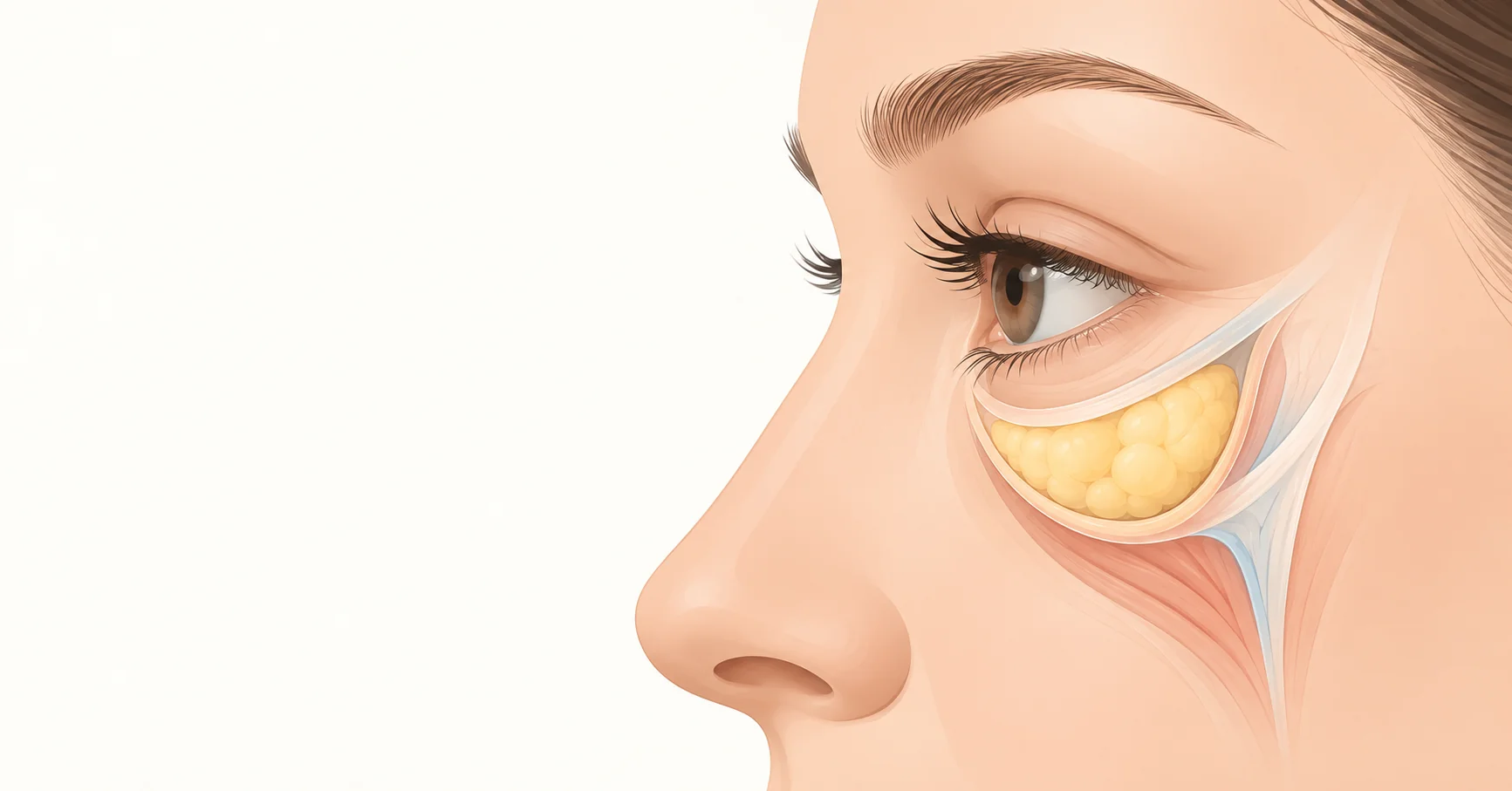
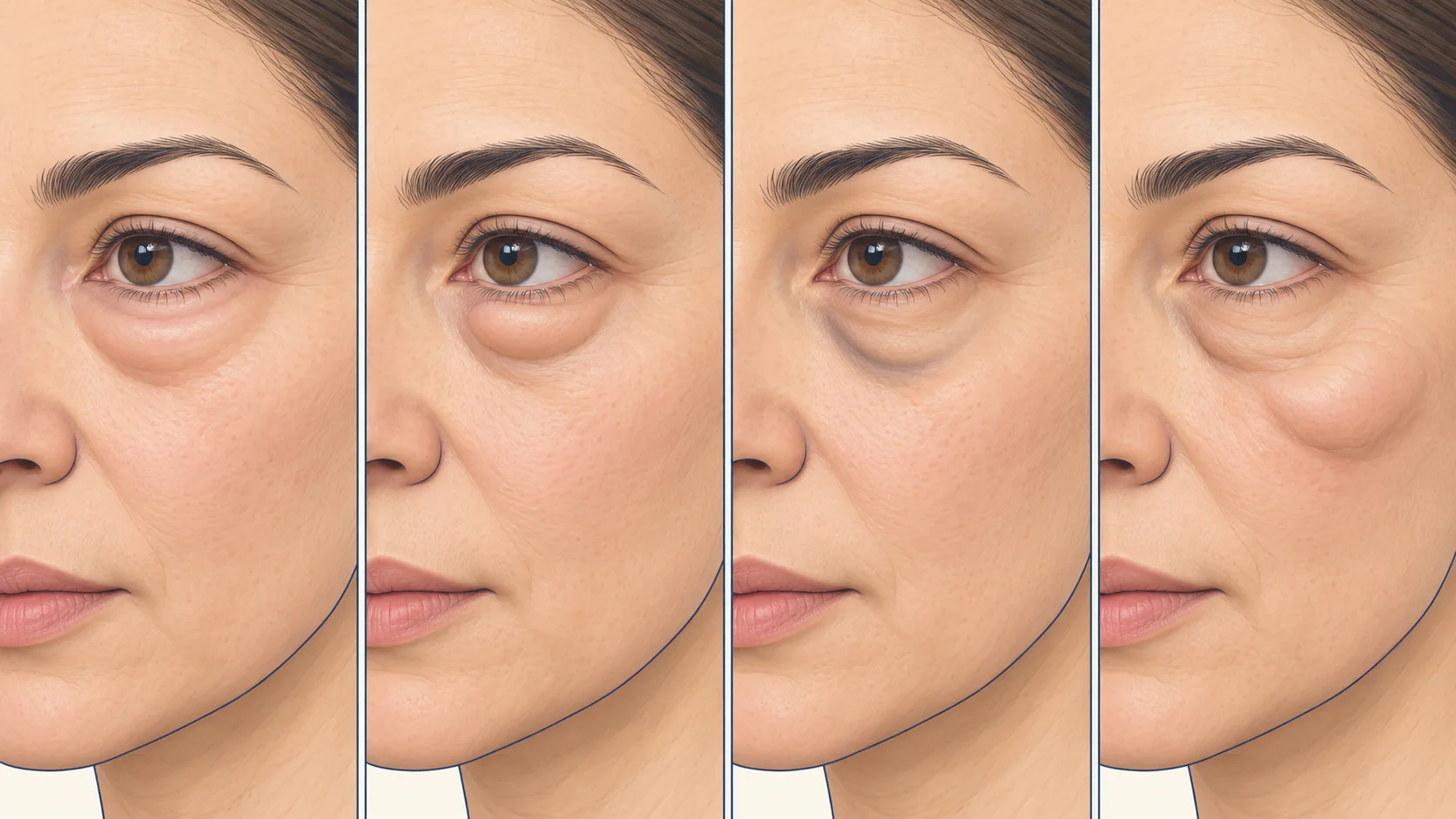
Most advice about eye bags fails because it treats four different problems as one. Puffiness from fluid comes and goes. A fat bag stays. A hollow groove under the eye casts a shadow that looks like a bag. And a swelling lower down, on the cheekbone, is a festoon or malar bag, which behaves differently again. Each has a different fix, and the wrong fix can make things worse.
| Type | How it behaves | What actually helps |
|---|---|---|
| Fluid puffiness | Worst on waking, after a short night, salty food, alcohol or crying; better by afternoon | Sleep, cold compress, treating allergies. Creams help briefly |
| Fat bag | Same size all day; a soft, rounded bulge right under the lashes; bulges more when you look up | Surgery to remove or reposition the fat. Filler only blends small ones |
| Tear trough hollow | A groove or shadow along the bone under the eye; looks worse under overhead light | Filler, or fat moved into the groove during surgery |
| Festoons / malar bags | Puffy pads lower down, on the cheekbone, often worse in the morning | Individual assessment. Standard eye-bag surgery usually does not address them, and filler can make swelling there worse |
A quick mirror test helps. Hold a mirror at chin level and look up at it without moving your head. A fat bag usually pushes forward more in this position. Then compare a photo taken just after waking with one taken mid-afternoon: if the difference is large, fluid is a big part of the problem. Many people over 35 have a fat bag and a hollow below it, which is why the two are so often treated together. If what you mainly see is dark colour rather than a bulge, our dark circles guide is the better starting point.
2. Why fat bags appear, and why they don’t go away
The eye sits in a cushion of fat. The lower eyelid holds the front of that fat in place. For years, surgeons argued about why the fat starts to bulge with age: does the eye sink, does the eyelid wall weaken, or does the fat itself grow?
A 2008 MRI study from UCLA measured this directly in 40 people across three age groups. The area of soft tissue in front of the lower half of the eye grew with age, and fat was the main reason: the fat in that area was about 50% larger in people aged 55–80 than in those aged 12–29. Total fat in the eye socket increased too. The position of the eyeball did not change. The authors concluded that fat expansion is the main age-related cause of lower-eyelid bulging, and that removing fat should be part of treating it.
Age is not the only factor. Some people have visible bags in their twenties, and one clinical report notes that bags often appear earlier than ageing alone would suggest. Either way, the practical point is the same: a fat bag is a structural change. Sleep, diet and skincare can change the puffiness on top of it, but not the fat underneath.
3. Morning puffiness: what actually helps
Fluid-based puffiness is the part you can influence at home. Sleep matters more than most people think. In a Karolinska Institute experiment, observers rated photos of the same ten people after normal sleep and after 31 hours awake. After sleep deprivation the faces were rated as having more swollen eyes, darker circles, more hanging eyelids and paler skin, and the people looked more tired and sadder.
The other measures below are cheap and low-risk. There are no good trials behind most of them, so think of them as sensible habits rather than proven treatments:
- A cold compress for a few minutes in the morning. It reduces swelling for a while; it does not change the fat.
- Sleeping with your head slightly raised, especially before an important day or a photo.
- Less salt and alcohol in the evening. Both are common triggers for morning puffiness.
- Treating allergies if your eyes itch or your nose is blocked, and not rubbing your eyes. A pharmacist or doctor can suggest antihistamine tablets or eye drops.
4. Eye creams: what they can and cannot do
A 2026 review of eye-area skincare found that retinoids, peptides, antioxidants and ingredients that act on blood vessels can improve hydration, firmness, even skin tone and puffiness. It also found that most studies test finished multi-ingredient products rather than single ingredients, and that they are short-term, industry-sponsored and limited in who and what they measured. A typical example: in a 12-week study with no comparison group, run by the product’s maker, 73% of users reported less puffiness. That is a self-report, not a measurement of fat.
So an eye cream is reasonable for skin texture, fine lines and temporary de-puffing, and Japanese drugstores sell many eye creams for less than in many Western countries (see our Japanese skincare guide). We found no study showing that a cream shrinks a fat bag, and there is no plausible way it could.
5. Filler: it hides the edge, not the bag
Hyaluronic acid filler injected along the tear trough does not remove anything. It fills the groove below a bag, so the step between bag and cheek is smaller and the shadow softens. For a small bag sitting on top of a hollow, that can be enough. For a large bag, adding volume underneath can make the whole area look fuller.
The evidence on filler for this area is reassuring for the right patient. A 2024 meta-analysis of 31 studies with 2,556 participants found a pooled satisfaction rate of 91.0%. Common side effects were swelling (19.2%), bruising (18.4%), redness (7.1%), lumps or contour irregularity (5.3%) and a bluish tint from filler placed too close to the surface (0.9%). A separate review of 1,956 patients, covering several filler materials, found satisfaction of 84.4% in the short term and 76.7% in the longer term; minor complications were common (44%), and a blunt cannula rather than a needle was linked to less bruising (7% vs 17%).
One delayed problem matters for anyone with puffy eyes. In a review of 52 published cases of late complications after tear-trough filler, the most common was swelling (42.3%), and most swelling cases involved hyaluronic acid. Across all delayed complications, the average onset was 16.8 months after the injection. If your main problem is fluid puffiness or festoons, a clinic should be cautious about filler. Our under-eye filler guide covers products, prices and the cannula question in detail.
6. Surgery: remove the fat, or move it
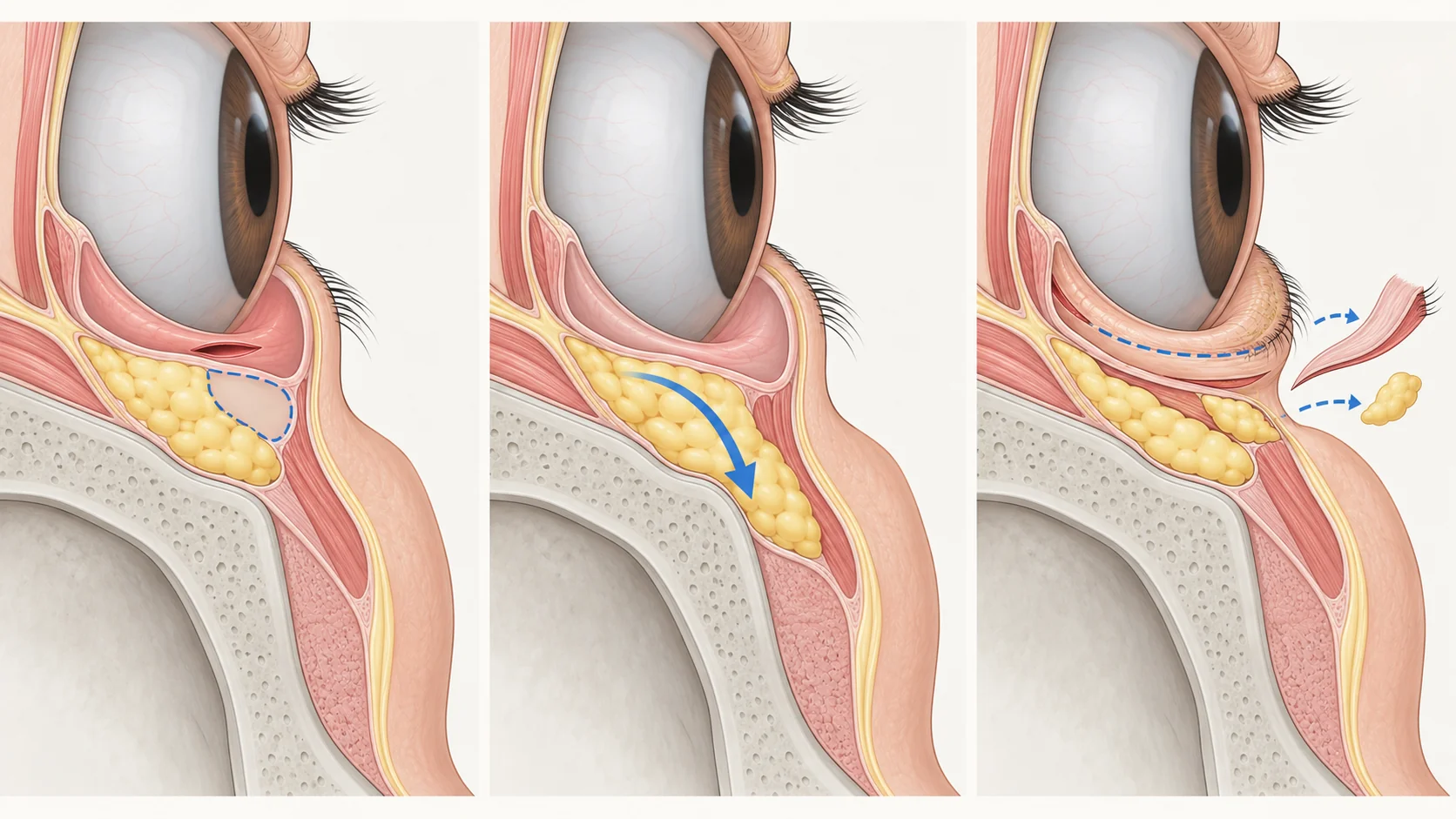
Lower-eyelid surgery (lower blepharoplasty) is the only treatment that deals with the fat itself. There are three main approaches, and choosing between them depends on two questions: is there a hollow under the bag, and is there loose skin?
| Approach | What it does | Best suited to |
|---|---|---|
| Fat removal from inside the lid transconjunctival; Japanese: 経結膜脱脂法 | A small cut on the inner surface of the eyelid; excess fat is removed. No visible scar | A clear fat bag, little loose skin, no deep hollow |
| Fat repositioning Japanese: 裏ハムラ法 (from inside) or ハムラ法 (through the skin) | Fat is moved down into the groove instead of being removed, smoothing bag and hollow together | A bag with a visible tear trough below it |
| Skin-incision blepharoplasty transcutaneous; Japanese: 下眼瞼切開 | A cut just below the lashes; fat and excess skin are treated together | Bags with loose, crepey skin, usually older patients |
Fat removal from inside the lid is the procedure most Japanese clinics advertise as “non-incision” eye-bag removal. It still involves an incision, just one you cannot see. A review of 40 cases drawn from a series of 200 such operations found that this route avoided the most common complication of the skin-incision approach, a lower lid that is pulled down or out of shape. Its most common problem was not removing enough fat. The authors considered people with prominent fat and no excess skin to be the ideal candidates.
Fat repositioning was developed because removing fat from someone who also has a hollow can deepen it. One Tokyo specialist clinic states on its own page that fat removal alone suits mild bags without much hollowing, and can make other cases look worse. Repositioning is more complex. A 2024 meta-analysis of 33 studies and 4,671 patients who had fat moved or grafted into the groove found an overall complication rate of 11.2%, including unsatisfactory correction or uneven contour (6.2%), bleeding, swelling or bruising (6.2%), and reoperation in 2.4%. The authors described these rates as high.
Across all approaches, a 2025 systematic review of 36 studies concluded that lower blepharoplasty has a low complication profile: no major complications affecting vision were reported, and most problems could be handled without surgery or with a revision. One rare but serious risk is bleeding behind the eye. In a survey covering 269,433 cosmetic eyelid operations, orbital bleeding occurred in about 1 in 1,800 and permanent vision loss in about 1 in 22,000; most cases started within three hours of surgery, and the risk fell sharply after 24 hours. That is reassuring overall, but it is not a reason to choose a surgeon on price alone. This is a precise operation close to the eye, and results depend heavily on the surgeon’s judgement about how much fat to take or move.
7. What eye-bag treatment costs in Japan
Scarless fat removal is one of the most heavily advertised procedures in Japanese cosmetic surgery, and headline prices are low. The catch is that the headline is rarely the total. Large chains sell the same operation in several tiers, and sedation, nerve blocks and fat grafting are often extra.
| Treatment | Clinic | Price |
|---|---|---|
| Fat removal from inside the lid | Shinagawa Skin Clinic | ¥58,000 (one fat pad) · ¥88,000 (three pads) |
| Shonan Beauty Clinic | ¥113,000 (three pads; local anaesthetic included) · ¥79,100 as a photo “monitor” | |
| TCB Tokyo Central | ¥83,600 (standard tier) up to ¥458,000 (top tier) | |
| Ginza Miyuki-dori Biyou Geka | ¥330,000 (local anaesthetic and medicines included) | |
| Fat removal + fat grafting | Ginza Miyuki-dori Biyou Geka | ¥660,000 |
| Fat repositioning from inside (裏ハムラ) | Shonan Beauty Clinic | ¥380,000 · ¥266,000 as a monitor |
| TCB (Osaka Umeda only) | ¥600,000 | |
| Ginza Miyuki-dori Biyou Geka | ¥660,000 | |
| Sedation / nerve block add-on | Shonan Beauty Clinic · TCB | ¥31,900 · ¥50,000 (TCB: higher tiers only) |
| Tear-trough filler | TCB | ¥19,200–69,800 per 1 cc, depending on product |
Prices are from the clinics’ own price pages and are planning figures, not quotes. A “monitor” price usually means agreeing to let the clinic use your before-and-after photos. ClinicJapan has no partnership with the clinics listed.
Before you agree to a price, ask the clinic to write down the total: which tier, how many fat pads, whether sedation is included, whether fat grafting or filler is being added, and the cost of aftercare medicines and follow-up visits. Because one chain’s tiers run from ¥83,600 to ¥458,000, the final total can be several times the headline price, so decide your budget before you walk in. Our guides to choosing a clinic and eyelid surgery costs in Japan cover this in more detail.
8. Fitting it into a trip
Clinic pages give a consistent picture of recovery from fat removal inside the lid. Shonan Beauty Clinic describes a 30-minute procedure with swelling that peaks on days 2–3 and is usually hard to notice after about a week; when fat grafting is added, it says 80–90% of the swelling has usually gone after a month. Shinagawa Skin Clinic lists swelling and discomfort for 2 days to a week and bruising for 1–2 weeks. Ginza Miyuki-dori Biyou Geka allows face makeup the same day and eye makeup from the next day, but asks patients to wait a week before wearing contact lenses.
- Book it early in the trip, with at least a week before you fly home, so you can go back if anything worries you.
- Ask about follow-up before booking: whether the clinic wants to see you again, and what happens if you have a question once you are home.
- Plan quiet days straight after. Sunglasses cover most bruising; long baths, exercise and alcohol are usually limited for the first week.
- Tell the doctor about every medicine and supplement, especially anything that thins the blood. Do not stop prescribed medicines without asking the doctor who prescribed them.
- Filler is easier to fit in: a short appointment, with possible bruising for several days. If a doctor confirms you have a small bag over a hollow, it can be a lower-commitment first step.
Related concerns. If the main problem is colour rather than a bulge, start with our dark circles guide. Lines at the outer corner of the eye are a separate issue, covered in crow’s feet, and a sagging lower face is covered in sagging jowls. Brown pigment under the eyes may be hyperpigmentation or melasma, which need different treatment. For fullness under the jaw rather than the eyes, see how to get rid of a double chin; some clinics also offer PRP for the under-eye area, where the evidence is limited.
9. What we would do
- Work out the type first. Morning-versus-afternoon photos and the look-up test help tell fluid from fat in a few days, at no cost.
- Fix the cheap part. Sleep, a cold compress and allergy treatment take care of the puffiness layer. Spend money only on what is left.
- For a small bag with a hollow below it, consider filler first, with a cannula, from a clinic that will tell you if filler is the wrong tool.
- For a clear fat bag, compare fat removal and repositioning with a surgeon who offers both. A clinic that offers only one will tend to recommend it.
- Get the total in writing before you agree, and book at the start of your trip.
10. FAQ
11. Sources & Method
Each clinical claim is sourced to a PubMed-indexed paper. Every PMID was found by searching PubMed, confirmed against the PubMed record, and the figures were taken from the published abstract. Japanese prices and recovery times are from the clinics’ own pages, checked on 2 October 2026; prices change and campaign prices vary, so treat them as ranges, not quotes. The four-type table, the mirror test, the home measures in section 3, the trip advice in section 8 and the plan in section 9 are our editorial judgement, based on the sources below, not findings from a single paper.
| Source | Used for |
|---|---|
| Magnetic resonance imaging characterization of orbital changes with age and associated contributions to lower eyelid prominence (PMID 18766060) Darcy et al., Plast Reconstr Surg, 2008 · 40 subjects · accessed 2 Oct 2026 | Fat expansion as main cause; globe position unchanged (section 2, FAQ) |
| Eyelid bags (PMID 20565888) Inchingolo et al., Head Face Med, 2010 · accessed 2 Oct 2026 | Bags often appearing earlier than age alone explains (section 2) |
| Cues of fatigue: effects of sleep deprivation on facial appearance (PMID 23997369) Sundelin et al., Sleep, 2013 · accessed 2 Oct 2026 | More swollen eyes and darker circles after sleep deprivation (section 3) |
| Dermocosmetics for Periocular Aging: Evidence, Mechanisms, and Integration with Aesthetic Procedures (PMID 42814367) Prudkin et al., Dermatol Ther (Heidelb), 2026 · narrative review, industry-funded (ISDIN) · accessed 2 Oct 2026 | What eye creams can do; limits of the evidence (section 4, FAQ) |
| Global periorbital skin rejuvenation by a topical eye cream (PMID 30636356) Colvan et al., J Cosmet Dermatol, 2019 · open-label, manufacturer-run · accessed 2 Oct 2026 | Example of a self-reported puffiness result without a control group (section 4) |
| The Efficacy and Safety of Hyaluronic Acid Injection in Tear Trough Deformity: A Systematic Review and Meta-analysis (PMID 37684413) Liu et al., Aesthetic Plast Surg, 2024 · 31 reports, 2,556 participants · accessed 2 Oct 2026 | 91.0% satisfaction; side-effect rates (section 5, FAQ) |
| Nonsurgical Tear Trough Volumization: A Systematic Review of Patient Satisfaction (PMID 33693530) Gorbea et al., Aesthet Surg J, 2021 · 28 studies, 1,956 patients · accessed 2 Oct 2026 | 84.4% vs 76.7% satisfaction; 44% minor complications; cannula 7% vs needle 17% bruising (section 5) |
| Delayed Complications following Dermal Filler for Tear Trough Augmentation: A Systematic Review (PMID 34666405) Trinh et al., Facial Plast Surg, 2022 · 52 cases · accessed 2 Oct 2026 | Delayed swelling 42.3%; mean onset of any delayed complication 16.8 months (section 5) |
| Updated Management of Malar Edema, Mounds, and Festoons: A Systematic Review (PMID 31051517) Newberry et al., Aesthet Surg J, 2020 · accessed 2 Oct 2026 | Festoons as a separate, individually treated problem (section 1) |
| Transconjunctival blepharoplasty. Complications and their avoidance (PMID 8357600) Palmer et al., Arch Otolaryngol Head Neck Surg, 1993 · accessed 2 Oct 2026 | Avoids lid malposition; under-removal as main problem; ideal candidates (section 6) |
| Complications of Fat Grafting and Repositioning for Correction of Lower Eyelid Pouch With Tear Trough Deformity or Lid-Cheek Junction: A Systematic Review (PMID 39158343) Xu et al., Ann Plast Surg, 2024 · 33 studies, 4,671 patients · accessed 2 Oct 2026 | 11.2% complications, 2.4% reoperation (section 6, FAQ) |
| Safety and Complications in Lower Eyelid Blepharoplasty: A Systematic Review (PMID 40995580) Gimenez et al., Plast Reconstr Surg Glob Open, 2025 · 36 articles · accessed 2 Oct 2026 | Low complication profile; no major visual complications reported (section 6, FAQ) |
| Lower eyelid blepharoplasty: a comparison of transconjunctival, transcutaneous, and combined techniques (PMID 42089982) Schwaiger-Hessel, HNO, 2026 · review · accessed 2 Oct 2026 | Transconjunctival: scarless, very low malposition risk; transcutaneous treats skin too (section 6) |
| Incidence of postblepharoplasty orbital hemorrhage and associated visual loss (PMID 15599241) Hass et al., Ophthalmic Plast Reconstr Surg, 2004 · 269,433 cases · accessed 2 Oct 2026 | Orbital bleeding 149 cases, permanent vision loss 12; timing (section 6, FAQ) |
| Source | Used for |
|---|---|
| Shinagawa Skin Clinic — 切らないクマ取り・目の下のたるみ取り official page, tax included · accessed 2 Oct 2026 | ¥58,000 / ¥88,000; swelling and bruising times (sections 7, 8) |
| Shonan Beauty Clinic — 目の下の切らないクマ取り・たるみ取り official page, tax included · accessed 2 Oct 2026 | ¥113,000 / ¥79,100; ura-hamura ¥380,000 / ¥266,000; IV sedation ¥31,900; recovery timeline (sections 7, 8) |
| TCB Tokyo Central Aesthetic Surgery — 目の下のクマ・たるみ・しわ取りの料金表 official price list, tax included · accessed 2 Oct 2026 | Tier prices ¥83,600–458,000; nerve block ¥50,000; ura-hamura ¥600,000; filler per cc (section 7) |
| Ginza Miyuki-dori Biyou Geka — 経結膜脱脂法 official page, tax included · accessed 2 Oct 2026 | ¥330,000 / ¥660,000 (with fat grafting); ura-hamura ¥660,000; suitability note; makeup and contact-lens timing (sections 6, 7, 8) |
Related Guides
About this guide: ClinicJapan is editorially independent. Where a clinic named on this site is an advertising partner, that relationship is disclosed on the page where it appears; no clinic named above is a partner, and nobody paid to be included. Prices change and vary by clinic; confirm before booking. Filler and eyelid surgery are medical procedures; discuss your medical history with a doctor before starting them. Informational only; not medical advice, and not a substitute for consultation with a physician.