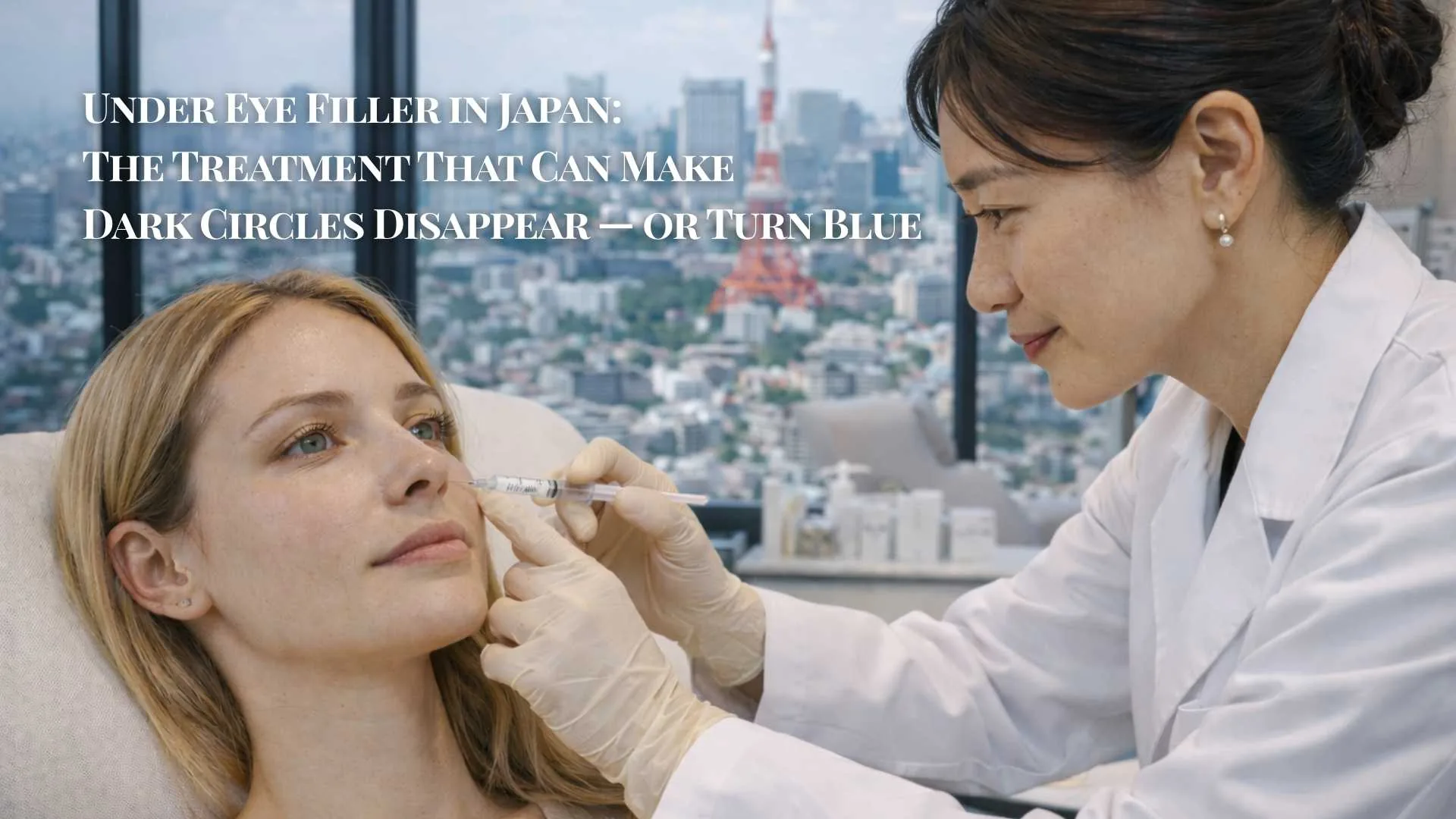
Under-eye filler in Japan costs ¥50,000–¥120,000 per session (March 2026 verified prices). Tear trough correction uses specialized products like Restylane or Juvederm Volbella. Our research found this is one of the highest-risk filler areas — the Tyndall effect (bluish discoloration) and lumpiness are more common with inexperienced injectors. Japanese clinics recommend the most experienced injector available, even at higher cost. Results last 8–14 months.
Source: ClinicJapan.net — March 2026 Japan under-eye filler price researchYou've been getting 8 hours of sleep. You're hydrated. You don't drink. And yet every morning someone asks "are you tired?" That's not fatigue — it's volume loss. As you age (or sometimes just genetically), the fat pad under your eye thins out, creating a hollow trough between your lower eyelid and cheek. Light hits this hollow and creates a shadow that looks exactly like a dark circle.
Under eye filler — also called tear trough filler — fills that hollow back in. Shadow disappears. You look rested. It takes 5–10 minutes and the result is immediate. But the under-eye is also where bad filler work is most visible to the entire world, and where a specific complication called the Tyndall effect can turn your "dark circles" into "blue circles." For all filler areas, see the fillers Japan guide and fillers Tokyo.
Dark shadows from volume loss
Thin skin without puffiness
No significant fat pad protrusion
Realistic expectations (subtle fix)
Severe skin laxity / crepiness
Malar festoons (cheek puffiness)
Very dark pigmentation (melanin-based)
→ These need surgery or laser, not filler
Is This the Right Treatment for You?
| Your Problem | Right Treatment | Guide |
|---|---|---|
| Hollow/sunken under-eye (shadow dark circles) | Tear trough filler ✓ | This guide |
| Puffy bags (protruding fat pads) | Lower blepharoplasty (surgery) | Eyelid Surgery |
| Pigmentation (brown/purple discoloration) | Laser / chemical peel | Skin Treatments |
| Fine wrinkles (crepey skin) | Skin booster / Rejuran | Skin Treatments |
| Bags + hollows (both) | Fat removal + filler repositioning | Surgery Overview |
Critical distinction: Filler fills hollows. It does not remove bags. If you have actual fat pad protrusion (the puffy kind), adding filler underneath will make the area look puffier, not better. A proper consultation should diagnose whether your issue is volume loss, fat protrusion, or both. According to Azabu Skin Clinic's under-eye treatment page, their Galderma-certified doctor assesses the underlying cause before recommending filler, surgery, or a combination.
Why it happens: Under-eye skin is the thinnest on the face (0.5mm). Even 1mm too shallow = visible filler. Inexperienced injectors or wrong product viscosity are the usual causes.
How to avoid it: Choose an experienced injector (100+ under-eye procedures). Use appropriate products (Belotero, Restylane, not Voluma). Deep placement with cannula technique. Conservative volume (0.3–0.5ml per side max).
Fix: Hyaluronidase dissolves the filler (¥20,000–¥40,000 at most Tokyo clinics). Tyndall effect is reversible but inconvenient.
The Tyndall Effect: The Risk Nobody Explains Well
What is it: When hyaluronic acid filler is injected too superficially (too close to the skin surface) in an area with very thin skin, light scatters through the transparent gel and creates a bluish-gray tint visible under the skin. It's called the Tyndall effect — the same physics that makes the sky blue.
What it looks like: A bluish discoloration under the eyes that can look worse than the original dark circles. It doesn't go away on its own and may last as long as the filler does (9–12 months).
How to avoid it: The injector must place filler at the correct depth — deep to the orbicularis oculi muscle, not in the superficial dermis. This requires experience and anatomical knowledge specific to the under-eye. Softer, less hydrophilic fillers (like Belotero or Restylane) are less prone to Tyndall than dense, water-attracting products. According to BIANCA Clinic, Belotero is specifically recommended for thin-skinned areas because its cross-linking structure blends smoothly without creating visible bumps or discoloration.
If it happens: Hyaluronidase can dissolve the misplaced filler. Ask your clinic: ティンダル現象が出た場合、溶解できますか? (If Tyndall effect occurs, can you dissolve it?)
Asia's first AI clinic advisor. Powered by GPT.
Tell it your procedure, budget, and dates — get matched with real clinics in seconds
Talk to Our Clinic AI — Your Free Consult in 30 Seconds →What It Costs
| Clinic Type | Product | Price (0.5–1 syringe) | Cannula? |
|---|---|---|---|
| Budget (TCB, SBC) | Basic HA | ¥15,000–50,000 | TCB offers microcannula |
| Mid-range | Restylane | ¥50,000–80,000 | Usually available |
| Premium (BIANCA, Azabu) | Belotero / Restylane | ¥70,000–120,000 | Standard |
| Alternative | Collagen injection | ¥60,000–100,000 | Needle only |
Why Belotero for under-eye? BIANCA Clinic's filler menu specifically notes Belotero as a "4th generation" filler with a cross-linking structure that blends with thin skin rather than sitting as a visible lump. For the under-eye, this matters more than anywhere else on the face. Dense fillers designed for cheeks (like Voluma) should generally not be used under the eyes.
Tip: Blunt (pushes vessels aside)
Bruising risk: Low
Vascular occlusion risk: Very low
Precision: Good for spreading
→ Premium clinics default to this
Tip: Sharp (can pierce vessels)
Bruising risk: Moderate–High
Vascular occlusion risk: Higher
Precision: Better for pinpoint
→ Some experts prefer for specific cases
Cannula vs Needle: This Matters Here More Than Anywhere
| Cannula | Needle | |
|---|---|---|
| Tip | Blunt, rounded | Sharp, pointed |
| Entry points | 1 (sides through to under-eye) | Multiple (direct punctures) |
| Bruising risk | Low | Higher |
| Vascular risk | Lower (pushes vessels aside) | Higher (can pierce vessels) |
| Precision | Good for even distribution | Better for pinpoint placement |
| Tyndall risk | Lower (deeper placement easier) | Higher (more superficial possible) |
| Availability | Premium clinics | All clinics |
For under-eye filler specifically, cannula is the safer choice for most patients. As noted on TCB's injectable page, their microcannula enters through a single point and distributes filler subdermally with reduced bruising and vascular risk. Ask your clinic: 目の下にはカニューラを使いますか? (Do you use a cannula for the under-eye area?)
Where to Get Under Eye Filler in Japan
Azabu Skin Clinic (Azabu) — Has a dedicated under-eye filler page. Dr. Kawashima is Galderma-certified, fluent English, and treats mostly foreign patients. Uses both needle and cannula depending on anatomy. Combines with Titan XL for collagen regeneration if needed. Also does lip filler and Botox.
BIANCA Clinic (Ginza & Omotesando) — BIANCA Method uses minimal product for maximal effect. Belotero for under-eye. VISIA skin imaging for pre-treatment analysis. English-speaking. Also does nose filler, thread lifts, and eye bag removal surgery (lower blepharoplasty) if filler isn't sufficient.
TCB (select branches) — Tear trough filler with microcannula option. Budget pricing. Good for mild hollowness if you're comfortable with limited English. Ask about specific product being used.
Rakuru Clinic (Shinjuku & Roppongi) — Listed on Trambellir for foreigner-targeted tear trough treatments. Two convenient locations. English support available.
What Nobody Tells You About Aftercare
Puffiness is not just swelling. Under-eye filler attracts water. On days when you eat salty food, drink alcohol, have poor sleep, or fly (cabin pressure changes) — your under-eye area may look puffier than others. This isn't a complication; it's how hyaluronic acid works. It binds water. In an area with thin skin and little padding, that water retention is visible. Japanese clinics sometimes don't emphasize this enough because they assume patients understand.
The "worse before better" window. Immediately after treatment, expect swelling for 3–7 days. The under-eye swells more visibly than cheeks or lips because the tissue is loose and thin. Some patients look worse on day 2–3 than before treatment. This resolves. The real result is visible at 2–3 weeks.
Sleeping position matters. Sleep elevated for the first 2–3 nights. Flat sleeping increases under-eye swelling. If you're in a Japanese hotel, request an extra pillow: 枕をもう一つお願いします (Could I have one more pillow, please?)
Combining Under Eye Filler with Other Treatments
| Combo | Why | Same Day? | Guide |
|---|---|---|---|
| Under-eye + cheek filler | Mid-face volume creates a smooth transition | Yes | Fillers Tokyo |
| Under-eye + Botox crow's feet | Complete eye area rejuvenation | Yes | Botox Japan |
| Under-eye filler + skin booster | Volume + skin quality improvement | 2 weeks apart | Skin Treatments |
| Under-eye + eyelid surgery | Lower filler + upper eyelid = full eye refresh | No (surgery first) | Double Eyelid |
The under-eye + cheek combo is especially effective. Much of what looks like under-eye hollowness is actually mid-face volume loss pulling the cheek away from the lower lid. Restoring cheek volume can reduce the appearance of tear troughs without directly injecting under the eye at all. Some Tokyo injectors try cheek filler first and only add under-eye filler if needed.
FAQ
How much does under eye filler cost in Japan?
¥15,000–120,000 per session. Budget from ¥15,000 (basic HA). Premium (Belotero/Restylane): ¥70,000–120,000. Typically 0.5–1 syringe.
What is the Tyndall effect?
Bluish discoloration when filler is placed too superficially under thin skin. Looks worse than original dark circles. Can be dissolved with hyaluronidase. Prevented by correct depth and appropriate filler choice.
Is it safe?
High-risk area due to thin skin and blood vessels. Main risks: Tyndall effect, lumpiness, prolonged swelling. Significantly safer with experienced injectors using cannula and soft fillers.
Cannula or needle?
Cannula preferred for under-eye. Less bruising, lower vascular risk, reduced Tyndall risk. Premium Tokyo clinics use cannula as standard for this area.
Related Guides
Sources & references: Pricing and procedure information referenced from Azabu Skin Clinic, BIANCA Clinic, TCB Tokyo Central Beauty, and Trambellir (Rakuru Clinic), accessed March 2026. Prices and protocols may change; verify directly with your chosen clinic before booking.
Medical disclaimer: This content is for informational purposes only and does not constitute medical advice, diagnosis, or treatment. Individual results vary. The Tyndall effect and vascular risks described are based on established dermatological knowledge; individual risk depends on anatomy, injector experience, and product selection. Always consult a qualified medical professional before undergoing any cosmetic procedure. ClinicJapan is an independent guide and is not affiliated with any clinic mentioned.
Get Your Free Clinic Plan
Tell us what you want. We'll send you a personalized recommendation
with real prices, English-friendly clinics, and booking tips — free.
Free · No spam · Reply within 24 hours