1. What a pore actually is, and why it looks big
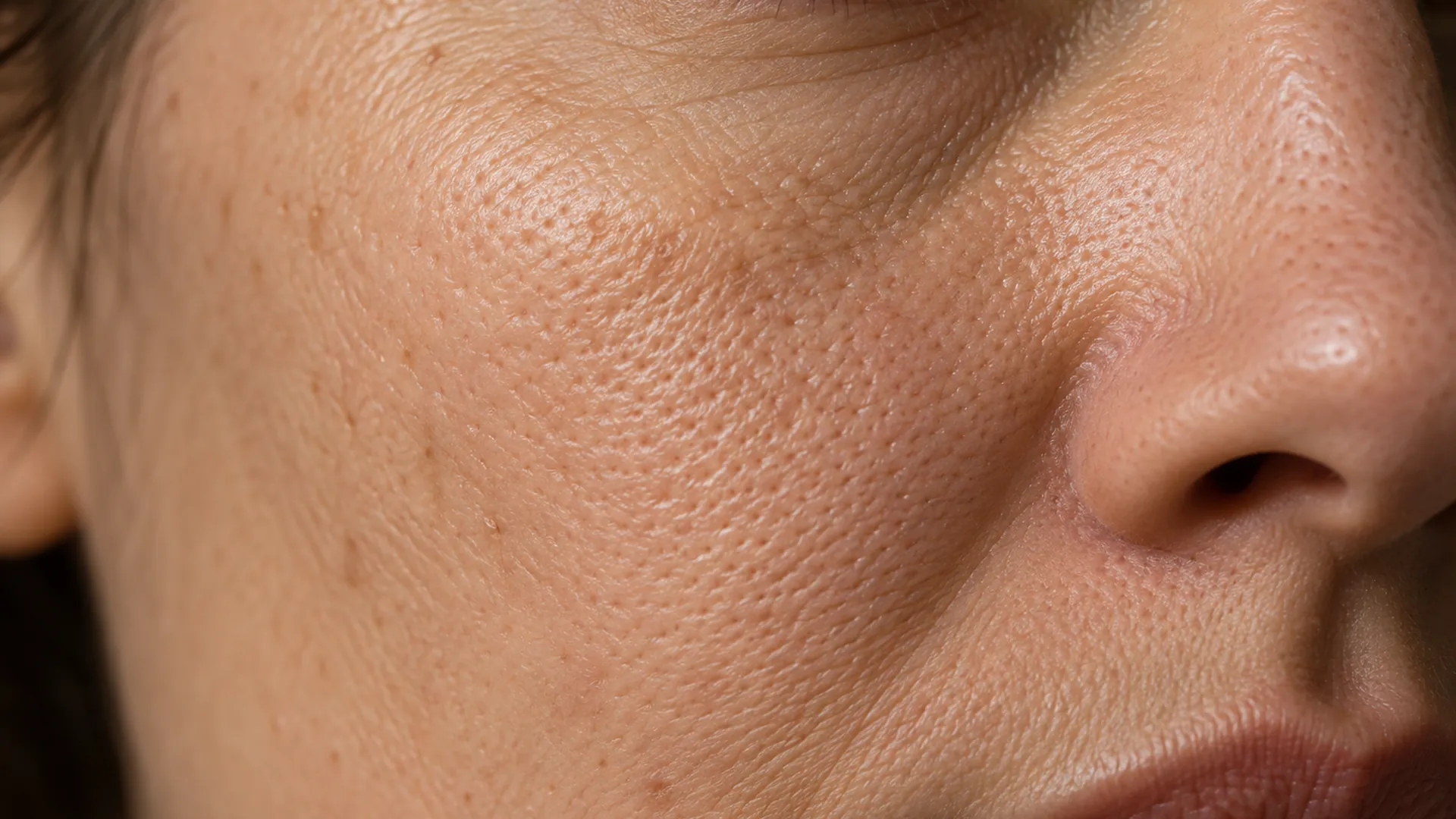
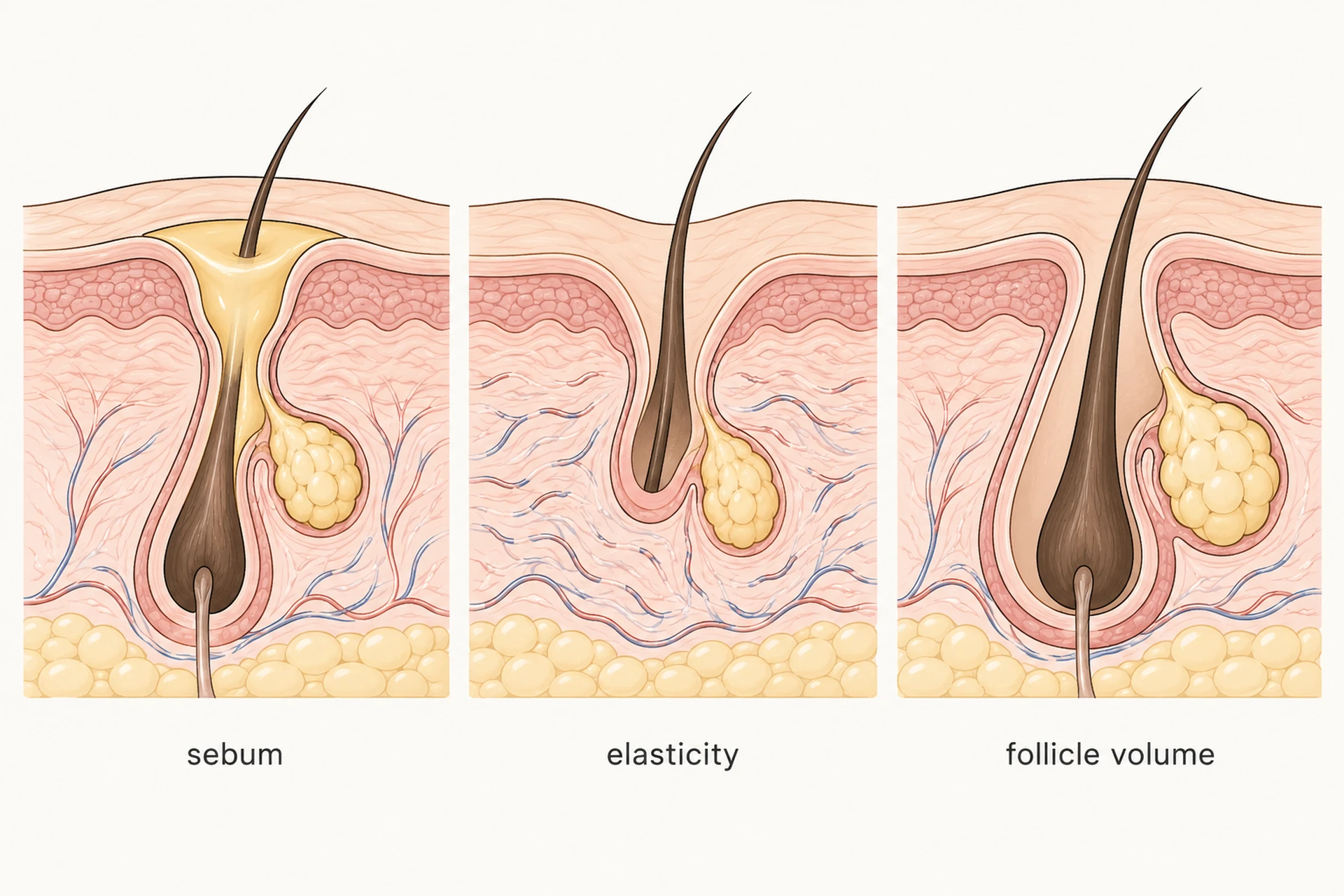
A facial pore is the opening of a pilosebaceous unit: a hair follicle with a sebaceous gland attached, delivering oil to the skin surface. There is no muscle around the opening — nothing that can constrict or dilate it — so it cannot open in steam or close in cold water, whatever the packaging says; what changes with temperature is the skin around it. A pore looks large for one of three reasons, and a 2016 review in Dermatologic Surgery set them out as the clinical framework this article uses: high sebum excretion, which stretches and fills the opening; decreased elasticity of the skin around the pore, which lets the opening sag into a teardrop; and increased hair follicle volume. The same review lists chronic recurrent acne, sex hormones and skin-care habits as modifiers of all three.
The relative weight of those causes was measured directly in a Korean study of 60 volunteers, 30 men and 30 women, that photographed pores under a dermoscopic camera, measured sebum with a Sebumeter, and ran everything through a regression. Pore size was significantly associated with sebum output, sex and age — and sebum output correlated most strongly, followed by male sex. The correlation was tighter in men (r = 0.47) than in women (r = 0.38), which the authors read as women having additional factors in play; pore size in women was significantly larger during the ovulation phase of the cycle (P = 0.008). One finding surprises people: acne severity was not significantly associated with pore size. Oily skin enlarges pores; breakouts, as such, do not.
| Cause | What you see | Who it tends to be | What addresses it |
|---|---|---|---|
| Sebum | Round, shiny pores on the nose and inner cheeks; a visible plug in some; skin looks oily by noon | Younger, oilier, more often men | Retinoids; sebum-reducing approaches; energy devices as a second step |
| Elasticity | Teardrop or oval pores that drift downward on the outer cheeks; they vanish when you stretch the skin | Older; sun-damaged skin | Retinoids; fractional lasers and other collagen-stimulating devices |
| Follicle volume | Larger openings that look the same whether the skin is oily or not | Often genetic; more visible with vellus hair | Least modifiable; devices may reduce the appearance |
One more piece of context, because it changes how you should read Japanese marketing. An in-vivo study of 80 women aged 30 to 39 from four ethnic groups — Caucasian, Asian, Hispanic and African American, all living in Dallas — measured cheek pore areas from surface replicas and found that Asian subjects had the smallest pore areas of the four groups. Japan's drugstores are nonetheless full of pore products, and Japanese clinics list pore treatments prominently. That is not because Japanese pores are unusually large. It is because the standard being aimed at is unusually high, which is worth remembering before you calibrate your own expectations against it.
2. Working out which kind you have
A 2023 review of the treatment literature — nineteen clinical trials, 591 patients, 83.7% of them women, aged 18 to 80 — came to a conclusion that doubles as a diagnostic rule: in young patients the focus should be on controlling sebum production; in older patients, on rejuvenation as well as sebum control. The review also found that combining modalities improved results more than any single one, and that the common side effects across the trials were mild, reversible burning and redness.
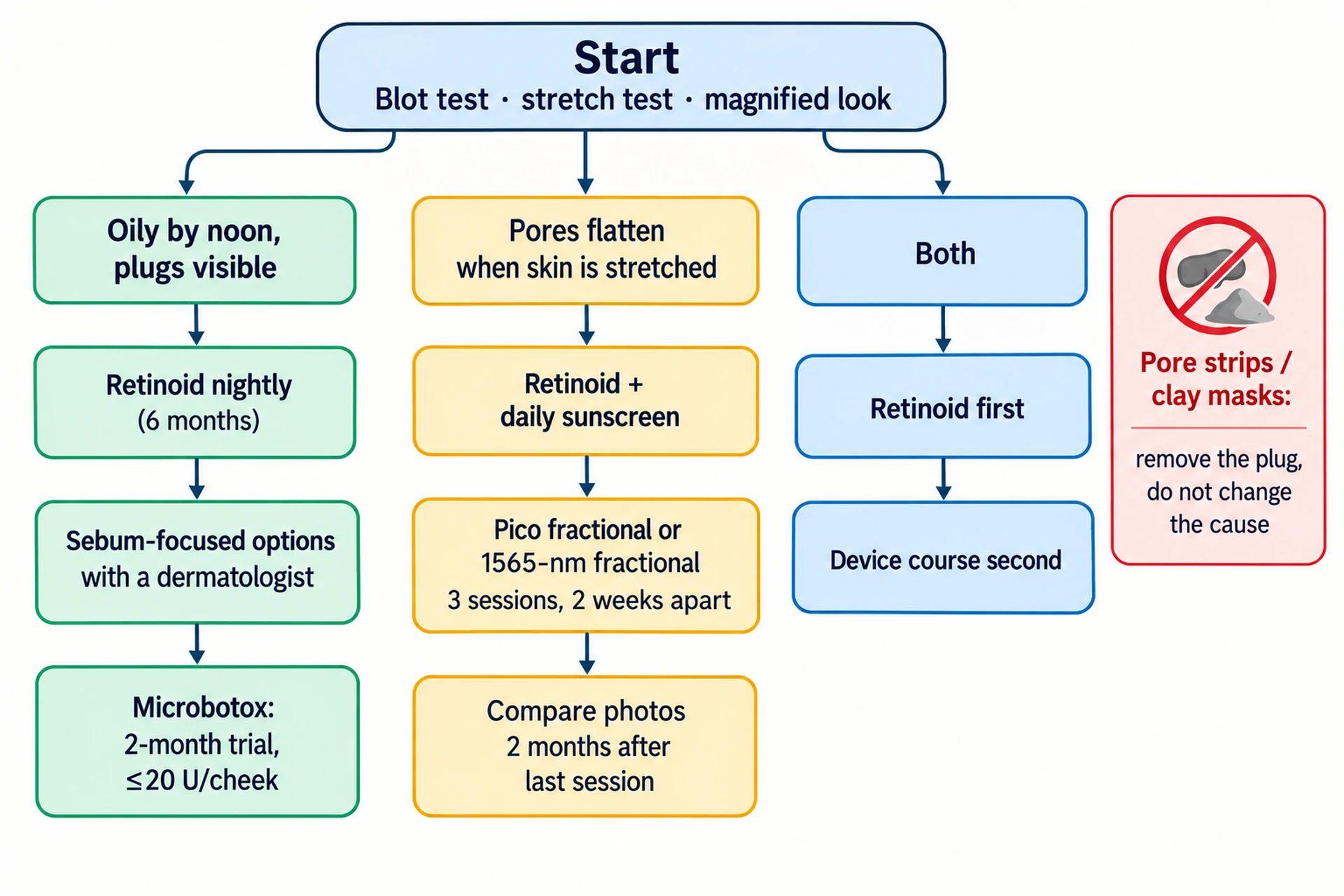
Our own version of that rule is a two-minute check in a mirror with a window behind you. First, blot your nose and cheeks with a tissue at midday and look at it: visible oil means sebum is at least part of your problem. Second, put a fingertip on your outer cheek and pull the skin gently upward and outward toward the ear; if the pores there flatten and largely disappear, the problem is elasticity, and they will come back the moment you let go. Third, look at the pores on your nose under magnification: a dark centre is an oxidised plug, which is a sebum sign; a clean, wide opening with no plug is more likely follicle size. By middle age most faces carry some of both of the first two, and the order you treat them in matters.
3. Retinoids: the boring winner
If there is one treatment for pores with proper trials behind it, it is a topical retinoid — not a serum, not a clay mask, and not any of the ingredients marketed at pores specifically. The two largest trials were of tazarotene 0.1% cream for facial photodamage, and both measured pore size as one of their endpoints.
In the first, 568 patients with at least moderate fine wrinkling or mottled pigmentation applied tazarotene 0.1% or vehicle cream once daily for 24 weeks. Tazarotene was significantly more effective than vehicle on every measure listed, including apparent pore size, and the improvement had not plateaued at week 24. In the second, 563 patients went through a 24-week double-blind phase followed by a 28-week open-label extension; at week 24, significantly more tazarotene patients had achieved at least a one-grade improvement in pore size, along with fine wrinkling, pigmentation, elastosis and roughness (P < .01), and improvement continued through week 52 without plateauing. The cost was irritation: in the double-blind phase, 20 of 283 tazarotene patients discontinued for adverse events, against 1 of 280 on vehicle. Adverse events in the first trial were predominantly mild or moderate skin irritation.
| Study | Design | Pore finding | Trade-off |
|---|---|---|---|
| Kang et al., 2005 | 568 patients, tazarotene 0.1% vs vehicle, once daily, 24 weeks | Apparent pore size significantly improved vs vehicle; not plateaued at week 24 | Mostly mild-to-moderate irritation |
| Phillips et al., 2002 | 563 patients, 24 weeks double-blind + 28 weeks open-label | ≥1-grade pore-size improvement significantly more frequent vs vehicle at week 24; overall photodamage still improving at week 52 | 20/283 vs 1/280 discontinued for adverse events |
Two honest caveats. Pore size was a secondary endpoint in both trials, which were designed around wrinkles and pigmentation, so the effect size on pores specifically is not reported in the abstracts and should be read as “real and significant” rather than “large”. And the retinoid that works is the one you can keep using: a strong retinoid you abandon at week three because your face is peeling does nothing. Start at a concentration you tolerate, use it nightly, and give it the six months the trials gave it. In Japan — to our knowledge as of September 2026, not a finding from these papers — tazarotene, the retinoid in these trials, is not an approved product; nor is topical tretinoin, which cosmetic clinics dispense in-house rather than through pharmacies. Adapalene 0.1% is approved for acne and available on prescription, and over-the-counter retinol is widely available. Ask the clinic what it can supply, because the answer varies.
4. Microbotox: the honest numbers
“Microbotox”, “skin botox” or “mesobotox” — dilute botulinum toxin injected into the dermis in many tiny blebs rather than into muscle — is heavily marketed for pores in Japan and Korea. The evidence is small, and it points in two directions at once, which is worth seeing in full before you pay for it.
The trial in its favour is a split-face study of 20 patients with enlarged pores and oily skin: one cheek received intradermal toxin, the other saline. At one month, both sides showed a significant reduction in sebum and pore scores (p = .001), with significantly more improvement on the toxin side; dermoscopy documented a significant decrease in average pore size and optical coherence tomography a significant increase in dermal thickness, though the thickness change did not differ between sides. At four months the toxin side had held its improvement. The authors conclude it is effective and safe with results lasting about four months. Read the first finding twice: the saline-injected cheek also improved significantly. Some of what people see after microbotox is the needling; the trial's own saline arm shows it.
The trial against is a double-blind split-face study of 18 volunteers given intradermal incobotulinumtoxinA in one cheek and saline in the other, followed at weeks 2, 4, 8 and 12. There was no significant effect on sebum secretion, and the improvement in pore size was observed only at week 2. Skin texture improved for eight weeks and nasolabial wrinkles for twelve. One volunteer developed facial palsy after 30 units in one cheek; 20 units in one cheek produced no adverse events. The authors' own summary is that the technique benefits texture and wrinkles, which is not what it is sold for.
5. Lasers and devices: what a head-to-head trial found
Energy devices are where Japanese clinics do most of their pore business, and the useful comparison is a 2024 randomised split-face trial of the two device classes you will actually be offered: a 1064-nm picosecond laser with a fractionated microlens array on one side of the face and a 1565-nm non-ablative fractional laser on the other. Twenty-five participants (3 men, 22 women) had three sessions at two-week intervals. At the end of treatment and two months later, pore counts were significantly reduced on both sides. On a quartile improvement scale the scores were 2.22 for the picosecond side and 2.14 for the fractional side; patient self-assessments were 3.72 and 3.68. None of those differences was significant. What did differ was pain — 4.11 versus 4.83 on the scale used, in favour of the picosecond laser — and the authors reported the picosecond device was less likely to cause hyperpigmentation, although the difference in pigmentation occurrence did not reach significance.
The practical translation: the two device families do the same job on pores about equally well, the pico version hurts slightly less and is the safer bet for skin that pigments easily, and three sessions is what the head-to-head trial used. That last point matters for pricing, which is why the Japan table below is per course, not per session. The broader review of nineteen trials adds that combining modalities improved pore area and number more than single treatments, at the cost of mild, reversible burning and redness.
What about the oral route? A small German study of very-low-dose oral isotretinoin — 5 mg a day, 2.5 mg a day, or 2.5 mg three times a week for six months in 11 patients — reduced sebum production by up to 64% and sebaceous gland size on biopsy by 51%. It is the only intervention in this article with biopsy evidence that the gland itself shrinks, and it is the one we mention last on purpose: eleven patients; a prescription-only drug that is teratogenic and absolutely contraindicated in pregnancy; not approved in Japan, so the clinics that offer it import it; and a decision that belongs with a dermatologist rather than a cosmetic menu.
6. Doing this in Japan — what it costs and how it differs
Pore treatment in Japan is jiyu shinryo, private-pay, with published prices and no insurance involvement. Two things stand out. Chains price lasers per session and per course at levels well below Western clinics, and they routinely bundle five sessions, which happens to match the three-session minimum from the trial with room to spare. And microbotox, when a clinic offers it, is priced per unit or per unit-band, which makes the dose visible on the price list — useful, given section 4.
| Treatment | Typical price | What we checked |
|---|---|---|
| Pico fractional, full face (chain) | ¥9,800 per session (¥7,800 first session); ¥41,650 for 5 | Shonan Beauty Clinic's laser price list, September 2026, as listed; pico toning is priced identically, with a 10-session price of ¥78,400 for toning only |
| Fractional CO2 (chain) | ¥6,200 / ¥10,600 / ¥20,100 per session for small / medium / large areas | Shonan's laser price list (standard plan), September 2026, as listed |
| Pico laser (all tiers) | ¥10,000–60,000 per session | Our March 2026 survey, budget to premium, pre-tax |
| Non-ablative fractional (Fraxel-type) | ¥20,000–80,000 per session | Our March 2026 survey, pre-tax |
| Microbotox (clinic group) | ¥22,000 for 10 units; ¥132,000 for 60 units and up, tax included | Mizunomori Clinic's menu (a multi-branch group; microbotox at its Ginza, Yokohama, Nagoya and Shinsaibashi branches), which uses Allergan's Botox Vista and gives 30–80 units as the guide for a full face |
| Chemical peel | ¥5,000–35,000 per session | Our March 2026 survey, pre-tax |
| Consultation fee | ¥0–5,000 | Free at chains; charged and usually credited at premium clinics |
At roughly ¥157 to the dollar, a five-session pico fractional course at a chain is about $265, and at the ¥2,200 per unit implied by that clinic group's 10-unit price, a 30-unit full face would be roughly ¥66,000, about $420 — our extrapolation, since the menu lists only the 10-unit and 60-unit-plus prices. The trade-off at the chain tier is the one it always is: a protocol rather than a judgement, and short consultations. For pores that is less of a problem than for most treatments, because the device does the same thing regardless of who presses the button; the skill is in choosing the device, which is why section 2 exists.
Our device-by-device breakdowns are on pico laser in Tokyo and laser treatment in Japan; skin treatment in Japan is the general entry point, acne treatment in Tokyo covers the oily-skin side, and English-speaking skin clinics in Tokyo lists where to go. For the drugstore end, Japanese skincare and Japanese sunscreen are the two that matter for pores.
7. What we would actually do, in order
This is our editorial sequence, built from the evidence above. It is not a protocol from any paper.
First, the two-minute check in section 2. Blot test, stretch test, magnified look at the nose. Decide whether you are mainly sebum, mainly elasticity, or both. Everything else follows from that.
Second, a retinoid, tonight, regardless of type. It is the only pore treatment with trials in the hundreds, it addresses both of the common causes, and it is the cheapest step to have in place before paying for any device. Start low, go nightly, and do not judge it before six months, because that is how long the trials ran.
Third, daily sunscreen. Loss of elasticity around pores is largely a photoageing change — chronic ultraviolet exposure is among the recognised causes listed in the 60-volunteer study — and the tazarotene trials were photodamage trials. Everything you spend on lasers is undone by the sun faster than it was built.
Fourth, if you are elasticity-type or mixed, a device course. Pico fractional or non-ablative fractional, three sessions minimum at roughly two-week intervals as in the head-to-head trial, pico if your skin pigments easily. Photograph before the first session and two months after the last; that is the interval the trial used, and it is the only fair comparison.
Fifth, and only if sebum is the main problem and the above has not been enough, discuss the sebum-specific options with a dermatologist, in ascending order of commitment: a microbotox trial with a two-month deadline and a 20-unit-per-cheek ceiling, and, well behind it, the question of oral treatment.
If you are flying to Japan for this, a laser course does not fit in a week — three sessions two weeks apart is a month — so either book the first session early and plan the rest for a return trip or at home, or accept that a single session is a test rather than a treatment. Our consultation guide covers what to expect in the room and how to book walks through the reservation forms.
8. FAQ
Sources & Method
Every clinical claim here is sourced to a named, PubMed-indexed paper, and each PMID below was confirmed against the PubMed record by retrieving the abstract directly rather than quoting a secondary source; the figures in the text are taken from those abstracts as published. Japanese prices in section 6 are from the clinics' own published price pages, accessed 26 September 2026, and from the ranges verified for our March 2026 Japan pricing survey; treat them as ranges, not quotes, and confirm with the clinic. The yen-to-dollar conversion uses roughly ¥157 to the dollar as of late September 2026. The “what you see” and “who it tends to be” columns of the Three Causes table and the statement that nothing around the pore opening can constrict it in section 1, the two-minute check in section 2, the note on which retinoids are available in Japan in section 3, the reading of the microbotox trials in section 4, the regulatory and contraindication note on isotretinoin in section 5, the treatment sequence in section 7, the trip-timing advice, the per-unit extrapolation in section 6, and the pore-strip and over-the-counter-retinol answers in the FAQ are our own editorial method and judgement, not findings from any single paper.
| Source | Used for |
|---|---|
| Facial Pores: Definition, Causes, and Treatment Options (PMID 26918966) Lee et al., Dermatologic Surgery, 2016 · review · accessed 26 Sep 2026 | The three-cause framework (sebum excretion, decreased elasticity, hair follicle volume) and the acne / hormone / skincare modifiers in section 1 and the FAQ |
| Sebum output as a factor contributing to the size of facial pores (PMID 17034515) Roh et al., British Journal of Dermatology, 2006 · 60 volunteers, 30 men and 30 women · accessed 26 Sep 2026 | Sebum as the strongest correlate, the male r = 0.47 / female r = 0.38 figures, the ovulation-phase finding (P = 0.008), and the absence of association with acne severity in section 1 and the FAQ |
| Ethnic differences in the structural properties of facial skin (PMID 18990545) Sugiyama-Nakagiri et al., Journal of Dermatological Science, 2009 · 80 women aged 30–39, four ethnic groups · accessed 26 Sep 2026 | The finding that Asian subjects had the smallest pore areas, in section 1 and the FAQ |
| The efficacy and adverse effects of treatment options for facial pores: A review article (PMID 36440737) Parvar et al., Journal of Cosmetic Dermatology, 2023 · review of 19 clinical trials, 591 cases · accessed 26 Sep 2026 | The 19 trials / 591 cases / 83.7% female / ages 18–80 figures, the young-versus-older treatment focus, the combination-therapy finding, and the mild reversible burning and erythema side effects in sections 2 and 5 and the FAQ |
| A multicenter, randomized, double-blind trial of tazarotene 0.1% cream in the treatment of photodamage (PMID 15692472) Kang et al., Journal of the American Academy of Dermatology, 2005 · 568 patients, 24 weeks · accessed 26 Sep 2026 | The apparent-pore-size result, the not-plateaued-at-week-24 finding, and the adverse-event profile in section 3 |
| Efficacy of 0.1% tazarotene cream for the treatment of photodamage: a 12-month multicenter, randomized trial (PMID 12437455) Phillips et al., Archives of Dermatology, 2002 · 563 patients, 24 weeks double-blind + 28 weeks open-label · accessed 26 Sep 2026 | The ≥1-grade pore-size improvement at week 24 (P < .01), the continued improvement through week 52, and the 20/283 vs 1/280 discontinuation figures in section 3 |
| The efficacy of intradermal injections of botulinum toxin in the management of enlarged facial pores and seborrhea: a split face-controlled study (PMID 31865815) Sayed et al., Journal of Dermatological Treatment, 2021 · split-face pilot, 20 patients · accessed 26 Sep 2026 | The one-month improvement on both sides (p = .001) with more on the toxin side, the dermoscopy and OCT findings, and the four-month durability in section 4 and the FAQ |
| A Double-Blind, Split-Face, Randomized Study on the Effects and Safety of Intradermal Injection of Botulinum Toxin A (Incobotulinum Toxin A) in the Cheek (PMID 36478426) Shin et al., Annals of Dermatology, 2022 · 18 volunteers, 12 weeks · accessed 26 Sep 2026 | The absence of a sebum effect, the pore improvement seen only at week 2, the 8-week texture and 12-week nasolabial findings, and the facial palsy at 30 units / no adverse events at 20 units in section 4 and the FAQ |
| Comparison of the 1064-nm picosecond laser with fractionated microlens array and 1565-nm non-ablative fractional laser for the treatment of enlarged pores: a randomized, split-face, controlled trial (PMID 38396012) Liu et al., Lasers in Medical Science, 2024 · randomised split-face, 25 participants, 3 sessions · accessed 26 Sep 2026 | The pore-count reduction on both sides, the quartile scores 2.22 vs 2.14, self-assessment 3.72 vs 3.68, pain 4.11 vs 4.83, and the hyperpigmentation observation in section 5 and the FAQ |
| Very low dose isotretinoin is effective in controlling seborrhea (PMID 16285647) Geissler et al., Journal der Deutschen Dermatologischen Gesellschaft, 2003 · 11 patients, 6 months · accessed 26 Sep 2026 | The dosing regimens, the up-to-64% sebum reduction and 51% sebaceous gland size reduction in section 5 |
| Source | Used for |
|---|---|
| Shonan Beauty Clinic — 医療レーザー外来の費用・料金 official price page · accessed 26 Sep 2026 | Pico fractional ¥7,800 (first session) / ¥9,800 per session and ¥41,650 for 5; pico toning priced identically with 10 sessions at ¥78,400; fractional CO2 (standard) ¥6,200 / ¥10,600 / ¥20,100 — in section 6 and the FAQ |
| Mizunomori Clinic — マイクロボトックス(スキンボトックス) official menu page · accessed 26 Sep 2026 | ¥22,000 for 10 units, ¥132,000 for 60 units and up, Botox Vista, and the 30–80 unit full-face guide in section 6 and the FAQ |
| ClinicJapan — Japan Cosmetic Surgery Price List 2026 our March 2026 survey, updated quarterly | The pico, non-ablative fractional and chemical peel ranges in section 6 and the FAQ |
| ClinicJapan editorial | The descriptive columns of the Three Causes table, the two-minute check in section 2, the retinoid-availability and isotretinoin notes, the interpretation of the microbotox trials in section 4, the per-unit extrapolation in section 6, the treatment sequence in section 7, the trip-timing advice, and the pore-strip and OTC-retinol FAQ answers. These are our judgement, not trial findings |
Related Guides
About this guide: ClinicJapan is editorially independent. Where a clinic named on this site is an advertising partner, that relationship is disclosed on the page where it appears; no clinic named above is a partner, and nobody paid to be included. Prices change and vary by clinic; confirm before booking. Laser, injectable and prescription treatments are medical procedures requiring a qualified physician, and outcomes vary with skin type and cause. Informational only; not medical advice, and not a substitute for consultation with a physician.