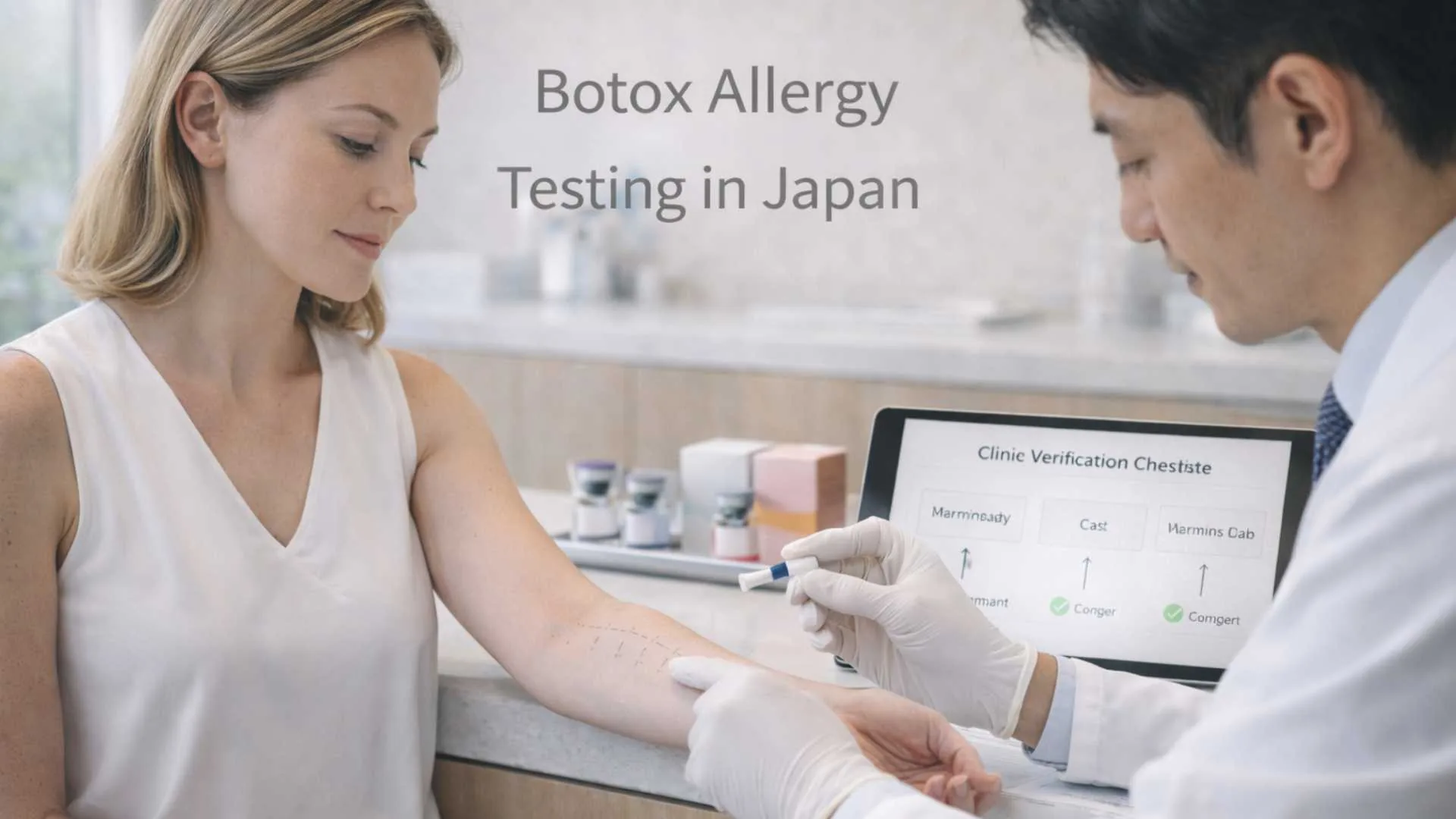
True anaphylactic reactions to botulinum toxin are exceedingly rare — documented only in isolated case reports across millions of procedures worldwide. There is no validated published incidence rate because confirmed cases are too few to calculate one meaningfully. Most adverse reactions patients experience are predictable side effects (bruising, headache, temporary weakness), not allergies. Japanese clinics do not routinely offer Botox allergy testing because the incidence is too low to justify it and no validated test protocol exists. If you have a history of allergic reactions to any injectable, inform your doctor before treatment.
Source: ClinicJapan.net — March 2026 Botox safety researchLet's separate fear from fact. Botox is one of the most studied cosmetic treatments in history — over 7 million procedures annually, approved in 70+ countries, with 20+ years of safety data. True allergic reactions are extraordinarily rare. The side effects you're likely to experience are temporary and predictable.
But "safe in general" doesn't help you when you're sitting in a Tokyo clinic and your forehead feels weird and you can't explain it in Japanese. This guide covers the realistic risks, what Japanese clinics do differently, and the exact phrases you need if something doesn't feel right. For the full Botox guide, see Botox Japan. For brand-specific safety info, see Botox brands Japan.
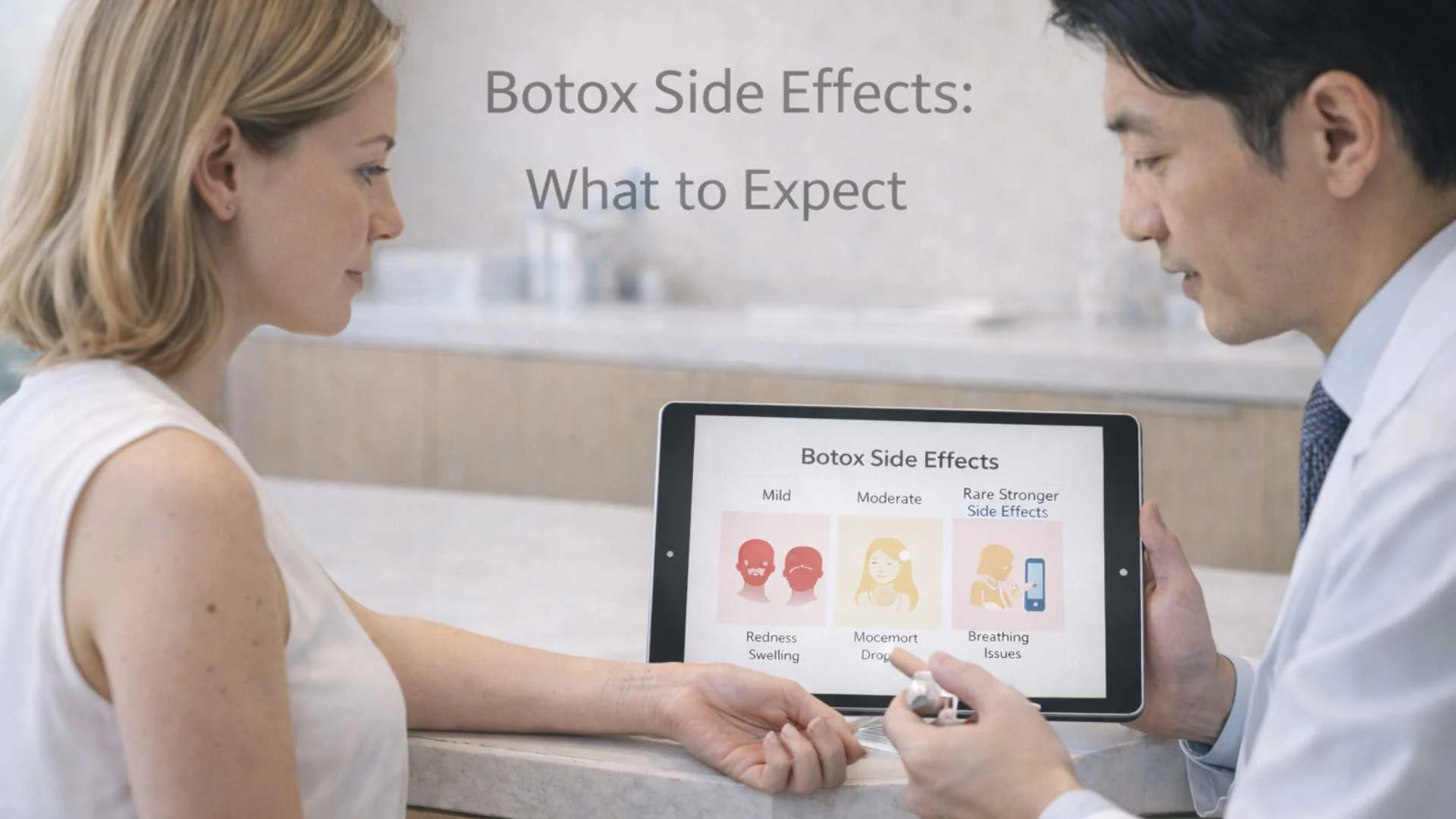
The side effect spectrum: 99% of patients experience nothing worse than mild bruising. True allergic reactions are extremely rare.
Common Side Effects: What Actually Happens
| Side Effect | Frequency | Duration | Action Needed |
|---|---|---|---|
| Bruising at injection site | 10–25% | 3–7 days | None — normal. Arnica may help |
| Redness/swelling | 10–20% | Hours to 1 day | None — resolves on its own |
| Headache | 10–15% | 1–2 days | OTC pain relief if needed |
| Heaviness/tightness | 5–10% | 1–2 weeks | Normal sensation as muscles relax |
| Eyelid drooping (ptosis) | 1–3% | 2–6 weeks | Contact clinic — treatable with eye drops |
| Asymmetry | 2–5% | Adjustable at 2 weeks | Follow-up appointment for touch-up |
| Flu-like symptoms | <5% | 1–3 days | Rest, hydrate |
The Japanese advantage: Clinics in Japan tend to use conservative doses. Where a US clinic might use 20 units on the forehead, a Japanese clinic may start with 10–15. Lower doses mean lower risk of side effects like ptosis or the "frozen face" look. The trade-off is that you may need a touch-up at 2 weeks, but the initial risk is significantly reduced.
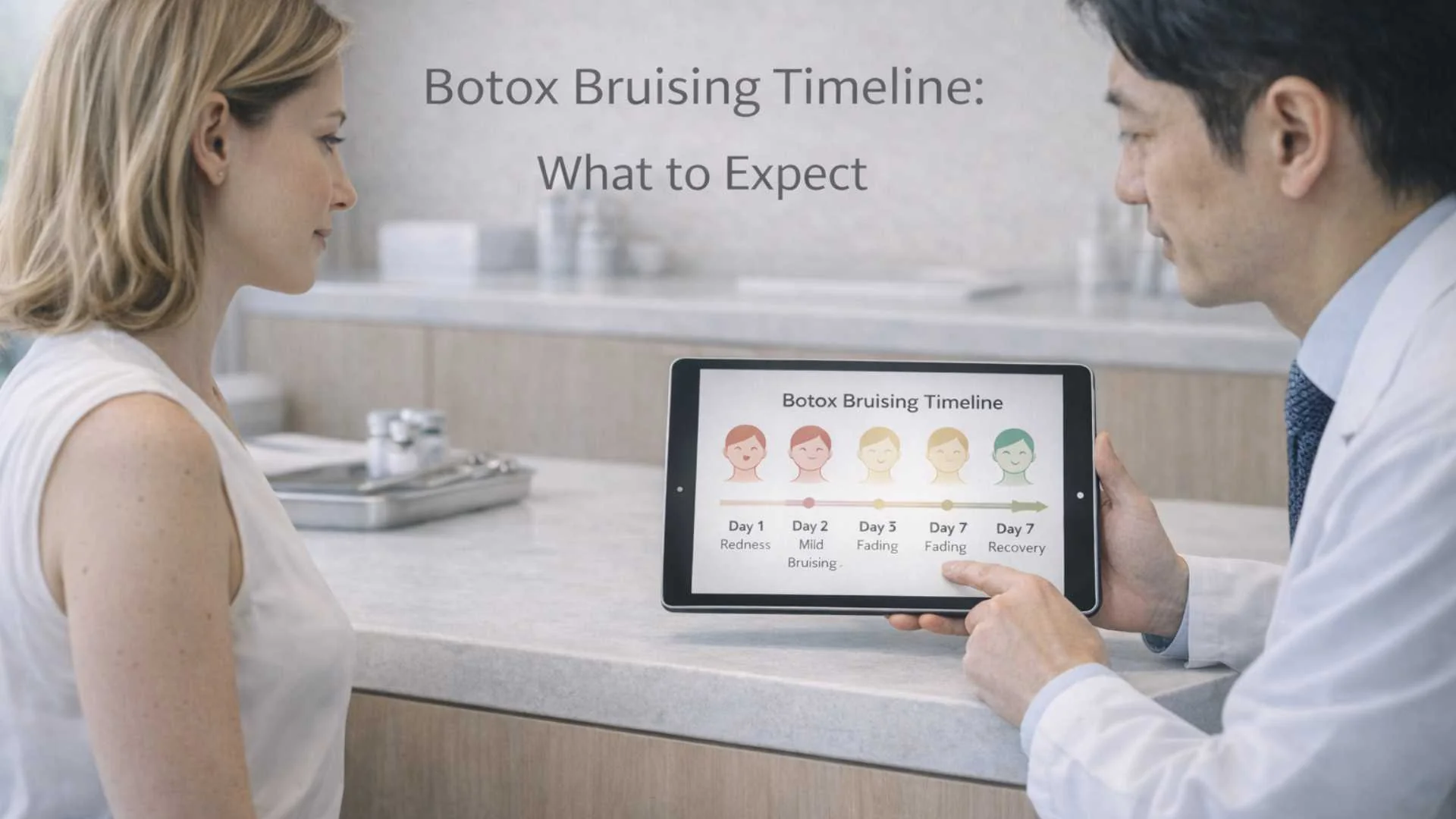
Bruising timeline: day 1–2 is the worst. Most bruises are fully gone by day 5–7. Ice immediately after helps.
True Allergic Reactions: Extremely Rare but Real
A true allergy to botulinum toxin means your immune system treats the protein as a threat. Published literature documents only a handful of confirmed anaphylactic reactions across millions of procedures globally. A 2024 case report in Plastic and Reconstructive Surgery – Global Open (Guo et al., DOI: 10.1097/GOX.0000000000005845) documented three cases of mild BTA-related hypersensitive reactions presenting as non-pruritic chest erythema — two resolved spontaneously, one required oral corticosteroid treatment.
What an allergic reaction looks like: Redness spreading beyond the injection site (within minutes). Hives or welts anywhere on the body. Itching that won't stop. Difficulty breathing or swelling of the throat (anaphylaxis — medical emergency). The key distinction: localized redness at the injection site is normal. Redness spreading to your chest, arms, or other areas is not.
Who is at higher risk:
Patients with multiple drug allergies — if you react to many medications, your risk of reacting to botulinum toxin is slightly elevated. Not confirmed, just slightly elevated.
Patients who've had allergic reactions to other botulinum toxin products — if you reacted to Dysport, you may react to Botox and vice versa.
Patients with neuromuscular disorders (myasthenia gravis, Lambert-Eaton syndrome) should not get Botox at all.
Egg allergy is NOT a risk factor. This is a common myth. Botox doesn't contain egg proteins. The confusion comes from certain vaccines that do.
Asia's first AI clinic advisor. Powered by GPT.
Tell it your procedure, budget, and dates — get matched with real clinics in seconds
Talk to Our Clinic AI — Your Free Consult in 30 Seconds →Allergy Testing: Is It Available in Japan?
Routine Botox allergy testing is not standard practice anywhere in the world — including Japan. The reason: true allergy is so rare that mass testing would produce more false positives than real ones, and no validated test protocol for botulinum toxin hypersensitivity exists in the medical literature.
On "intradermal skin tests" for Botox:
Some clinics may offer an intradermal skin test on request — a tiny amount of diluted botulinum toxin injected into the forearm to observe for reaction. Patients should understand that this is not a validated diagnostic procedure. There is no international clinical consensus on how to perform or interpret it, it carries known risks of both false positives and false negatives, and a negative test does not guarantee you will not react to facial injection.
If you have a history of severe drug allergies, anaphylaxis, or confirmed reactions to previous botulinum toxin injections, the appropriate path is an allergist/immunologist consultation — not an unvalidated test at an aesthetic clinic. Discuss your full allergy history with the treating physician before any injection.
If you want to discuss your allergy history at the clinic:薬のアレルギーが複数あります。事前にリスクについて相談したいです。 (I have multiple drug allergies. I'd like to discuss the risk beforehand.) A responsible clinic may decline to treat you until an allergist has cleared you, which is the medically correct response, not a refusal.
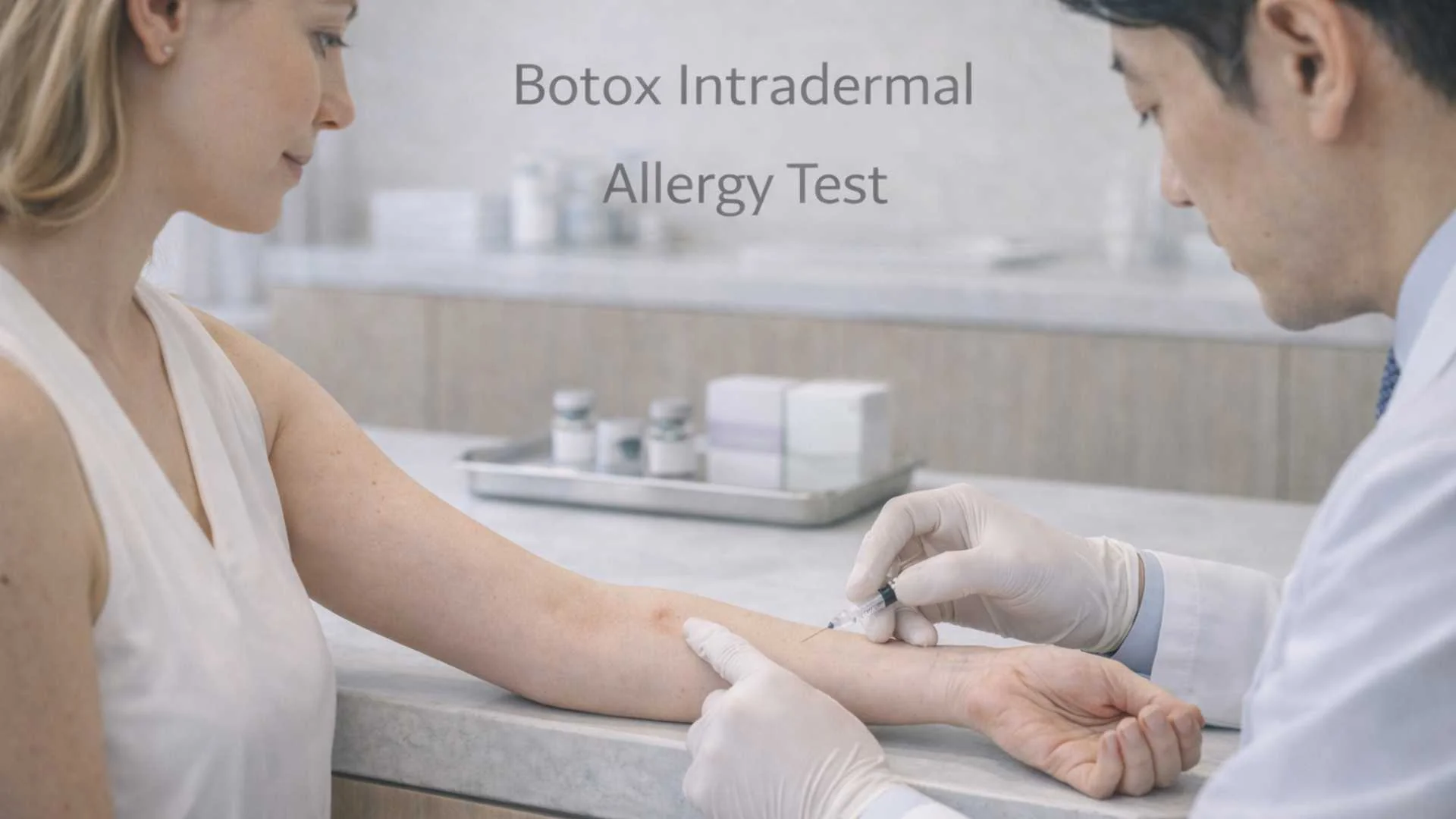
Intradermal test: a tiny amount on the forearm, wait 20–30 minutes. Negative = safe to proceed. Available at premium clinics.
Antibody Resistance: When Botox Stops Working
This isn't an allergy — it's your immune system learning to neutralize the botulinum toxin before it can work. Studies show this affects fewer than 1% of cosmetic users. However, a 2022 survey of Korean dermatologists found that nearly half reported encountering suspected resistance cases, suggesting it may be underreported.
Signs your Botox isn't working as well: Results wear off faster than before (3 months instead of 4–6). You need more units to achieve the same effect. Some areas don't respond at all.
What to do: Switch brands. Particularly from traditional formulations (Allergan Botox Vista, Nabota) to pure-type formulations (Coretox, Xeomin/Bocouture) that have removed the complexing proteins suspected of triggering antibody formation. Extend the interval between treatments to at least 3–4 months. For details on brand differences, see Botox brands Japan.
Emergency Phrases at the Clinic
| Situation | Japanese | Reading |
|---|---|---|
| I feel strange / something's wrong | おかしいです。気分が悪いです | okashii desu. kibun ga warui desu |
| I'm having an allergic reaction | アレルギー反応が出ています | arerugii hannou ga dete imasu |
| Difficulty breathing | 息が苦しいです | iki ga kurushii desu |
| My eyelid is drooping | まぶたが下がっています | mabuta ga sagatte imasu |
| I have drug allergies | 薬のアレルギーがあります | kusuri no arerugii ga arimasu |
| Please help | 助けてください | tasukete kudasai |
| Call an ambulance | 救急車を呼んでください | kyuukyuusha wo yonde kudasai |
| Emergency number | 119 (Japan's ambulance/fire number) | |
Practical tip: Screenshot this table on your phone before your appointment. If you can't speak, you can show the screen. Japanese medical staff will understand the written Japanese even if your pronunciation isn't perfect.
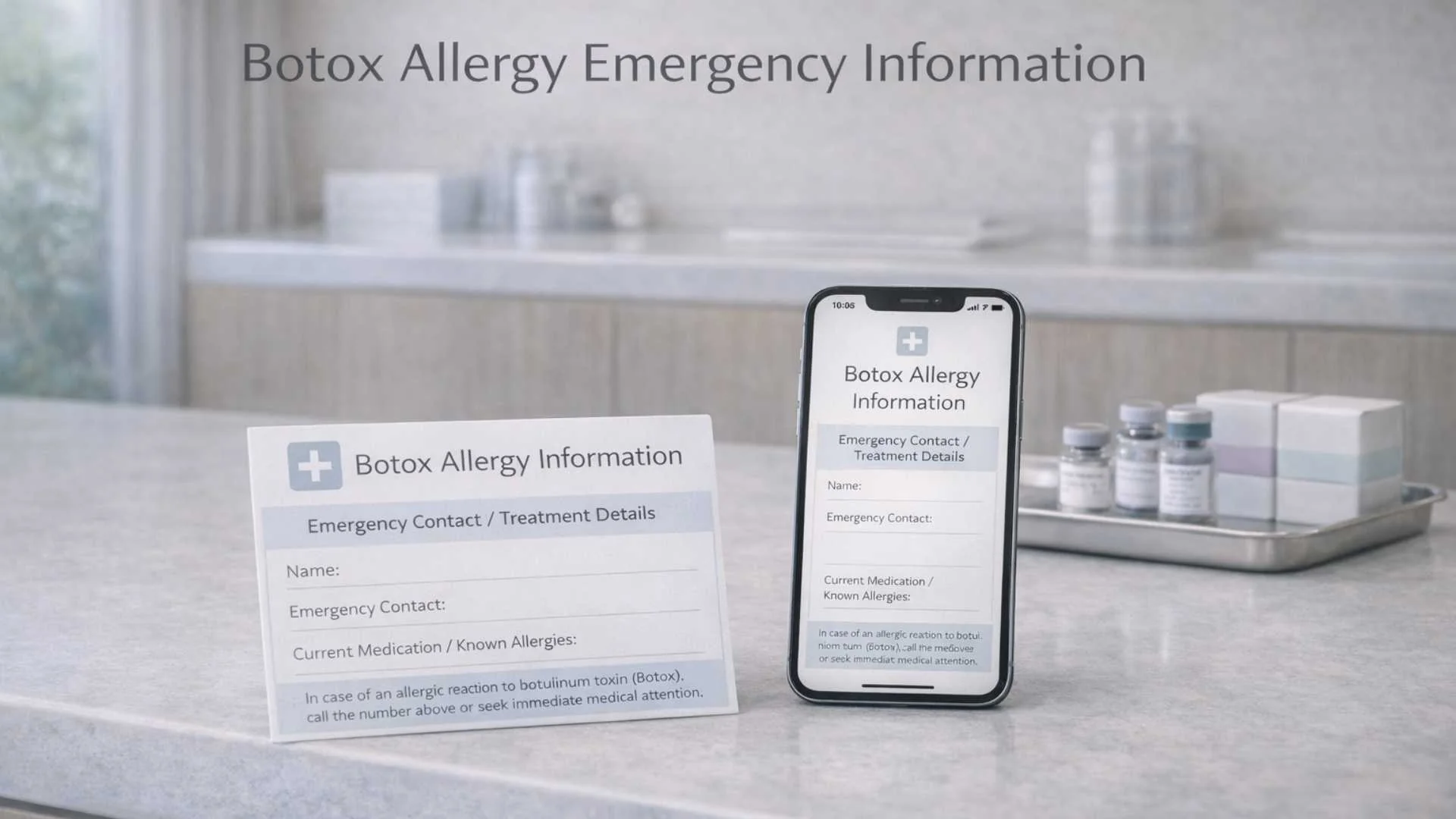
Save these phrases on your phone. Showing written Japanese is faster than trying to explain in English during a reaction.
How to Minimize Risk
Before treatment:
Tell your clinic about ALL drug allergies, even unrelated ones. In Japanese: 薬のアレルギーリストです (Here is my drug allergy list). Bring a translated list.
Stop blood thinners (aspirin, ibuprofen, fish oil, vitamin E) 7 days before if medically safe. These increase bruising risk significantly.
Avoid alcohol 24 hours before. Alcohol dilates blood vessels and increases bruising.
Choose a clinic that uses MHLW-approved Botox Vista for your first treatment. Maximum safety data for maximum peace of mind.
After treatment:
No rubbing, pressing, or massaging the injection site for 24 hours.
No lying face-down for 4 hours.
No intense exercise, hot baths, saunas, or onsen for 24–48 hours.
No alcohol for 24 hours.
Stay near the clinic for 15–30 minutes after injection. If a reaction occurs, it usually happens within this window.
What If Something Goes Wrong After You Leave the Clinic?
Eyelid drooping (most common complication): This typically appears 1–2 weeks after injection. It's not dangerous but is annoying and visible. Call your clinic: 施術後にまぶたが下がりました。診てもらえますか? (My eyelid drooped after treatment. Can you see me?) Most clinics will prescribe apraclonidine eye drops that temporarily lift the eyelid while the Botox wears off.
Asymmetry: One side works, the other doesn't — or one side works too much. This is fixable with a touch-up injection at the 2-week mark. Most premium clinics include one free touch-up. Budget clinics may charge separately. Ask before treatment: 修正注射は含まれていますか? (Is a touch-up injection included?)
Results too strong ("frozen face"): This resolves on its own as the Botox wears off (3–6 months). There's no way to reverse Botox once injected. This is why Japanese clinics start conservative — you can always add more at 2 weeks, but you can't take it away.
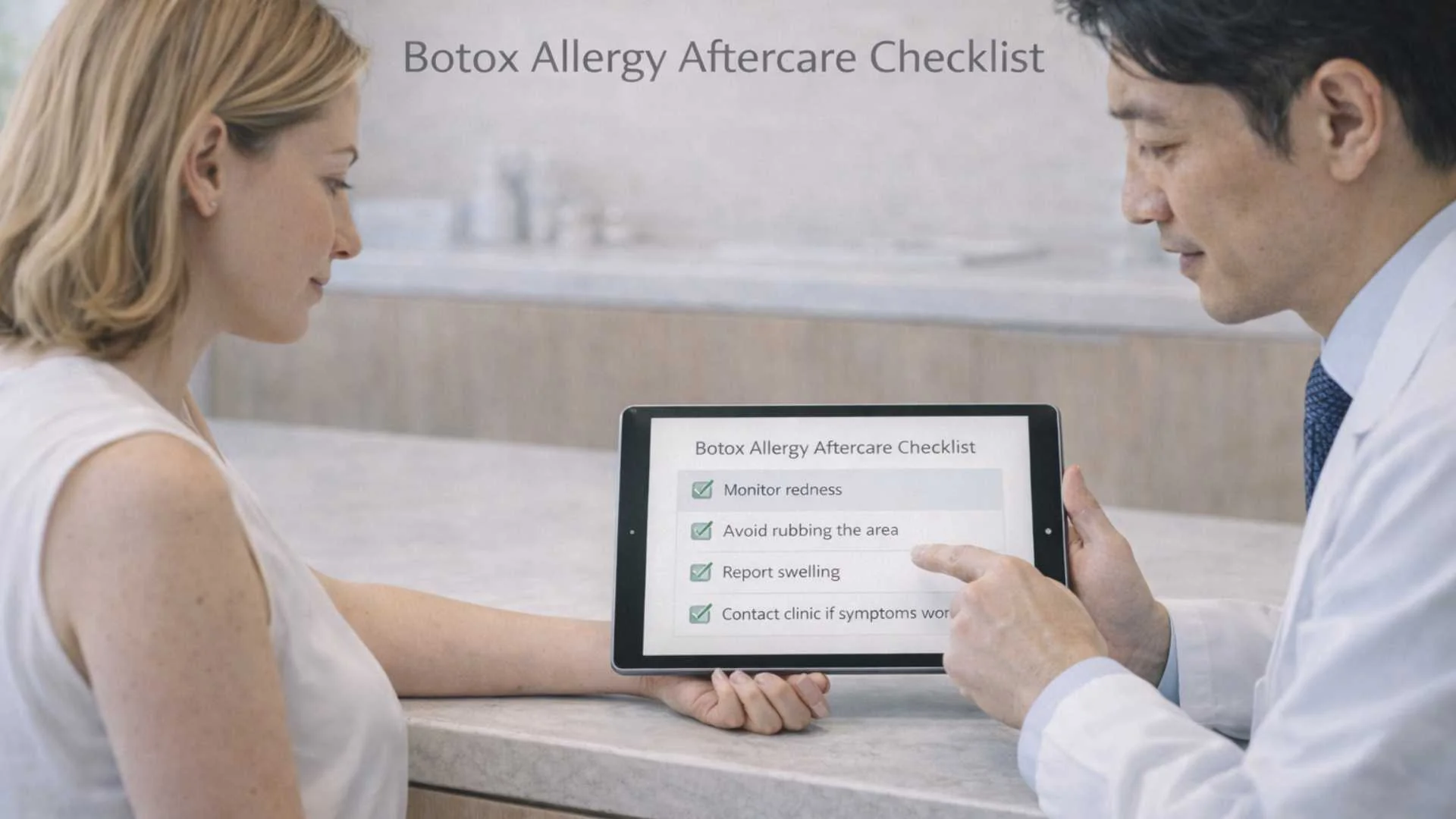
The aftercare list: no rubbing, no heat, no alcohol, no exercise for 24 hours. Stay near the clinic for 30 minutes.
FAQ
Can you be allergic to Botox?
Yes, but it's extremely rare — fewer than 1 in 10,000. Most "reactions" are normal side effects that resolve in days.
Do Japanese clinics offer allergy testing?
Not routinely — and the intradermal test some clinics may offer is not a validated diagnostic procedure. If you have serious allergy concerns, consult an allergist (not an aesthetic clinic) before booking.
Common side effects?
Bruising (10–25%), redness (10–20%), headache (10–15%). All temporary. Japanese clinics use conservative doses which may reduce severity.
What if I have a reaction at the clinic?
Say: アレルギー反応が出ています。助けてください。Japanese clinics are medically equipped for emergencies. For severe reactions outside: call 119.
Related Guides
Sources & references: Safety data from PMC review: The whole truth about botulinum toxin (2021), PMC: Mild Allergic Reactions after BTA Injection (2024), and Allergan manufacturer documentation. Side effect rates from published clinical literature. Prices and clinic protocols from publicly available data, accessed March 2026.
Medical disclaimer: This content is for informational purposes only and does not constitute medical advice, diagnosis, or treatment. If you experience severe symptoms after Botox injection, seek immediate medical attention. Call 119 in Japan for emergency services. ClinicJapan is an independent guide and is not affiliated with any clinic or brand mentioned.
Get Your Free Clinic Plan
Tell us what you want. We'll send you a personalized recommendation
with real prices, English-friendly clinics, and booking tips — free.
Free · No spam · Reply within 24 hours